
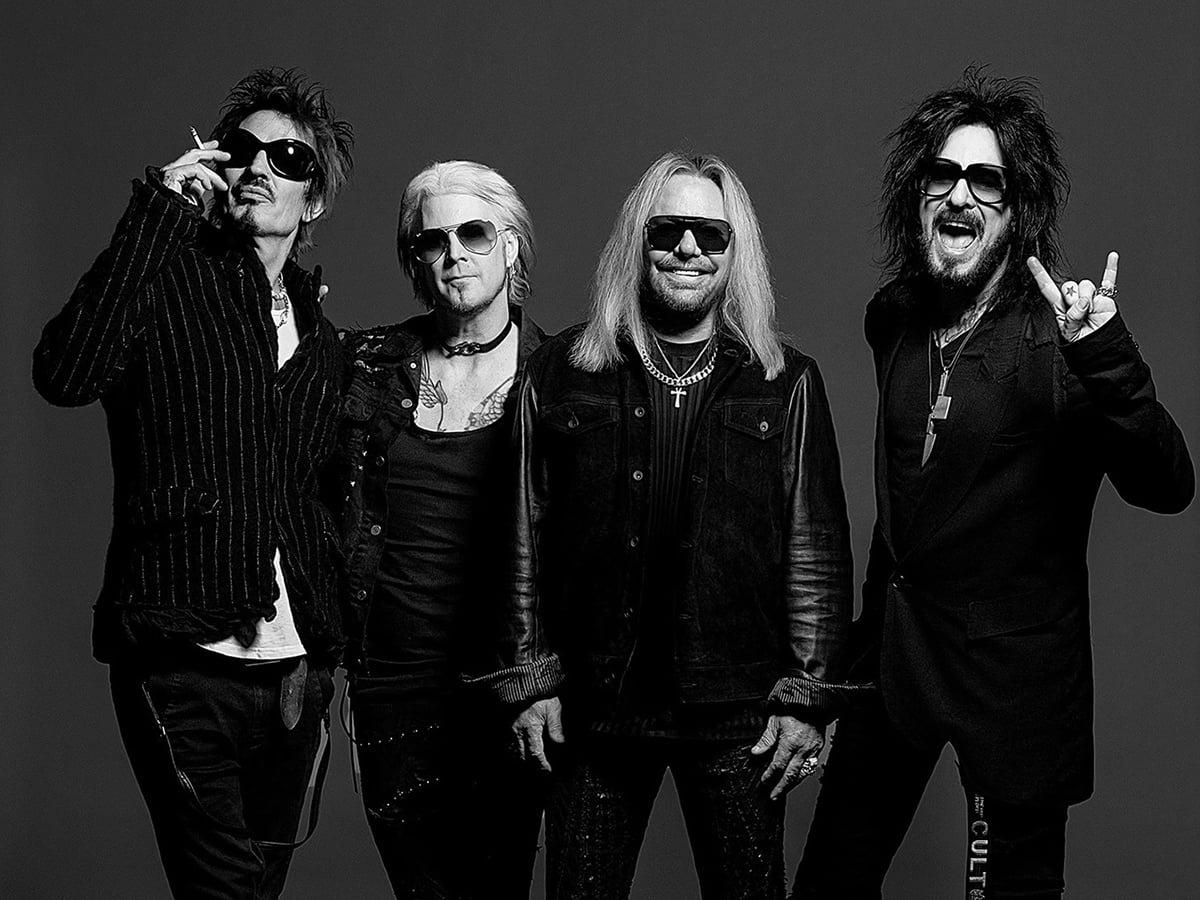
(Credits: Mötley Crüe)
Fri 10 April 2026 21:00, UK
There aren’t too many band names that stand as a byword for rock hedonism and excess quite like Mötley Crüe.
The Dirt was an apt title for their autobiography. Entering the 1980s’ hair metal debauchery in earnest, the Hollywood glam quartet always stayed firmly affixed to the Los Angeles gutter, leaning closer to the likes of Ratt or Hanoi Rocks than the cartoonish realms of Twisted Sister or Bon Jovi.
Not that they weren’t core members of the spandex brigade, however, keenly mugging the day’s MTV to the simmering fatigue of an alternative rock scene bubbling away to eventual explosion for the next decade.
But a fierce reputation for drink and drugs swirled around Mötley Crüe from the moment they first struck the charts in 1981. With each record came bigger budgets and more substance abuse funds, and by 1985’s Theatre of Pain, cocaine and booze began to supersede cutting the album in importance. In bassist and principal songwriter Nikki Sixx’s case, a gnawing heroin habit had struck, which would nearly claim his life more than once.
The party had soured by this point. Mötley Crüe was riding high as the glam metal forerunners, playing a massive show at US Festival ‘83 and sophomore LP Shout at the Devil, cracking the mainstream and winning a support slot on Ozzy Osbourne’s Bark at the Moon Tour. Yet, the hedonism spiralled to dangerous levels. The drugs got harder, the alcohol flowed without end, and frontman Vince Neil ended up crashing his De Tomaso Pantera while under the influence in 1984, killing Hanoi Rocks drummer Nicholas ‘Razzie’ Dingley and resulting in 18 days of jail time and a hefty $2,500,000 in damages.
Such a bad cloud affected their output. Veering into deeper glam material over their former hard rock chops, the abundance of chemicals and booze flooding the Mötley Crüe team wrought a third album that the band were less than thrilled with. Then there were the touring commitments. With drugs the most available on the road, Mötley Crüe’s people were worried that such an undertaking might well spell the end of the band.
“Our managers basically said, ‘If we send you guys to Europe with what you guys are doing, someone’s gonna come back in a body bag,’” Neil recalled to Google Play in 2012. “And literally right after that, when we would have been in Europe touring, is when Nikki OD’d.”
They weren’t wrong. Playing London’s Hammersmith Odeon in February 1986, a battered Sixx was so strung-out he asked his dealer to inject heroin for him. Blacking out, he woke up in a rubbish tip covered in bruises and welts, the dealer having tried to stir him out of his morphine comatose by beating him with a baseball bat. It would take several more overdoses, one big one in 1987 where he was clinically dead for two minutes, before finally knocking heroin on the head for good the next year.
While drinking hadn’t entirely left, but a clear swerve away from drugs for all of Mötley Crüe ended up yielding 1989’s Dr Feelgood, a Billboard 200 chart topper and hair metal’s final hurrah that nearly never happened had the scourge of cocaine and smack decided to turn the band’s fate in a darker, more ugly direction.
