
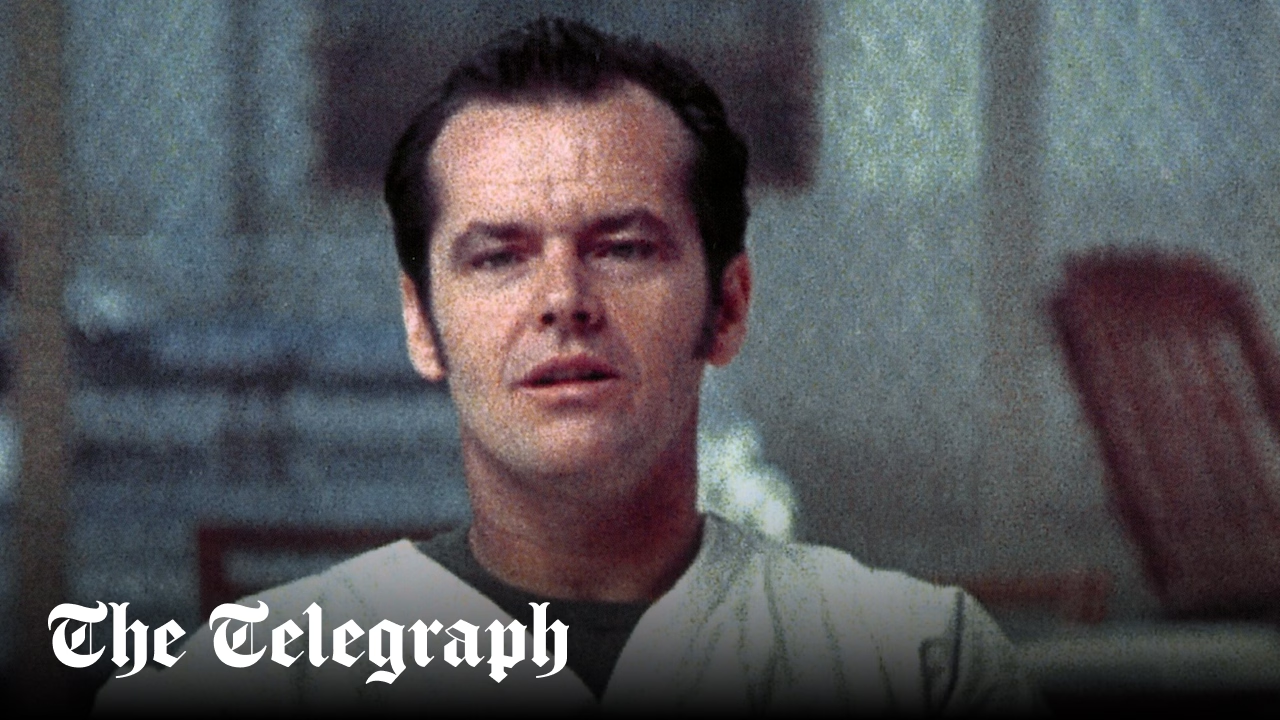
Though Kesey’s novel was rooted in post-war paranoia, when it was published in 1962 it read as a parable of contemporary social upheaval – entrenched state power versus the hippies, cranks and outcasts. But to Forman it rang another, more sinister, bell. “His American friends challenged him when he took the job,” Paul remembers. “‘How dare you think you, a European, can make this American story?’ And he’d reply, ‘Yes, for you Americans it’s a story. For me, who grew up under the Nazis and the Communists, it was my life.’”
Kirk Douglas’s passion for Kesey’s book began before it had even been published. He had read an early proof copy in 1961 and immediately purchased the rights, before enlisting the budding playwright Dale Wasserman – then a busy television writer – to come up with a stage adaptation.
It opened in November 1963, with Douglas, then at the height of his stardom, in the McMurphy role. But it closed just two months and 82 performances later. With missionary zeal, the actor then channelled his efforts into getting a film version off the ground – though to an industry still working under the censorious Hays Code it was just too weird, too bleak, too politically charged.
But his son was similarly convinced that something was there. So Kirk handed over the rights to Michael, then in his 20s, and he brought Saul Zaentz on board in 1973. Douglas’s first move was to ask Kesey himself to write the screenplay. But the result “was very surreal”, Paul says tactfully. “He had Nurse Ratched in a valkyrie’s helmet, and scenes where she’d scratch the walls and they’d drip with blood.” Following a more grounded rewrite, Forman – at the time living in New York’s notorious Hotel Chelsea while undergoing a nervous breakdown – was hired to direct.
Gene Hackman, Marlon Brando, Burt Reynolds and James Caan were all floated as potential McMurphys: Douglas approached their agents, but they all declined. Nicholson, however, leapt on the role.