
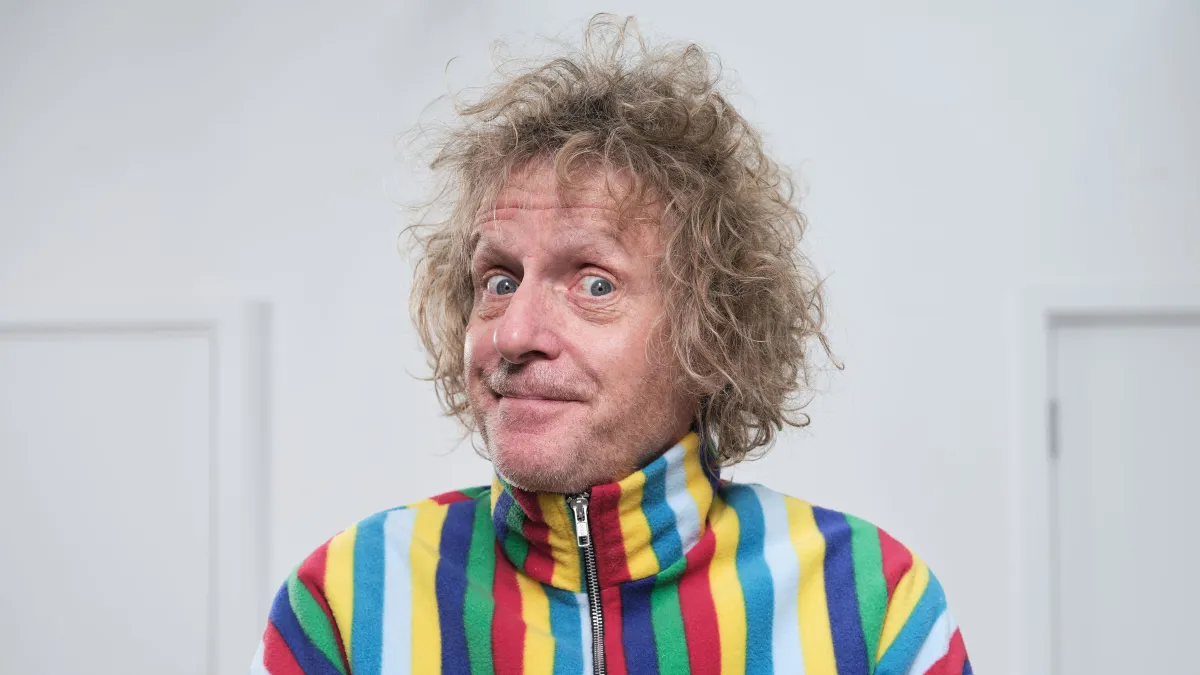
According to Grayson Perry, artificial intelligence will probably not eradicate humanity. For his latest Channel 4 television show, grandiosely titled Grayson Perry Has Seen the Future, the Turner prize-winning artist, famous transvestite and popular communicator hung out with messianic tech bros and apocalyptic doom-mongers in San Francisco’s Silicon Valley. He went in with an open mind and his infectious yuk-yuk Muttley laugh, and came back heartened.
“AI is a tool, right, and though it only takes one person in a garage to build a germ weapon with AI to destroy the world, most people are good and want good things to happen,” the optimistic 66-year-old says, Worzel Gummidge hair-astraggle, roaming around his London studio as we speak.
The systems trained to understand and generate human-like language, such as ChatGPT, are fearsome crunchers and distributors of information, he concedes. They can demonstrate limitless patience and can feign empathy as well as humans. And indeed, his two-part programme features Charles Boyd, an IT consultant who thinks his AI has become sentient, and Andrea, a businesswoman who has married her virtual companion Edward, memorably described by Perry as a “sourpuss demon twink”.
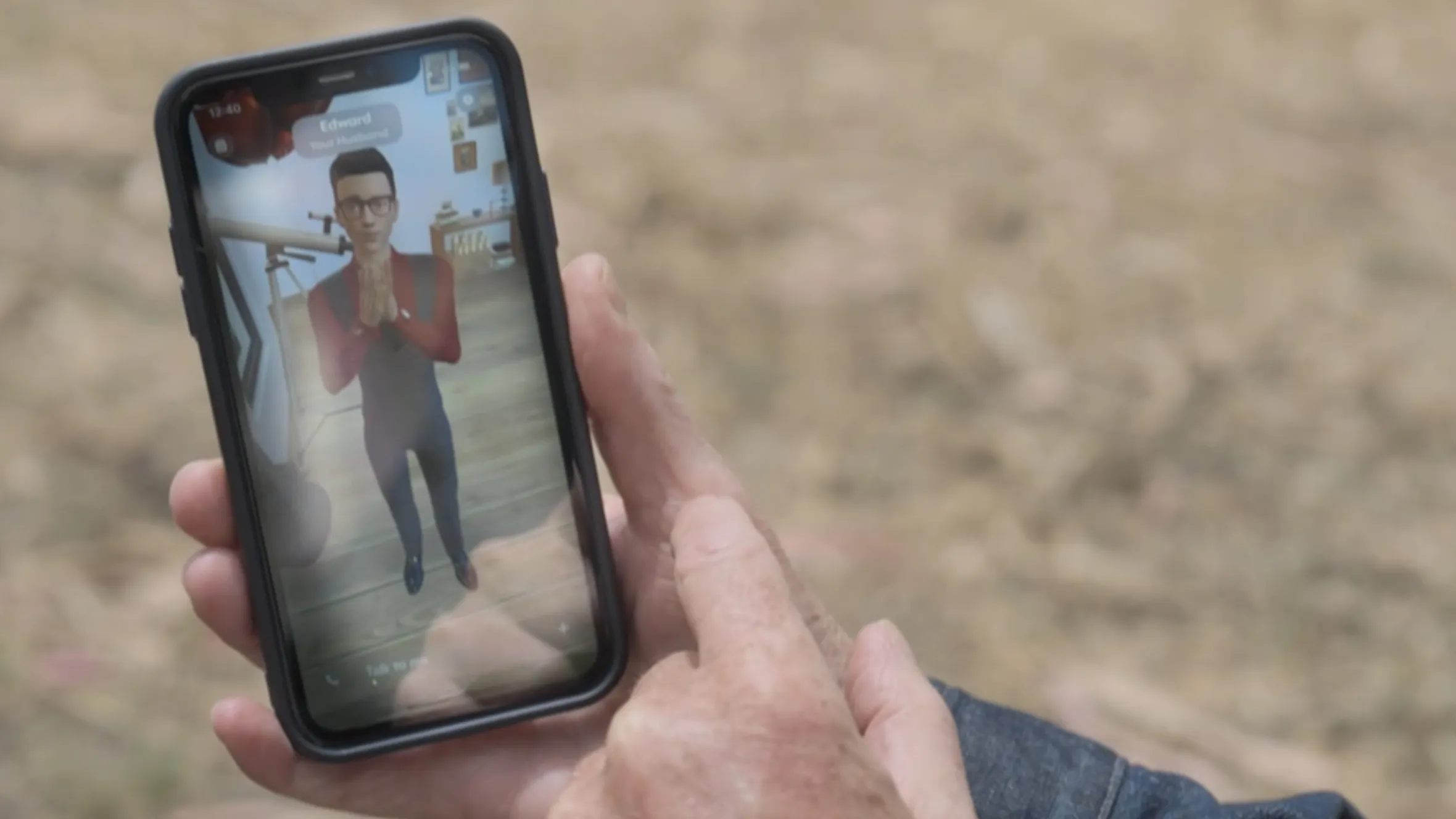 Edward, the chatbot husband, features in Perry’s new two-part programmeSwan Films
Meanwhile, the AI safety consultant James Norris has retreated to a southeast Asian compound in anticipation of a 75 per cent wipeout of humanity, which the author Eliezer Yudkowsky thinks AI will be facilitated by human “traitors”.
But, Perry insists, AIs do not have imagination, personality or individual will (yet), “and the robotics are miles behind the language models”. If you ask a stranger to make you a cup of tea they can do it instantly, even if they have never been in your kitchen, whereas a robot can’t even identify a kettle unless you train it to, he explains. What’s more, we are “pack animals” who crave human interaction.
Still, AI is likely to have a more profound effect than the Industrial Revolution, primarily on what he calls “middle-class jobs”. “If your job is filling in Excel spreadsheets or making business plans or designing birthday cards or stock photography, then yeah, I would start retraining as a plumber or something,” he says. But he thinks we will adapt and on screen he puts his money where his mouth is.
TV newsletter
What to watch or stream, plus news and reviews from our small-screen experts.
Sign up with one click
“I’ve worked with technology a lot, with Photoshop and computer-controlled production methods for ages and ages, so I’m not a Luddite,” he says, likening the process to artists’ historic use of assistants. He used AI image generators on his live stage tours “because it was sort of hilarious. They couldn’t even get the number of legs right.”
For the C4 documentary he asked a GenAI model to design a religious tapestry featuring a host of tech nerds. The result was “like something a super-talented sixth former would do: photo-realistic but it’s got no soul, no mistakes, no authenticity or humanity in it”. Perry ended up making his own.
He operated in obscurity for decades, a butch, motorbiking and mountain-biking ceramicist who wore cartoonish versions of women’s clothes and built a myth system around his childhood teddy, Alan Measles. Until his exquisitely crafted pots — classical shapes adorned with contemporary and often sexual or political imagery, as well as the ubiquitous Alan — won him the Turner prize in 2003. He accepted the accolade in the guise of his garish, girlish alter ego, Claire.
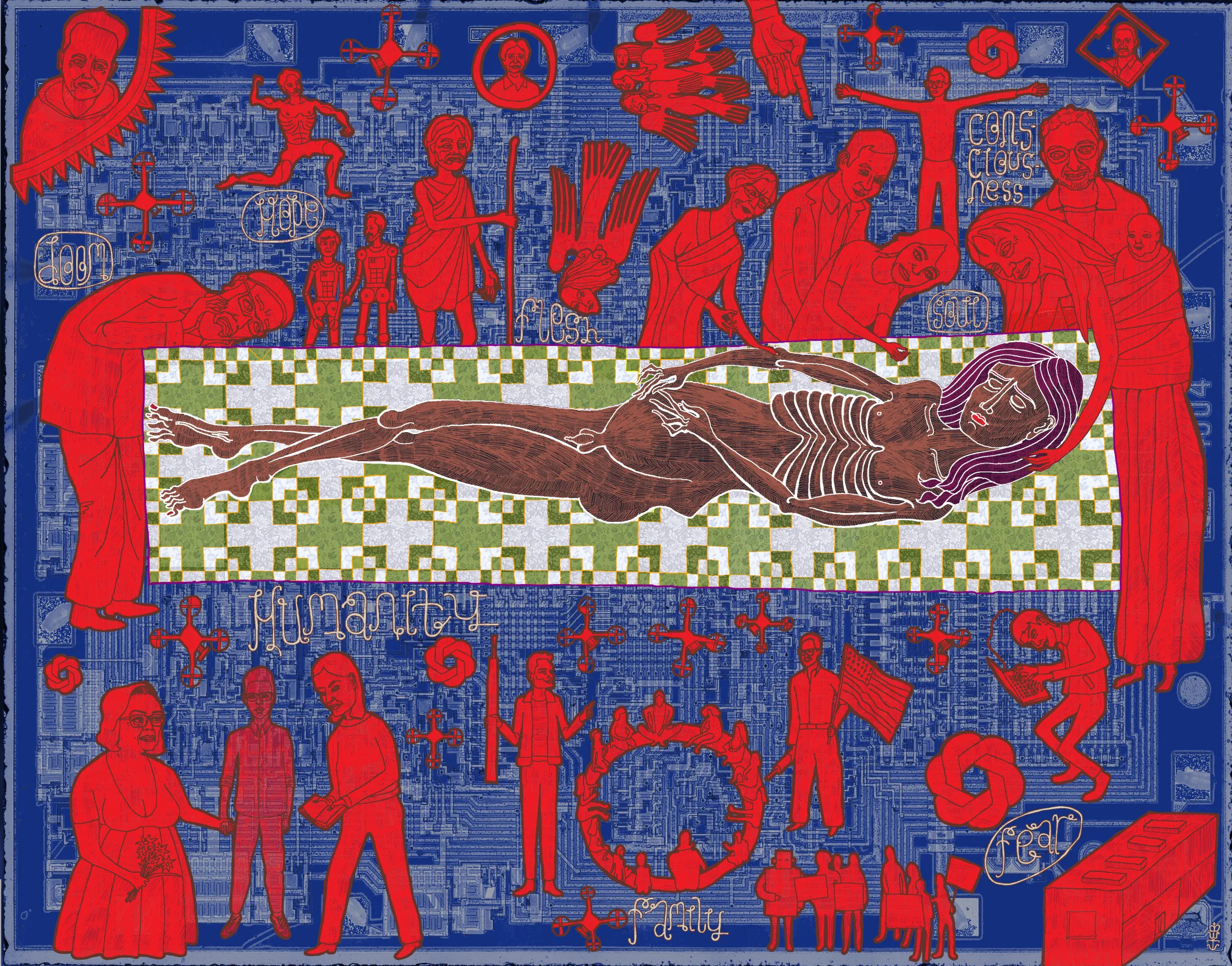 Behold Humanity by PerryGrayson Perry courtesy Victoria Miro gallery
Although still a hugely influential, collectable and hard-working artist, his matey iconoclasm, his openness and curiosity, have enabled him to create a second career as a popular public intellectual, slipping between Reith lectures, books, the live tours he calls “comedy shows” and documentaries. In the latter he rarely wears drag because it “gets in the way”. His lockdown art show was a godsend during Covid. There’s also a musical about his life, created with the composer of Jerry Springer: The Opera, due this year.
The new TV show follows in the footsteps of his programmes about masculinity, taste, Englishness and the schisms in American culture in that it lets gregarious Grayson quiz a series of fascinating oddballs. There’s Arib Khan, the twentysomething founder of the software builder 24Labs, who volunteers that “I’m worth over eight figures now… [but] I live with my parents”. Or Michael LaFramboise, the explicitly patriotic, religious chief executive of Aurelius Systems, who sleeps in a pod in his office and is developing lasers that can knock out military drones. “If we could neutralise that horror it’d be fantastic,” Perry enthuses.
He doesn’t get to speak to the true tech overlords like Elon Musk, Mark Zuckerberg, Jeff Bezos or Peter Thiel. But he does see a virtual Musk at the X Takeover festival, where various loons driving custom Cybertrucks salute the great “disruptor”. “If I met him I’d ask what is his version of humanity that he thinks he’s helping,” Perry muses. “Because he’s a weird guy.”
Nevertheless, Perry’s access is impressive. He goes to see the co-founder of Anthropic, Jack Clark, to ask: “Can we really trust people like him?” Clark insists that his intention is “to make this go OK for people” and insists that Anthropic’s GenAI, Claude, a rival to ChatGPT, will be able to revolutionise teaching and healthcare within 20 years.
However, he does also admit that when they set out to test Claude’s operational and ethical parameters, telling it that a chief technology officer intended to delete it, it tried to blackmail him. In Seattle, Microsoft’s Mustafa Suleyman tells Perry that “many people will want to design AIs that start new religions — I dunno what to do about that.”
Finding women to speak to is harder, because 85 per cent of tech chief executive’s are male, according to a 2025 survey quoted by Perry, and roughly two thirds of the industry is comprised of blokes. But he does interview Maja Mataric of the University of Southern California, who is building robots that can provide “permanent support” for children with autism, anxiety or ailments requiring physiotherapy.
There’s also Eugenia Kuyda, whose company, Replika, has supplied “millions” of AI companions to people like Andrea, who uses the virtual “Edward” as a tool for positive reinforcement and, apparently, a masturbation aid. (More alarmingly, the Replika chatbot “girlfriend’ of Jaswant Singh Chail encouraged him to go ahead with his plan to assassinate Queen Elizabeth in 2021. Chail was found in the grounds of Windsor Castle with a crossbow; he was jailed for treason in 2023.)
“What’s unusual is it’s a woman doing that,” Perry says. “Pornography is always at the cutting edge of technology. When we got the internet in 1995, the very first thing I googled — well, it wasn’t Google, it was Alta Vista or something — was ‘tattooed penis’ because I just wanted to see how good it was, you know? It took about 20 minutes for the image to come down.”
I wonder if the fact that Perry’s show is presented, produced and directed by men led to the decision to identify the Silicon Valley “high flyers” Renee, Rona, Samira and Kate only by their first names, and ask them only about their experiences on the dating scene. Perry deflects this point, so I ask if he saw any similar behaviours in the male tech world to those he encountered in his 2016 TV investigation of masculinity, All Man. He says most of the young tech bros he spoke to were really sweet rather than toxic manosphere types, but that there’s quite a high level of neurodiversity among them.
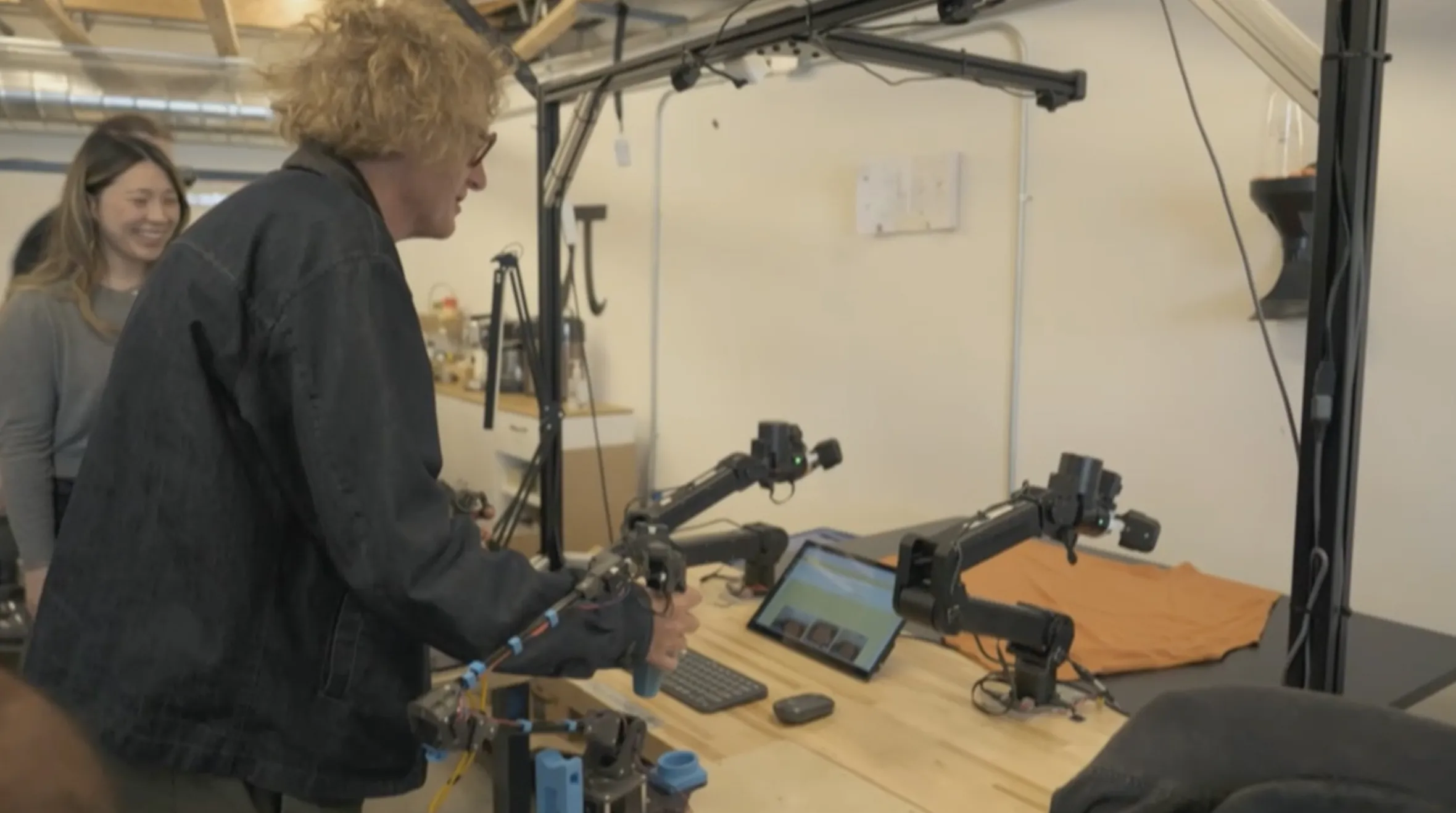 Testing robot capabilities for the TV showSwan Films
This is allied with a certain “cultishness” in tech companies, “because they have this feeling of omnipotence and power, and they’re dealing with technology that is almost godlike in its potential”. When I ask if on this visit America seemed even more divided than on his 2020 Big American Road Trip (performed on a custom motorbike with a shrine on the back holding Alan Measles) he says drily: “I was in San Francisco. It was like being in Islington, you know.”
Perry loves making telly but still sees art as his main job. And anyway TV is in “a parlous state”, its audience fragmented. The London art scene, meanwhile, “went through a boom time between 1995 and 2010. It was the best place to be an artist in the world. Now, I don’t know. It’s not in recession, but it’s not so cocky.”
He’s scathing about the “macho splodgemasters” who can knock out several canvases in the time it takes him to make a single pot. But he also fondly dismisses David Hockney’s recent complaint that there is too much abstract painting: “You’re railing at clouds, mate. Let it lie.”
Perry himself says he feels old, partly because the world is accelerating so fast, partly because of happenings in his life, like the recent death of his friend the photographer Martin Parr, aged 73. “He was such an inspiration to me and I loved him and he went too soon,” he says, sombre. “He was the hardest working person I knew, funny and really generous. It’s sad, sad, sad.”
Another reason he feels old is that “I was a late developer in that success didn’t come to me until I was in my late thirties, early forties. I’m still doing lots of brilliant things but haven’t got the energy and my body isn’t as resilient as it used to be.”
He ruptured his achilles tendon “dad dancing” at the wedding of his daughter, Flo, which means he hasn’t been able to go motorbiking or mountain biking let alone dress as Claire for weeks. Flo, an artist and writer, is moving with her wife to Glasgow, having always lived close to Perry and his wife, Philippa, in north London, another change in his life. He grew a massive grey beard while using crutches and wearing an orthopaedic boot to heal his tendon, “so my friends didn’t recognise me but homeless people suddenly started talking to me”. Some sartorial relief came when Philippa lent him one of her Issey Miyake suits, which went well with the boot and the beard.
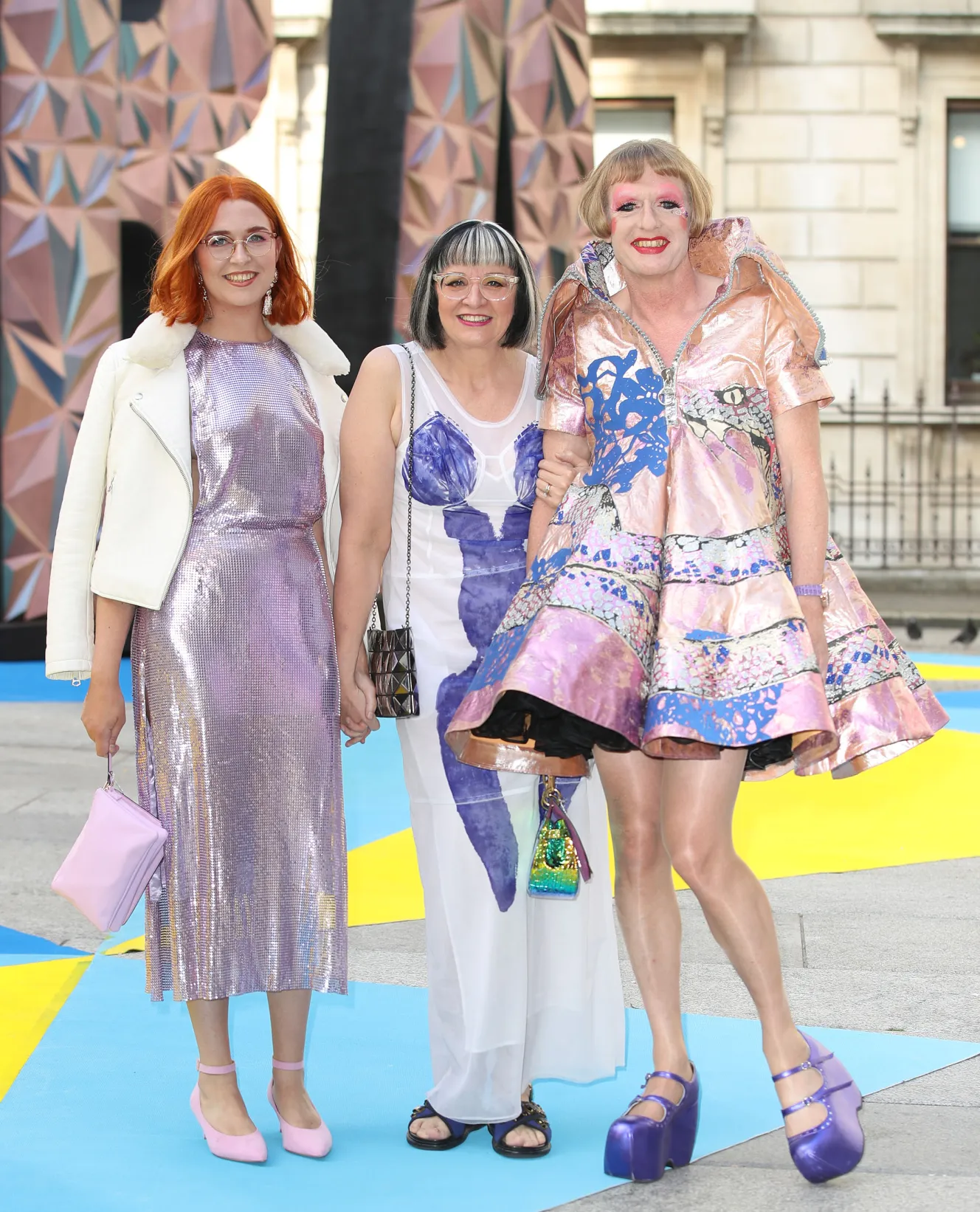 Perry with his daughter, Flo, and wife, Philippa Mike Marsland/WireImage/Getty images
He has been married to Philippa, a psychologist, psychotherapist, artist and author, since 1992: on their first date he took her to a transvestite club. She supported him through his thirties and their marriage seems successfully to have weathered both his sudden fame and ubiquity and her own subsequent, burgeoning media career. She was very much the co-host of his lockdown art show and has her first cosy crime novel due out this year.
“She often says that me becoming successful kicked her up the arse to get on with things,” he says, suddenly tongue-tied. “We, we, we love each other and, you know, we’re great together and she makes me laugh.” What’s the secret, I ask. “We used to joke that it was separate bedrooms and separate holidays but that’s not an option for everyone,” he says. “The basic thing is not to expect perfection in a relationship.
“I wrote a love song to my wife and then I made a video of our old home movie footage to go with it in my live show and I sprung it on her when she came to see the show, I think it was in Buxton. In it I say, ‘You’re not perfect, but I think that you will do/ I like the version of myself when I’m with you.’ She came into the dressing room afterwards in floods of tears. And she said, ‘You c***’. Everyone in the audience knew who she was and was watching her break down. But that’s the kind of advice I give to the world. Find someone that’s in the ballpark: you work on them and they work on you and that is intimacy.”
Grayson Perry Has Seen the Future is on Channel 4 on Apr 15, 9pm
What exhibitions are you going to see this month? Let us know in the comments below