
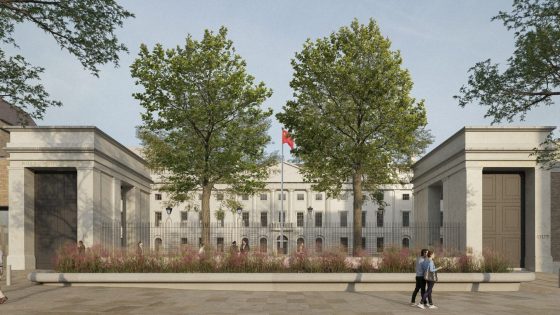
Housing and communities secretary Steve Reed approved the massive 2.3ha scheme on 20 January despite concerns that the proposed 2.3ha complex posed a national security risk.
Now it has been reported that a judicial review brought by residents of the neighbouring Royal Mint Estate will be heard in late June after the government failed to have the case thrown out at a preliminary hearing on 30 March.
Residents, represented by law firm Leigh Day, argue that the government failed to consider security and public safety, the risk posed by protests, and the use of public money to protect sensitive information cables running along the site.
The 2.3ha embassy complex, set to be built opposite Tower Bridge and the Tower of London UNESCO world heritage site, consists of accommodation, offices and a cultural centre for the Chinese Embassy. It combines new buildings alongside a range of repurposed existing buildings on the former Royal Mint site.
Reed approved the scheme on the recommendation of the planning inspector in January, 15 months after his predecessor as communities secretary, Angela Rayner, called in the application, which China resubmitted after Labour’s election victory in July 2024.
Reed said in his decision that there was ‘no suggestion that the operational development permitted by any grant of planning permission would interfere with the cables, nor that a lawful embassy use of the site would give rise to any such interference.’
Tower Hamlets, the local planning authority, has twice rejected the proposals. It said its committee had rejected China’s application ‘due to concerns over the impact on resident and tourist safety, heritage, police resources and highway safety given the congested nature of the area’.
Other reasons for its rejection included potential harm to surrounding heritage assets such as the Tower of London, and the impact of the development on residents of the neighbouring Royal Mint Estate. However, the council’s planning officers had described the scheme as ‘well-designed’ and recommended its approval.
Opposition was also mounted by protesters and local politicians because of China’s repression of the predominantly Muslim Uyghur people, while David Chipperfield was criticised for accepting the commission.
In November last year, the Guardian reported that MI5 did not have any security concerns about the project, while the Metropolitan Police withdrew an earlier objection.
Last year, then-home secretary Yvette Cooper and then-foreign secretary David Lammy signalled cautious support for the proposals if China amended the scheme to include a ‘hard perimeter’ around the embassy to solve concerns over public safety. But at the planning inquiry, China signalled that it would not amend its plans.
Before that, Rayner asked the Chinese embassy last August to supply further information over the blanked-out sections of submitted planning documents, which had been ‘redacted for security reasons’.