
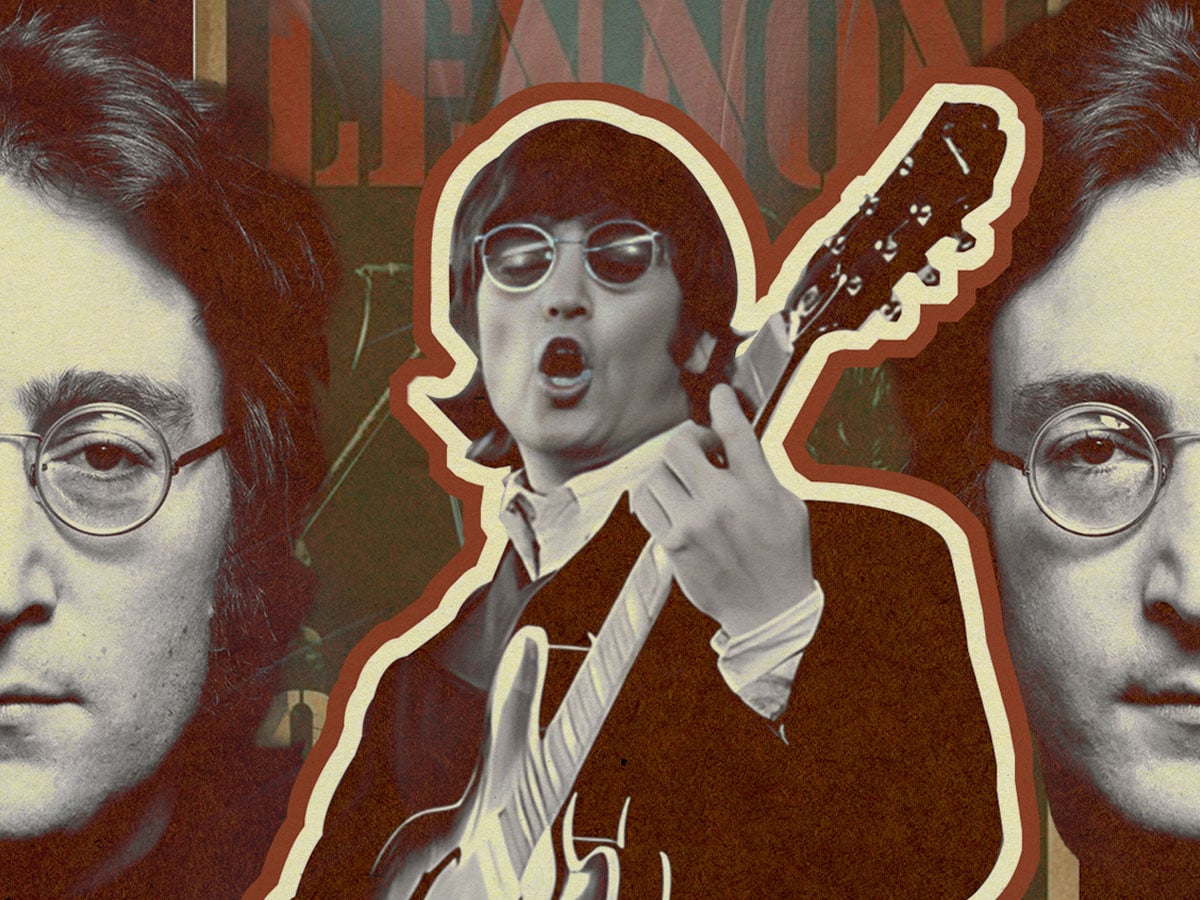
(Credits: Far Out / Bent Rej / John Lennon)
Mon 13 April 2026 18:00, UK
Why did The Beatles break up? Was it drugs? Personal issues? The pressures of fame? Well, yes, all of those things, but the easiest thing to pin it on is creative differences.
The moment John Lennon said that one of his favourite songs that he ever wrote for the band was ‘Help!’, it became clear that he wasn’t long for the pop rock outfit. This has nothing to do with how the song sounds, as it was very much in keeping with The Beatles’ style at the time, but has everything to do with what inspired the song.
You have to keep in mind, during these early records, the Liverpool outfit were complete heartthrobs, and that meant that they were constantly writing songs about falling in love. While this is a topic Lennon knew well and could explore throughout his music, he didn’t want to spend all his time constantly putting sound to empty declarations. Instead, influenced by artists like Bob Dylan, he wanted his music to well and truly mean something, and he felt as though he achieved that on ‘Help!’
“I meant it, it’s real. The lyric is as good now as it was then, it’s no different, you know,” he said when discussing why he liked the song so much, adding, “It was just me singing ‘help’, and I meant it, you know. I don’t like the recording that much, the song I like”.
“We did it too fast to try and be commercial”.
John Lennon
This was a rare glimpse of unwavering honesty in the earlier days of The Beatles. While Lennon was obviously happy that the band were rising to fame at the rate that they were, he also couldn’t help but think they had to give up on their truthfulness in pursuit of said fame. This impacted not only the songs they sang, but the way they dressed and how they acted as well.
“We weren’t as open and as truthful when we didn’t have the power to be,” he said, “We had to take it easy. We had to shorten our hair to leave Liverpool. We had to wear suits to get on TV. We had to compromise.”
This balance between honesty and commercial music became an ongoing problem for the Fabs, as while Paul McCartney was quite happy writing music which got people dancing and singing along, Lennon wanted to go deeper. It frustrated him in the earlier days of the band, but it became apparent to everyone listening to their later albums. Lennon was rebelling somewhat, which meant releasing songs which barely resembled songs, and also borderline sabotaging the tracks that he didn’t think were good enough.
 (Credits: Far Out / Tony Barnard / Los Angeles Times / UCLA Library)
One of his least favourite songs from this period was Paul McCartney’s ‘Ob-La-Di, Ob-La-Da’, which he never wanted to record and so played at the wrong speed when it came to laying down the music. “John Lennon came to the session really stoned, totally out of it on something or other, and he [McCartney] said, ‘All right, we’re gonna do ‘Ob-La-Di, Ob-La-Da’,” recalled Richard Lush, the band’s engineer.
He continued saying that Lennon “went straight to the piano and smashed the keys with an almighty amount of volume, twice the speed of how they’d done it before, and said, ‘This is it! Come on! He was really aggravated.”
Lennon also released the song ‘Revolution 9’, which he called a prediction of what music would sound like in the future, but it was much more likely a sliver of sonic rebellion. It was the complete antithesis of pop music and showed that he was done with having to work on songs with the sole intention of them being commercially successful.
When the band split up, he took it as his sign that he could start writing music which was better suited to the honest approach that he was always keen on channelling. When you listen to what he released as a solo artist and with the Plastic Ono Band, Lennon wasn’t worried about dividing audiences with whatever music he chose to put out. He even admitted that he was happy making his listeners uncomfortable if that meant ensuring he was putting his most authentic self at the heart of his music.
You can hear that clearly on a lot of his songs, as offerings like ‘Imagine’, ‘Working Class Hero’ and ‘Mother’ are all either opinionated, unwavering, or upsetting. It’s nice to hear Lennon write the kind of music he had been wanting to write for so long, and while you get to experience the different layers of the musician, there is also an elephant in the room, which is, compared to his bandmates’ solo careers, his was probably the worst.
OK, well, we can count Ringo Starr out of this, but he never considered himself much of a songwriter in the first place; George Harrison and Paul McCartney, on the other hand, both of whom were vital to The Beatles’ sound, went on to also have successful solo careers with music that trumped anything Lennon put out himself.
 (Credits: Far Out / Alamy)
What McCartney did on his own and with Wings, and what Harrison managed to do as a solo musician and as a part of the Traveling Wilburys, borderline rivalled what The Beatles were putting out, and while Lennon’s music gave listeners something a bit different to what they’d come to expect, it was nowhere near the level of the others.
Lennon became obsessed with the meaning contained within his songs, and melody was left by the wayside as a result. That’s not necessarily a huge critique, as there are a lot of musicians who have made meaningful music which doesn’t come packed with a catchy chorus. However, when we compare the music he made along with his former bandmates, his offerings aren’t quite what the others managed to achieve.
On top of that, despite putting so much effort into giving listeners something meaningful, half of his messages also fell completely flat. Some people hail ‘Imagine’ as being one of the greatest political songs ever written, while others call Lennon out for being a hypocrite, as he, a millionaire who didn’t want for anything, was preaching about having no possessions. Steely Dan captured the critique of many with their opening line of, “Oh world become one, of salad and sun, only a fool would say that”.
There is no denying that John Lennon was one of, if not the most important, members of The Beatles, so while he might have grown frustrated by a lot of the songs they were writing, he was still the most prominent voice. However, when it came to his solo career, his former bandmates overtook him in the overall quality of songs, as he seemed to get too bogged down in his exploration of truth, and even then, those explorations fell flat as the messages contradicted how he lived his life.
In the words of John Lydon (albeit he was talking about Joe Strummer at the time), “You can’t be a champagne socialist”.
ADD AS A PREFERRED SOURCE ON GOOGLE  The Far Out Beatles Newsletter
All the latest stories about The Beatles from the independent voice of culture.
Straight to your inbox.