
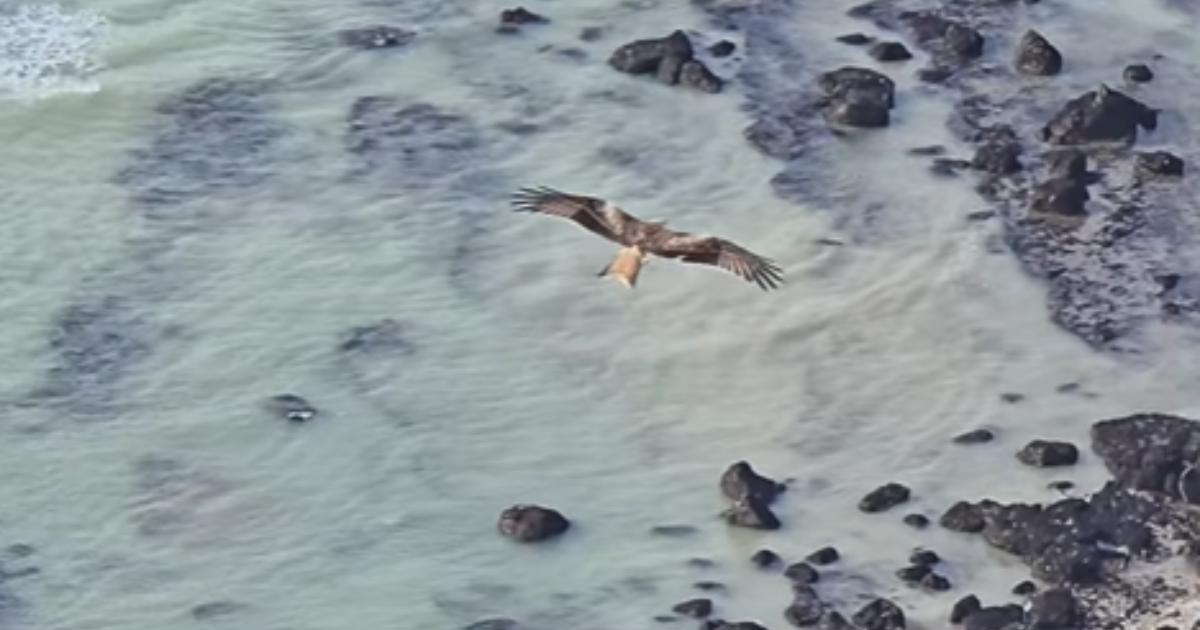
A red kite was photographed flying over Beachy Head in Eastbourne by Tadas Kaminskas, who owns TK Photography.
Kaminskas shared the video on social media and described the moment as a first-time encounter at Beachy Head.
The red kite was recorded by Tadas Kaminskas (Image: Tadas Kaminskas)
Tadas Kaminskas said on Facebook: “I finally caught the iconic Red Kite soaring over Beachy Head.
“I feel lucky.”
Red kites are medium-sized raptors known for their forked tails and wing tips that look like splayed fingers.
They mainly feed on carrion and worms.
Commenters expressed excitement at the sighting.
Amy Tibbo said: “Stunning!
“I walked over 50km over Easter weekend and kept my eyes peeled the whole time but didn’t see any, I feel cheated.”
Michael Howell said: “Majestic.”
Andy Vine said: “Great work mate.”
Other photographs taken by Tadas Kaminskas can be found on his Facebook page TK Photography.
By the 20th century, red kites were extinct in England and Scotland due to persecution and egg collecting.
Their return is considered one of the UK’s greatest conservation success stories, thanks to a reintroduction scheme launched in July 1990.
Tony Juniper, chairman of Natural England, said: “Red kites are one of our most majestic birds of prey with a beautiful plumage, and are easily recognisable thanks to their soaring flight and mewing call.
“Persecuted to near-extinction, they have made a triumphant comeback in England over the past three decades.”
The reintroduction project began in the Chilterns in July 1990 and involved releasing 13 young birds brought from Spain.
The first successful breeding occurred in 1992, and by 1996, at least 37 pairs were recorded in southern England.
The programme was the result of a partnership between the Nature Conservancy Council (now Natural England), the RSPB, the Joint Nature Conservation Committee (JNCC), Zoological Society London, and British Airways.
Jeff Knott, RSPB operations director for Central and Eastern England, said: “In the 1980s, anyone wanting to see a red kite had to make a special pilgrimage to a handful of sites.
“Today it is a daily sight for millions of people.
“In a few short decades we have taken a species from the brink of extinction, to the UK being home to almost 10% of the entire world population.”
A 2025 South Downs National Park report found that red kite and buzzard populations have also seen slight increases, with strongholds in West Sussex from Midhurst to the Havant area.
The RSPB said in 2023 that red kites are among the most frequent victims of poisoned bait on land associated with gamebird management.