
March saw the largest increase in global energy inflation in at least 25 years, UBS finds
The Iran war has led to the biggest rise in global energy inflation in at least 25 years, new data suggests.
Swiss bank UBS has analysed the latest inflation reports from advanced and emerging economies, and found that energy prices rose by 5.5% on average in March. That exceeds the surge seen after the onset of the Russia–Ukraine conflict in March 2022.
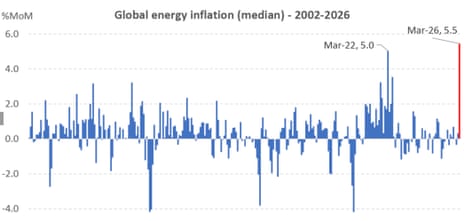 A chart showing monthly energy inflation Photograph: UBS
UBS tracks inflation across roughly 45 major advanced and emerging economies; 27 have reported March data so far.
Arend Kapteyn, global head of economic and strategy research, told clients:
double quotation markThe increases were broad-based. Around two-thirds of reporting economies registered monthly gains in the 97th percentile or higher of their historical distributions, reflecting the globally synchronised shock to energy prices triggered by developments in the Middle East.
That said, there were a few exceptions. Energy inflation declined in Sweden—mainly due to a sharp fall in electricity prices (March was the warmest month ever recorded in Sweden) which offset strong fuel price increases—as well as in Estonia and Slovenia, while Chile also recorded only modest increases.
UBS has also found that the rise in headline inflation inflation remains slightly below the peak reached in March 2022.
Thats’s because there was also acute supply-chain disruptions and exceptionally strong post-pandemic demand four years ago, which led to price rises across a broader set of goods and services.
Updated at 05.38 EDT
Key events
Show key events only
Please turn on JavaScript to use this feature
Greenpeace have calculated that the UK has commissioned enough wind and solar this year to generate ten times as much electricity than the fossil fuel it imports through the Strait of Hormuz.
It says:
double quotation markCalculation: Gas coming through Hormuz would generate 4.2TWh of power. Offshore wind from renewables auction 36.0TWh, solar 5,15TWh, onshore wind 4.1TWh.
Total wind and solar is 45.25TWh, which is 10.8x more than the 4.2TWh that the Hormuz gas would generate.
According to the government, only about 1% of the UK’s gas supply in 2025 came from Qatar – more comes from North Sea production, pipelines with Norway, interconnectors with continental Europe and three LNG terminals.
Updated at 07.36 EDT
RAC: UK fuel prices have stopped rising, and should drop soon
UK fuel prices appear to finally be levelling off after 43 days of increases, the RAC reports.
The motoring group argues that prices should now start to decline.
RAC head of policy Simon Williams explains:
double quotation markWholesale fuel costs are now significantly lower than they were at the start of the month, so forecourt prices should begin to come down. As things stand, we’d expect petrol and diesel to drop by several pence a litre in the next week or so.
“It will be very interesting to see if this plays out as the data indicates. We hope it does as drivers could do with some relief at the pumps with a tank of petrol for a family car now costing £87 and the diesel equivalent £105 – £14 and £27 more than they did at the start of the conflict.”
According to the RAC, petrol is averaging 158.30p a litre, while diesel is 191.54p a litre.
A chart showing average UK fuel prices Photograph: RACShareJP Morgan profits rise despite ‘complex set of risks’
JP Morgan has reported a surge in profits as the Middle East conflict drove volatility in the financial markets.
Net income jumped 13% to $16.5bn in January-March 2026, up from $14.6bn in the first quarter of 2025.
Revenues at JP Morgan’s markets division reached a record $11.6bn in the quarter, while investment banking fees rose by 28% “due to stronger advisory and ECM [equity capital market] activity.”
JP Morgan’s CEO Jamie Dimon says the company faces ‘an increasingly complex set of risks’, including conflict and surging energy prices, saying:
double quotation mark“The U.S. economy remained resilient in the quarter, with consumers still earning and spending and businesses still healthy. Several tailwinds are supporting this resiliency, including increased fiscal stimulus, the benefits of deregulation, AI-driven capital investment and the Fed’s asset purchases.
At the same time, there is an increasingly complex set of risks— such as geopolitical tensions and wars, energy price volatility, trade uncertainty, large global fiscal deficits and elevated asset prices. While we cannot predict how these risks and uncertainties will ultimately play out, they are significant and they reinforce why we prepare the Firm for a wide range of environments.”
ShareAxel Springer: We’ll ‘invest significantly’ in the Telegraph
Axel Springer has confirmed it has received approval from the UK Department for Culture, Media and Sport (DCMS) to proceed with its acquisition of Telegraph Media Group.
It says the decision marks “a significant milestone toward completing the transaction”.
Mathias Döpfner, CEO of Axel Springer, says:
double quotation markWe are pleased to have received UK government approval to proceed with this acquisition. After a long period of uncertainty, we can confirm that we will invest significantly in The Telegraph’s editorial excellence and international growth.”
The acquisition will strengthen Axel Springer’s portfolio of premium journalism brands, which includes POLITICO, BUSINESS INSIDER, BILD, and WELT, among others. The Telegraph will join a global network committed to independent reporting while retaining its distinct editorial voice and British identity.
Updated at 06.42 EDT
Nandy gives green light to Axel Springer buying the Telegraph
In the media world, Culture secretary Lisa Nandy has given permission for European media group Axel Springer is to acquire the Telegraph newspaper.
In a written statement to parliament, Nandy says she has given her written consent for RB Investco Ltd to sell its call option to purchase the Telegraph Media Group Holdings Ltd to Axel Springer.
Importantly, Nandy also says she is “not minded” at this stage to intervene in the proposed merger, under either the public interest media mergers regime and the foreign state influence regime, adding:
double quotation markI am pleased to be able to take these positive steps, which give greater certainty to the Telegraph and its staff.
RB Investco is a joint venture between US private equity firm, RedBird Capital Partners LLC and Abu-Dhabi based media conglomerate, IMI. They dropped their £500m bid for the Telegraph Media Group last November, following concerns about links to China.
Axel Springer swept in with its a £575m deal in early March, scuppering a rival deal from the owner of the Daily Mail.
ShareOil price spike drove US small business sentiment to 11-month low
The surge in energy costs has pushed confidence among small US companies down to its lowest level in almost a year.
The National Federation of Independent Business has reported that its Small Business Optimism Index dropped 3.0 points to 95.8 last month.
That pushes the index below its long-term average for the first time since April 2025 (the month of Donald Trump’s ‘Liberation Day’ tariffs).
Higher energy costs wiped out the benefits from taxes cuts, NFIB found.
NFIB chief economist Bill Dunkelberg explained:
double quotation mark“The 20% Small Business Deduction and other supportive small business tax provisions in the Working Families Tax Cut Act have had many positives for small business owners.”
“However, the dramatic spike in oil prices has spooked consumers and owners alike. Small business owners are having to absorb those higher input costs and pass them along to their customers.”
Investors were bracing for a growth shock in Europe before last week’s US-Iran ceasefire, Bank of America reports.
It’s latest Fund Manager Survey has found that investors lowered their global growth prospects again in the last month, due to the inflation shock from the Iran conflict.
They found:
A net 36% of respondents think the global economy will weaken over the coming year, the most since August last year and compared to a net 39% seeing a global growth acceleration back in February.
Across regions, investors have turned most gloomy on Europe, with a net 25% now expecting growth to slow, compared to a net 66% that expected acceleration back in February on the back of support from fiscal stimulus.
Recession concerns remain reasonably low, with 79% of investors seeing a recession as unlikely over the next year, close to recent months.
However, around 80% of participants responded to the survey before last week’s US / Iran ceasefire announcement….
The pound has recovered all its losses since the Iran war started.
Hopes of de-escalation in the Middle East have lifted currencies against the US dollar, which has dropped today.
The pound has gained almost half a cent to $1.354, the highest since 26 February.
Matthew Ryan, head of market strategy at Ebury, says:
double quotation mark“Renewed optimism over the war has driven the US Dollar Index to its lowest level since the conflict began, underscoring just how quickly sentiment has shifted. This leaves room for a correction should we see any further bumps in the road, which is probably likely even if a deal materialises before the month is out.”
ShareMarch saw the largest increase in global energy inflation in at least 25 years, UBS finds
The Iran war has led to the biggest rise in global energy inflation in at least 25 years, new data suggests.
Swiss bank UBS has analysed the latest inflation reports from advanced and emerging economies, and found that energy prices rose by 5.5% on average in March. That exceeds the surge seen after the onset of the Russia–Ukraine conflict in March 2022.
A chart showing monthly energy inflation Photograph: UBS
UBS tracks inflation across roughly 45 major advanced and emerging economies; 27 have reported March data so far.
Arend Kapteyn, global head of economic and strategy research, told clients:
double quotation markThe increases were broad-based. Around two-thirds of reporting economies registered monthly gains in the 97th percentile or higher of their historical distributions, reflecting the globally synchronised shock to energy prices triggered by developments in the Middle East.
That said, there were a few exceptions. Energy inflation declined in Sweden—mainly due to a sharp fall in electricity prices (March was the warmest month ever recorded in Sweden) which offset strong fuel price increases—as well as in Estonia and Slovenia, while Chile also recorded only modest increases.
UBS has also found that the rise in headline inflation inflation remains slightly below the peak reached in March 2022.
Thats’s because there was also acute supply-chain disruptions and exceptionally strong post-pandemic demand four years ago, which led to price rises across a broader set of goods and services.
Updated at 05.38 EDT
Reeves ‘very frustrated and angry’ over ‘folly’ of Trump’s lack of Iran exit plan
Chancellor Rachel Reeves has blasted Donald Trump over his ‘folly’ for starting the Iran war without an exit plan.
In an interview with the Daily Mirror, Reeves says she is “very frustrated and angry” about the situation.
She says:
double quotation mark“This is a war that we did not start. It was a war that we did not want. I feel very frustrated and angry that the US went into this war without a clear exit plan, without a clear idea of what they were trying to achieve.”
“And as a result the Strait of Hormuz is now blocked,” the Chancellor added. “We are hosting a conference this week with President Macron of France on how to secure passage through the Strait of Hormuz.
Reeves (who is heading to Washington DC for the IMF’s spring meetings this week) points out that before the conflict, inflation was expected to fall, allowing more cuts to interest rates.
She adds:
double quotation mark“Obviously no sensible person is a supporter of the Iranian regime, but to start a conflict without being clear what the objectives are and not being clear about how you are going to get out of it, I do think that is a folly and it is one that is affecting families here in the UK but also families in the US and around the world.”
ShareEuropean steelmakers welcome new tariffs Lisa O’Carroll
The European steel industry has said radical new measures to double tariffs on steel imports and halve duty-free quotas (see earlier post) will help pull the industry “back from the brink” of collapse.
Faced with unprecedented cheap imports from China and elsewhere, the industry has for the last year pleaded with Brussels to introduce trade measures to deal with the sheer volume of competition for local manufacturers.
Axel Eggert, director general of the European Steel Association (EUROFER), said:
double quotation mark‘European steel has been standing at the edge of a cliff and this trade measure helps pulls us back from the brink. By curbing unsustainable import pressure, it supports viable domestic steel capacity and enables the industry to continue its decarbonisation.
“It will bring back 15 million tonnes of EU steel-making capacity utilisation, while helping preserve around 30,000 direct jobs and 200,000 indirect jobs in Europe’’.
The new tariffs and quota system agreed in late night talks by the European Parliament and member states will see quotas imposed in each of the 28 steel product sectors and could impact exports from the UK as well as countries like China.