
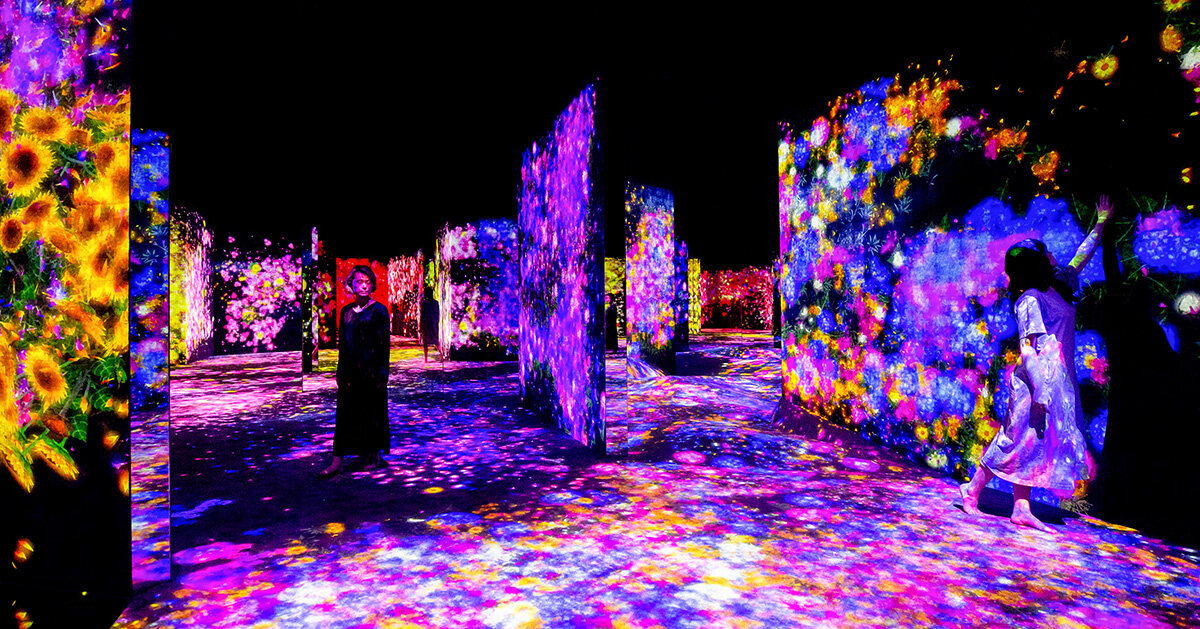
teamLab redefines the artwork as a borderless experience
teamLab constructs environments that challenge the idea of the world as a collection of separate entities. Instead, the collective proposes what it describes as a ‘long, fragile yet miraculous, borderless continuity’, a condition in which boundaries dissolve and relationships take precedence. Their installations are not conceived as isolated objects, but as immersive fields that bloom through time and presence. As teamLab tells designboom, their work can be understood as ‘the experience itself’, shifting perception away from fixed forms toward a more fluid awareness of connection.
Within this framework, the viewer is never external to the work, but becomes part of its structure. Interaction is not an added layer but a defining condition, where ‘the artistic work is made up of both the art and the viewer’, teamLab explains. This reciprocity transforms not only the artwork itself, but also the relationships between those who encounter it. The presence of others becomes perceptible within the work, such that ‘if the effect of another person’s presence on the art is beautiful, that person’s presence itself may be seen as beautiful’.
This expanded approach is currently unfolding across a growing global network of exhibitions, from Tokyo and Shanghai to Jeddah and Abu Dhabi, as the collective continues to develop large-scale, permanent environments. Now, the interdisciplinary creative group is preparing to bring this model to Europe for the first time, with teamLab Borderless Hamburg set to open soon within the UBS Digital Art Museum in HafenCity (find designboom’s previous coverage here).
At the same time, the collective extends the notion of experience beyond physical presence. Reflecting on memory and absence, teamLab suggests that ‘in that moment, doesn’t a form of beauty arise that transcends physical absence?’, pointing to a more expansive understanding of perception that includes recollection, imagination, and emotional resonance. Beauty, in this sense, is not confined to what is directly seen, but emerges through continuity across time and experience.
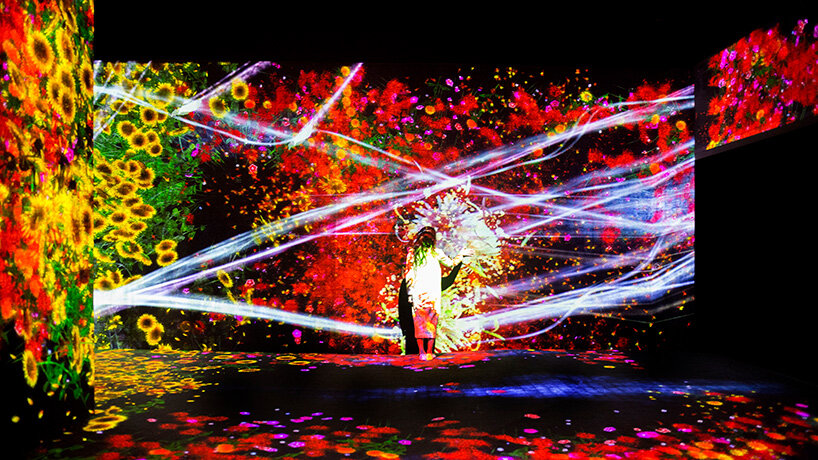
Crows are Chased and the Chasing Crows are Destined to be Chased as well, Flying Beyond Borders © teamLab
from perpetual transformation to a digital garden
Working through digital media, teamLab develops artworks that resist fixity, installations that evolve continuously, shaped by an ongoing exchange between viewer and environment, where interaction can ‘continue forever’. In contrast to more conventional notions of permanence, they propose another understanding of eternity, one grounded in transformation, like ‘waves of the sea or a vortex,’ teamLab describes. Digital technology becomes a material condition that allows expression to ‘change form freely’, enabling artworks to exist as dynamic systems.
Despite their technological foundation, references to nature remain central to their thinking. Rather than reproducing natural forms, the international art collective seeks to evoke a bodily sense of connection that is often diminished in contemporary urban life. The team shares with us that their works aim to ‘allow people to feel the continuity of nature and the world with their bodies’, using light, sound, and networks as non-material elements. Technology is not positioned in opposition to nature but as a means of reconnecting with it, suggesting that what they create may be understood as something closer to a ‘garden’.
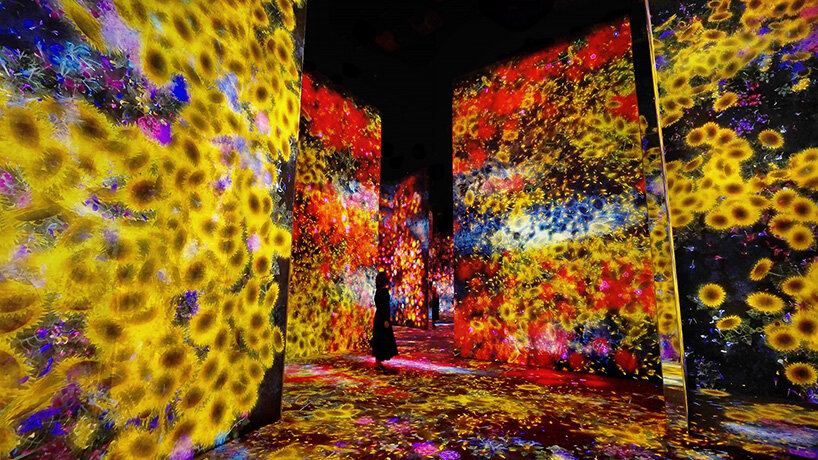
Flowers and People, Cannot be Controlled but Live Together – A Whole Year per Hour © teamLab
collective creation and the beauty of continuity
This method is inseparable from teamLab’s interdisciplinary structure, which brings together artists, engineers, programmers, and scientists in what they describe as ‘collective creation’. Knowledge circulates across the group as ‘transferable knowledge’, accumulating through continuous experimentation. Authorship becomes secondary to the work itself, as they emphasize that ‘what matters to us is not who made it, but the output itself’, privileging the emergent qualities of the final environment over individual contribution.
Scale plays a crucial role in intensifying these relationships. teamLab often develops projects in direct response to specific spaces, using the flexibility of digital media to expand across surfaces and volumes. This adaptability allows installations to grow in complexity and immersion, while supporting a key principle of their work, that ‘the more people there are, the more beautiful it becomes’. In these environments, the artwork operates as a social system, shaped by density, movement, and interaction.
Ultimately, what teamLab seeks to leave with the viewer is not a singular image, but a shift in perception. They hope that visitors come to feel that ‘the continuity of all the works is beautiful in itself’, expanding the boundaries of what can be understood as beauty. Often described as dreamlike, their environments instead open onto a state in which ‘the boundaries between the self and the world become fluid’, a condition where the individual dissolves into a shared, continuously unfolding whole. Find our full interview with teamLab ahead.
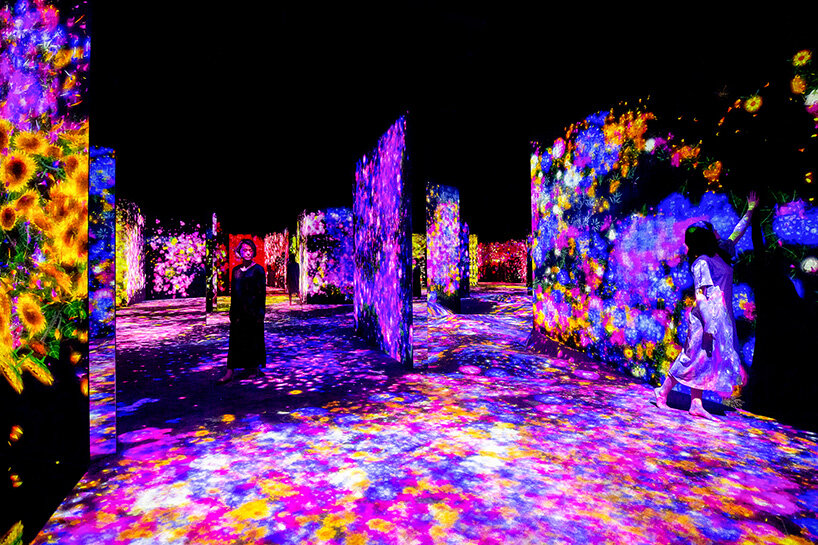
Forest of Flowers and People © teamLab
discussing with teamlab
designboom (DB): Your work invites viewers into environments that continuously change in response to them. What kind of way of seeing or experiencing the world are you aiming to reconstruct through these environments?
teamLab (TL): We believe that people tend to separate the world into independent entities with perceived boundaries, and our work challenges this by emphasizing that everything exists in a ‘long, fragile yet miraculous, borderless continuity’. Through our artworks, teamLab aims to explore the relationship between humans and the world, seeking to transcend boundaries in our perception. Indeed, as you pointed out, teamLab’s work can be understood as ‘the experience itself.’ Some of our works embody this quality. We hope that after people come and see the artworks, it expands how they perceive the world. Everything in this world exists in continuity. We hope people realize that continuity itself is beautiful and life-affirming.
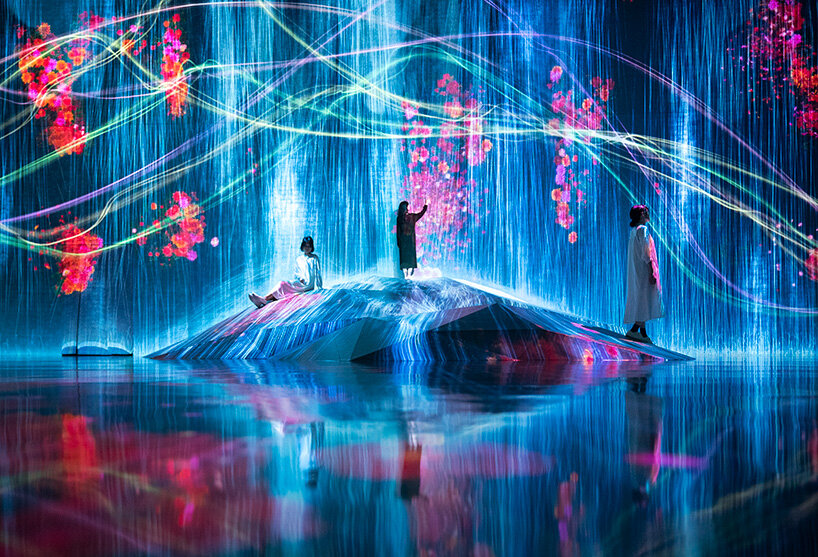
Universe of Water Particles on a Rock where People Gather © teamLab
DB: How do you think participation changes the meaning of an artwork?
TL: One characteristic of interactive art is that the existence and behavior of the viewer can influence the art, thereby blurring the line between art and viewer. In other words, the artistic work is made up of both the art and the viewer. One consequence of this is a shift in the relationship between art and viewer as well as between the individual viewer and the group. This changes the relationship between an artwork and an individual into a relationship between an artwork and a group of individuals. The result is that the art gains the ability to influence the relationships between the viewers standing in front of it. And if the effect of another person’s presence on the art is beautiful, that person’s presence itself may be seen as beautiful.
At the same time, beauty exists even when no one is there. For instance, we sometimes recall the beauty of a deep forest encountered in our lives and find ourselves lost in thought about that place. In that moment, doesn’t a form of beauty arise that transcends physical absence?
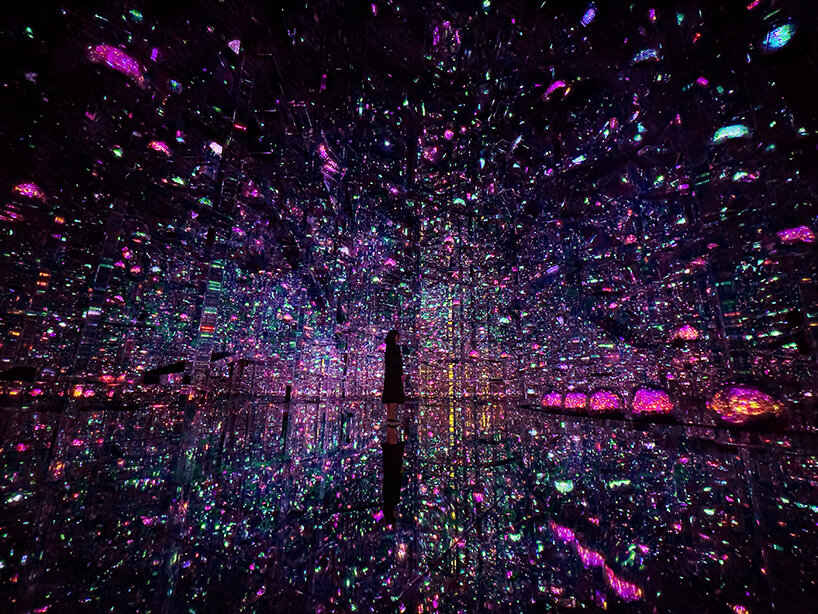
Microcosmoses: Wobbling Light and Environmental Light, 2024, Interactive Installation, LED, Endless, Sound: teamLab O teamLab, courtesy Pace Gallery
DB: Your environments evolve, respond, and sometimes even remember. What interests you about creating works that exist in time rather than as fixed objects?
TL: We want to show that digital technology can provide a new possibility for art. Videotape appears to be finite but we can transform video work into an endless form using technology. In terms of the relationship between the works and the viewer, viewers can influence the work and vice versa, and this can continue forever. We want people to experience the ‘futuristic something’ which already exists. Before people started accepting digital technology, information and artistic expression had to be presented in some physical form. Creative expression has existed through static media for most of human history, often using physical objects such as canvas and paint. The advent of digital technology allows human expression to become free from these physical constraints, enabling it to exist independently and evolve freely. We believe it depends on how one defines ‘eternity.’
One way is to capture a momentary radiance within a physical substance, like a stone sculpture, and preserve its form forever. Another way is to find eternity within a continuity of natural phenomena that are constantly changing yet perpetually reborn, like the waves of the sea or a vortex. For us, digital technology is strictly a material and a tool. To express ourselves through these media is nothing less than confronting the reality of phenomena that never cease to change. Digital technology allows artistic expression to be released from the material world, gaining the ability to change form freely. The characteristics of digital technology allow artworks to express the capacity for change much more freely. Viewers, in interaction with their environment, can instigate perpetual change in an artwork.
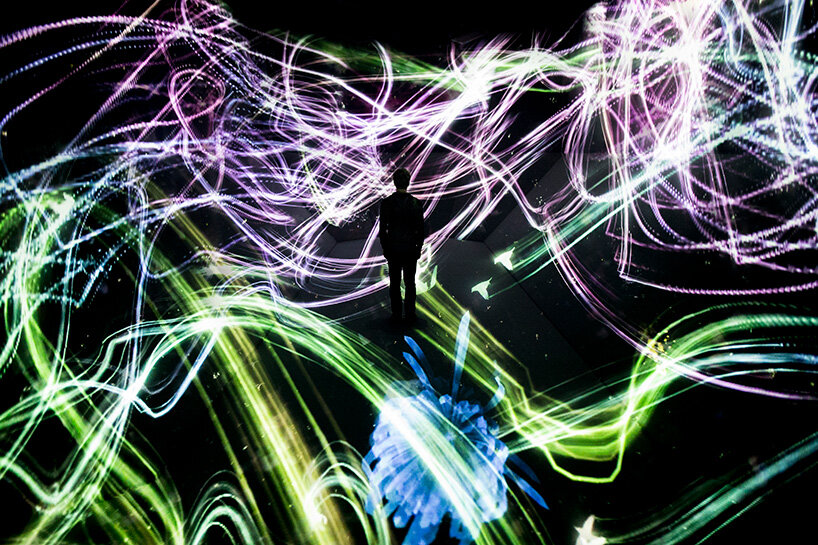
Crows are Chased and the Chasing Crows are Destined to be Chased as well: Flying Beyond Borders, 2013/2018-, Interactive Digital Installation, Endless, Sound: Hideaki Takahashi © teamLab, courtesy Pace Gallery
DB: There is often a strong reference to natural phenomena in your projects, yet everything is digitally constructed. How do you approach this relationship between nature and algorithm?
TL: We believe that the relationship between humans and nature is something that each of us must realize and discover over a long period of time in nature. However, in our modern and urban lives, it is difficult to experience being surrounded by and at one with nature. We have no desire to copy nature through digital technology, but we believe that digital technology and its use in creating artistic expression will enable us to perceive more widely the relationship between humans and nature, which we have lost touch with in our daily lives. Rather than reproducing nature itself, we want to create works that allow people to feel the continuity of nature and the world with their bodies. We believe that technology is not in conflict with nature, but has the potential to complement it.
Digital technologies such as sensing, networks, light and sound, are non-material and have no physical impact on the environment. By using such non-material digital technologies, nature can be turned into living art, without harming it.
We do not see any irony in using technology to portray nature and its forms. When artists painted nature, they used paint and steel, the most advanced technologies of their time, to make sculptures or representations of natural objects. What is the difference between that and what we are doing with digital technology? In thinking about this, what we are creating may be something akin to a ‘garden.’