
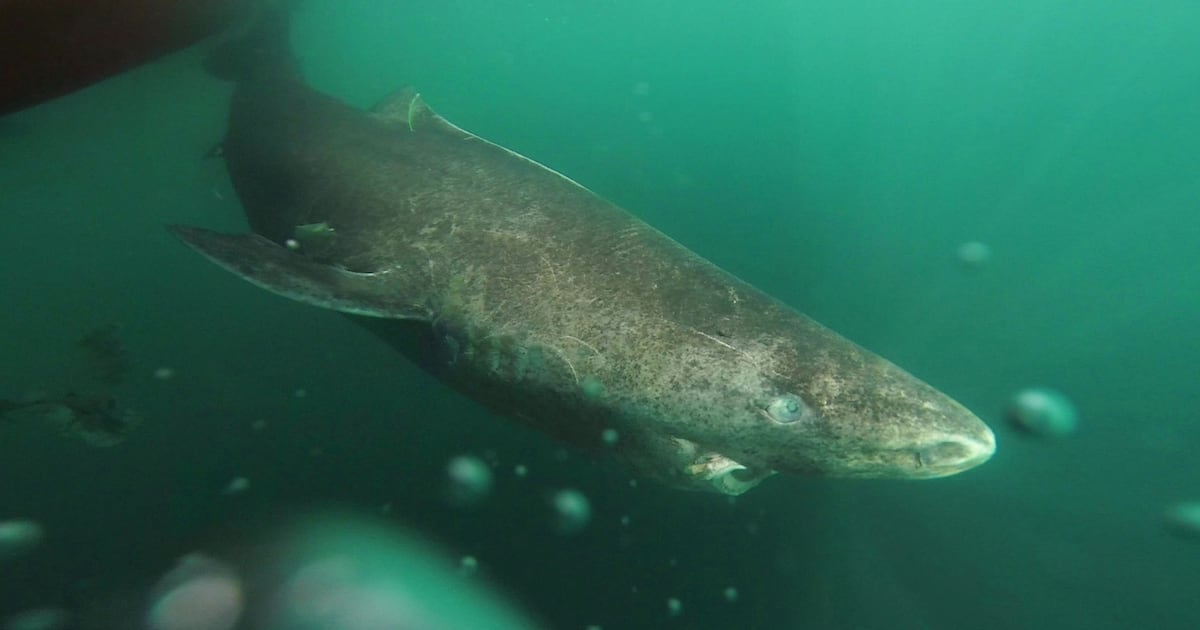
A shark from the longest-living vertebrate species in the world washed up on the shores of Sligo on Saturday.
“Exceptionally rare in Irish waters”, in the words of the National Museum of Ireland, the Greenland shark can live for more than 500 years.
It typically reaches a length of four to six metres, with the creature found in Sligo measuring just shy of three.
This was the first recorded stranding of the species on the Irish coast. Its usual habitat is in the deep and remote waters of the Arctic and North Atlantic and it is not clear how it wound up on Irish shores.
It was initially reported by members of the Irish Whale and Dolphin Group (IWDG) whose stranding hotline had been informed of a dead basking shark. Photos received by the conservation group confirmed a much rarer stranding.
Given the shark’s difficult-to-access location, and its condition, it had to be lifted by a crane to remove it from the shore before tidal conditions could cause it further damage or drag it back out to sea.
A spokesperson for the IWDG speculated that the crane may have facilitated “the highest recorded altitude of a Greenland shark ever”, certainly in Ireland.
“It’s a tough call to get an exact number,” the spokesperson said of estimating an age for the shark, but noted that the species tends to reach sexual maturity at around 150 years of age.
[ Greenland sharks beginning to shed their secrets on longevityOpens in new window ]
This male Greenland shark, measuring 287cm long, had very developed claspers, suggesting it could have been on the verge of maturity.
One of the ways the shark might be aged is from the crystalline structure of its eyes, with a method called radiocarbon dating perhaps key to shining a light on exactly how long the creature has been around.
“You’re probably talking ancient by our standards,” the IWDG spokesperson said.
After it was recovered on Monday, the animal was brought to the Regional Veterinary Laboratory in Sligo where it is undergoing a detailed scientific postmortem examination. Tissue samples and anatomical components of the shark will be preserved as part of the National Museum’s collections.
The museum hopes to display the specimen in the future, subject to the condition of its skin and its suitability for preservation. It described the Greenland shark as “one of the world’s most mysterious shark species” and said it hopes this finding will provide a learning opportunity for future visitors.