
WTF. It is difficult to think of a more suitable title for an artwork in 2026 but Jenny Holzer’s frantically swinging LED sign, which displays tweets by US president Donald Trump and the QAnon conspiracy theorist Q, made its debut four whole years ago.
The world has just done very little to make it feel less urgent.
WTF is one of more than 100 works set to appear in the National Gallery of Victoria’s Triennial in Melbourne this December. Holzer, one of the world’s most celebrated living conceptual artists, is among the nearly 100 artists from 35 countries who will take part in the entirely free, blockbuster contemporary art show, which this year includes several works exploring the perception of truth, artificial intelligence, digital culture and the importance of human community.
Jenny Holzer’s 2022 work WTF. Photograph: Filip Wolak
Hung from the gallery ceiling, WTF moves frantically and unpredictably, echoing the chaos of digital conversation. Holzer has previously described Trump as “an abomination”, telling the Guardian in 2023 that WTF was about “the damage one man can do, and what happened around him”.
Donna McColm, the NGV’s assistant director of curatorial and audience engagement, said the gallery was excited to work with Holzer, acclaimed for her 50-year career making large-scale works using words to deliver ideas in public spaces such as Times Square and the Louvre Pyramid.
“As WTF swings across the gallery, it becomes increasingly frenetic and the words become illegible – it is a really interesting portrait of how text just infiltrates our daily lives now, and questioning ideas around truth and authority,” McColm said.
US artist Avery Singer is also exploring our relationship to truth with her painting Deepfake Stan: a portrait of the photojournalist Stan Honda built from digitally altered composite images. Honda is particularly known for his photos taken during the 9/11 terrorist attacks in New York; Singer, who was 14 when 9/11 happened, will present Deepfake Stan in the NGV within a recreation of the World Trade Center offices where her mother worked, based on her own memories.
A Wolfgang Tillmans exhibition at the Albertinum in Dresden in 2025. Photograph: Jens Schlueter/AFP/Getty Images
Other artists in the NGV Triennial this year include German photographer Wolfgang Tillmans, who will create a new room-sized photography installation; US artist Christine Sun Kim, who is deaf and creates works translating American sign language into graphic form; and Melbourne artist Louise Paramor, who will create a human-sized chess set that gallery visitors will be invited to play with in the Great Hall.
Kresiah Mukwazhi’s 2024 work Nyenyedzi nomwe (the Seven Sisters Pleiades), made of stitched bra straps on canvas. Photograph: Supplied by NGV
Several works explore solidarity and community in the modern world. Korean artist Ayoung Kim will show Delivery Dancer’s Arc: Inverse, a work built with AI, CGI and game engines that follows two female couriers in a futuristic Seoul – inspired by the boom in South Korea’s gig economy during the pandemic.
Zimbabwe’s Kresiah Mukwazhi will exhibit an eight-metre textile work made from thousands of used bra straps and lingerie fragments from sex workers in the suburbs of Harare, while Timor-Leste artist Maria Madeira will deliver a live performance with her work Kiss and Don’t Tell, repeatedly kissing the canvas to honour the women subjected to abuse and violence during Indonesia’s occupation of Timor-Leste.
And the bestselling Vietnamese poet Ocean Vuong will present a series of photographs of his mother Rose’s nail salon, honouring the experience of his family and others as Vietnamese immigrants to America.
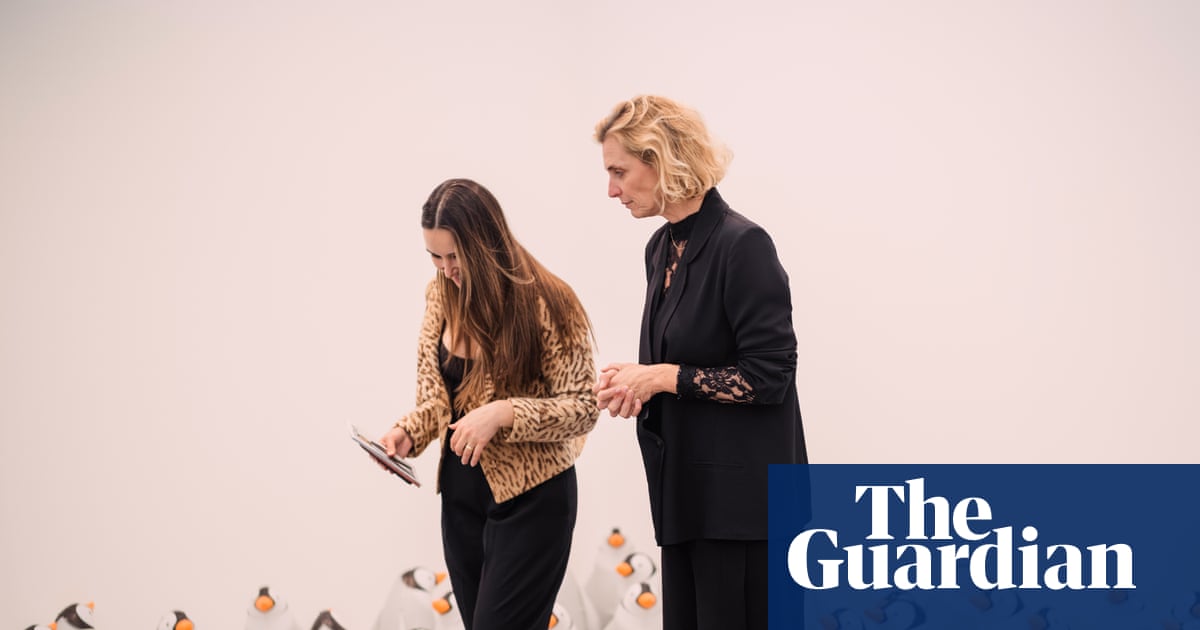
Several works touch on the natural world. Wunambal Gaambera and Worrora artist Angelina Karadada Boona will take over the NGV’s Waterwall entrance with a giant glowing Wandjina figure, a creator spirit that lives in the clouds and is responsible for bringing the monsoon. And The Birds by Danish artist Benedikte Bjerre – a crowd of foil-balloon penguins filled with helium – will make their Australian debut, having already charmed art lovers overseas; the work is a playful commentary on the destruction of penguins’ natural habitat due to the climate crisis.
Pamela Rosenkranz’s Old Tree, 2023, pictured on New York’s High Line. Photograph: Timothy Schenck
The grand scope of triennials invites monumental work: this year, the bigger works include a 15-metre painting by Australian artist Juan Ford; a huge pink tree by Swiss artist Pamela Rosenkranz; a 3.3-metre sculpture of South African artist Zanele Muholi as the Virgin Mary; and a new major limestone sculpture by Lebanese-French artist Najla El Zein. Carved in Beirut by master artisans, the work has been commissioned by the City of Melbourne with NGV and is designed for public gatherings.
With so many artists, McColm advised the public to see the Triennial over multiple visits. “The beauty is that the exhibition is free and runs for several months,” she said. “It can be quite overwhelming – so my recommendation is, take it slow.”
The 2026 NGV Triennial will be on from 13 December to 11 April 2027.