
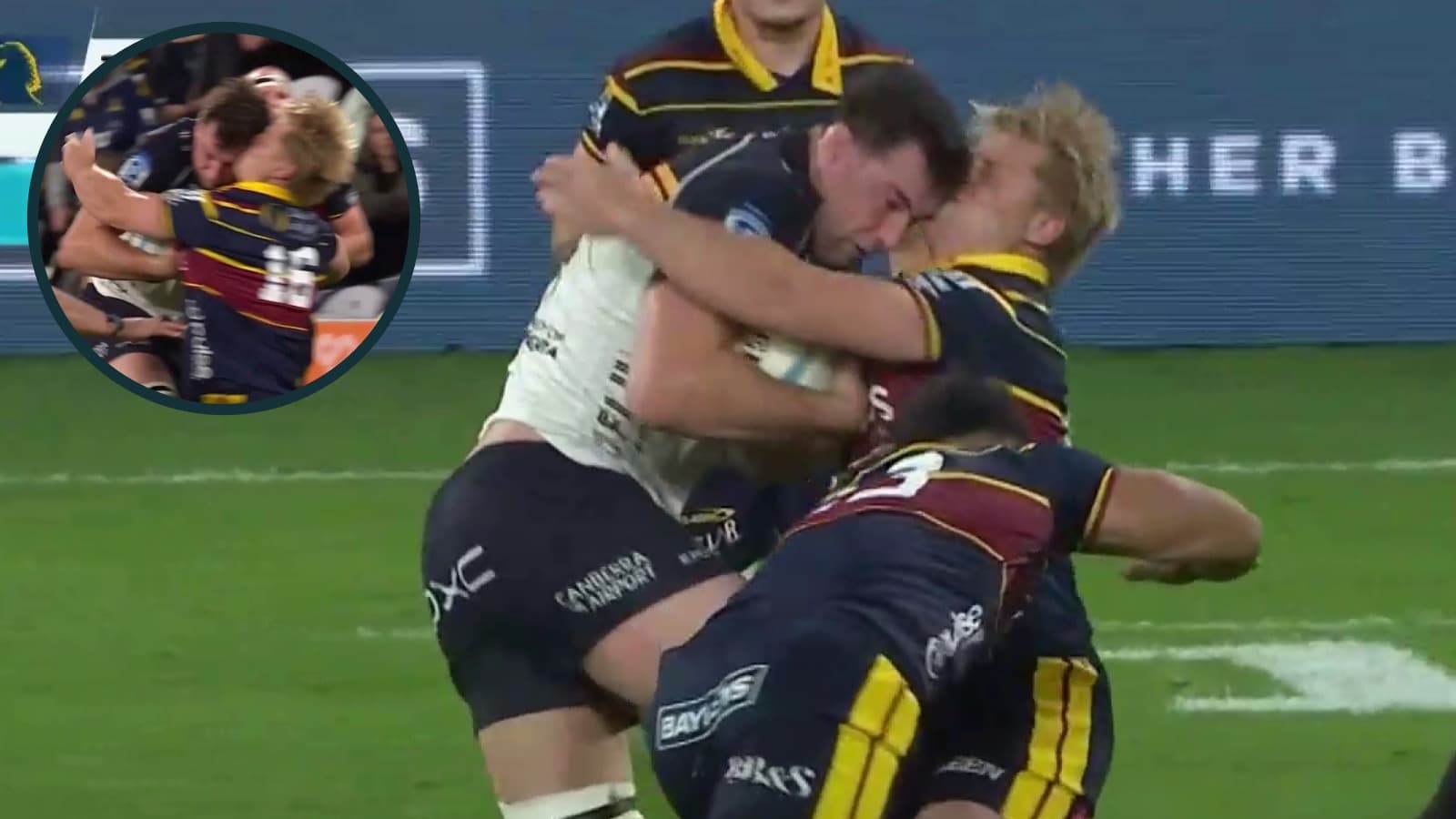
Nick Frost’s collision with Henry Bell during last weekend’s Super Rugby Pacific clash between the Brumbies and Highlanders has been hotly debated throughout the week.
Wallabies lock Frost has been accused of purposefully headbutting Bell, who was attempting to tackle the Brumby. This after replays showed the second rower step towards the replacement hooker, leaning forward and making head-on-head contact with the Highlander.
Controversial Super Rugby Pacific incident
The incident was initially missed by the officials, but TMO Richard Kelly notified referee Ben O’Keeffe that it needed to be reviewed. The experienced New Zealand referee reviewed the footage and deemed that Bell’s actions met the yellow card threshold and duly issued the sin-binning and sent the decision to be reviewed by the Foul Play Review Officer [FPRO].
“He is upright; he does need to be lower, so we do have foul play,” O’Keefe said in his review.
“It is head-on-head, we have a degree of danger that meets the yellow threshold, so it’s going to be a yellow card against #16 blue. It’s going for an off-field review for head-on-head contact.”
The FPRO deemed that a yellow card was a sufficient punishment for the Highlanders hooker, but many fans, pundits, and former players believe that it should have been Frost who was punished and not Bell.
“This is INSANE. You can see him look up, spot the defender, then lean his head into him. Absolutely insane,” one fan remarked in a reply to a post featuring a video of the incident.
Another added: “How in the world is it given that way, the other player should see red for a deliberate headbutt.”
Whilst there has been a huge outcry suggesting that the officials got the decision wrong, there have been those who believe that O’Keeffe and his officiating team got the decision spot on, with Bell at fault for failing to drop his height into the tackle.
“You’ve got to be able to drop your body height. I know it’s unfortunate in terms of the circumstances of how it was, but you know as a player if you don’t show any form of dip – it doesn’t matter if it’s a late movement – you just know that your body height has to be dipping,” ex-Crusaders and Maori All Blacks scrum-half Bryn Hall said on the Aotearoa Rugby Podcast.
Assessing Henry Bell’s actions
So are the outraged fans correct, or did the officials handle the incident correctly? To find out, Planet Rugby not only delved into the lawbook to find the answer, but reached out to multiple high-ranking match officials to ensure that the technicalities and law interpretations expressed were accurate and fair.
And the verdict was consistent across the board that Bell was rightly punished for his actions, irrespective of Frost’s actions.
This is because Bell failed in his duty of making a safe, legal tackle as per Law 9.13, which meant that World Rugby’s Head Contact Process (HCP) came into play.
Law 9.13: A player must not tackle an opponent early, late, or dangerously. Dangerous tackling includes, but is not limited to, tackling or attempting to tackle an opponent above the line of the shoulders, even if the tackle starts below the line of the shoulders.
Ultimately, the responsibility of avoiding head contact lies with the tackler, who is expected to be low into contact, with a clear bend in the hips and knees.
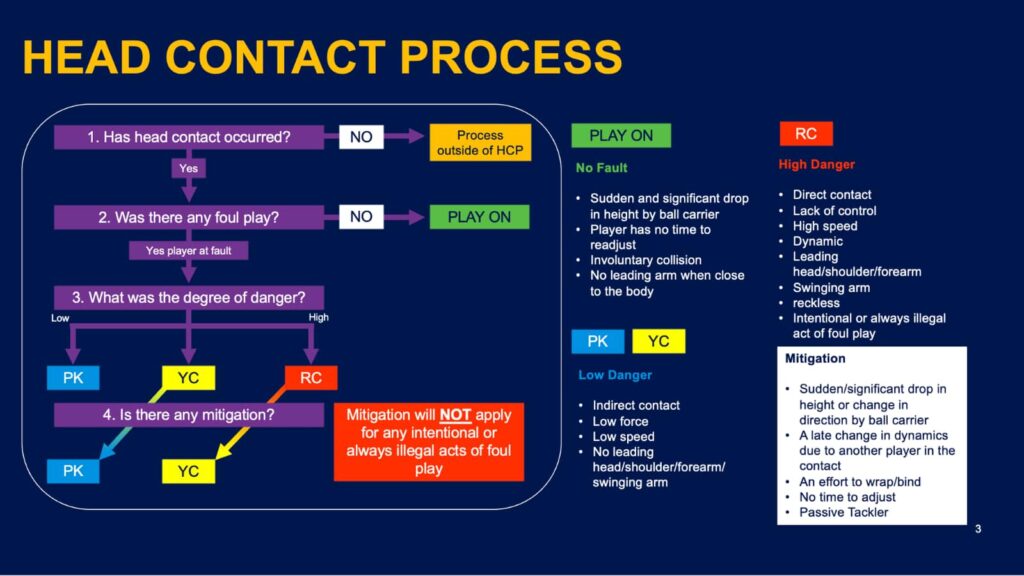
World Rugby’s Head contact process.
Using the HCP table above, here’s how Bell fared.
1. Has head contact occurred? Yes
2. Was there any foul play? Bell is upright going into contact and does not make an effort to drop his height, so the answer has to be Yes.
3. What was the degree of danger? Direct head-on-head contact means that it is automatically a high degree of danger, with force.
At this point, Bell is effectively on a red card, but because of the bunker being in place for Super Rugby, O’Keeffe is able to determine that the incident meets the yellow card threshold, with the FPRO left with the decision to upgrade it to a red card or allow it to remain yellow. They chose the latter because of the fourth and final step in the HCP.
4. Is there any mitigation? The ball carrier [Frost] changes his height and direction just before contact is initiated. The sudden and significant change in height becomes a mitigating factor. Outcome: Yellow Card.
Headbutt, yes or no?
The actions of Frost do look unnatural for a ball carrier going into contact, which has led to claims that he deliberately headbutted Bell.
However, one source argues that the Wallaby dipped his head to avoid head-to-face contact with Bell; this then results in contact with the side of his head, which is unavoidable for Frost.
The overriding verdict, though, was that the HCP has been adopted to protect the ball carriers and ensure safe tackling practices from defenders, forcing them to go low and be bent at the hips. If they don’t do this, they adopt a significant amount of risk in the process, and that’s exactly what Bell fell victim to.
Want more from Planet Rugby? Add us as a preferred source on Google to your favourites list for world-class coverage you can trust.
Hall’s remark that players simply have to ‘drop their body height’ is spot on, with ex-All Blacks hooker James Parsons providing an astute review of the incident too, and why it looked more like a headbutt motion from Frost than it actually was.
“He’s a big man, a bit of a giraffe, so him dropping his height compared to someone of a smaller stature, it looks more protruding because he’s so tall,” he said.
“But I go back to the defender doesn’t need to put himself in the position. If he started low, he’d have to scrape his nose on the grass to do that if it was intentional. You [the tackle] put it in your control.”