
Afossil uncovered along the Yangtze River in China is forcing scientists to rethink not just the origins of sponges but also the way they search for the earliest traces of animal life. For decades, a contradiction persisted: molecular clock studies pointed to sponges first appearing around 700 million years ago, yet clear sponge fossils only appeared from around 540 million years ago, leaving a 160-million-year gap that was unexplained.
This gap has now been partially bridged. A team led by geobiologist Shuhai Xiao, in collaboration with the University of Cambridge and the Nanjing Institute of Geology and Paleontology, has described a 550-million-year-old sponge fossil that falls squarely within this missing window.
A Discovery That Started With a Photograph
The story of this fossil is, in some ways, as striking as the specimen itself. Shuhai Xiao first encountered it roughly five years ago in a photograph sent to him by a collaborator.
“I had never seen anything like it before,” he said. “Almost immediately, I realized that it was something new.”
 A phylogenetic tree showing the evolutionary relationships of early sponges. Credit: Yuan Xunlai
From there, the team worked through a methodical process of elimination. The fossil did not match the known features of sea squirts, sea anemones, or corals, which left one intriguing possibility: an ancient sea sponge. What the specimen then revealed about its identity was equally unexpected. According to the study, published in the journal Nature, the fossil’s surface is covered in a grid of regular box-like shapes, each subdivided into smaller, repeating units.
“This specific pattern suggests our fossilized sea sponge is most closely related to a certain species of glass sponge,” said Xiaopeng Wang, a postdoctoral researcher at the Nanjing Institute of Geology and Paleontology and the University of Cambridge.
Then there was the matter of size. As explained by Alex Liu, a collaborator from the University of Cambridge in a statement:
“When searching for fossils of early sponges I had expected them to be very small,” he added that: “The new fossil is about 15 inches long with a relatively complex, conical body plan, which challenged many of our expectations for the appearance of early sponges.”
Why the Earliest Sponges Left Almost No Trace
In earlier work published in 2019, Xiao and his team had already begun to trace this problem backward through geological time, finding that sponge spicules become progressively more mineralized as you move forward in the record. The further back they looked, the more organic and less mineral-based these structures appeared.
“If you extrapolate back, then perhaps the first ones were soft-bodied creatures with entirely organic skeletons and no minerals at all,” Xiao said. “If this was true, they wouldn’t survive fossilization except under very special circumstances where rapid fossilization outcompeted degradation.”
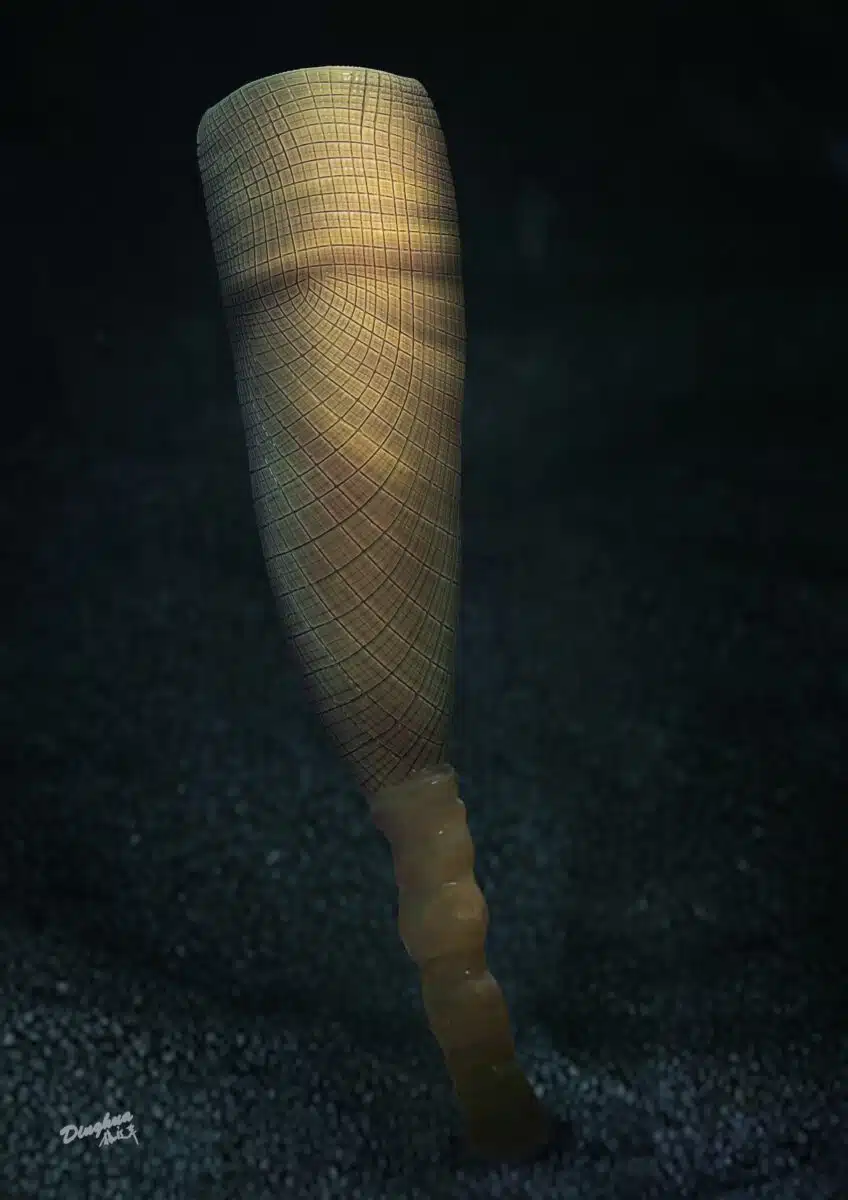 Reconstruction of an ancient sea sponge from the Ediacaran period, revealing its spiral structure. Credit: Yuan Xunlai
That same 2019 research had already turned up one such rare case: a separate sponge fossil preserved in a thin layer of marine carbonate rock, a geological formation known for its capacity to capture soft-bodied organisms before decay overtakes them, including some of the earliest animals capable of movement. The new Yangtze River specimen represents another such exceptional case.
“Most often, this type of fossil would be lost to the fossil record,” Xiao noted. “The new finding offers a window into early animals before they developed hard parts.”
A Find That Changes How Scientists Search for Early Life
According to the research, if thefirst spongeswere entirely soft-bodied and lacked mineral skeletons, then a significant portion of early animal life may have vanished without leaving any conventional fossil trace whatsoever. That realization shifts the burden onto researchers to seek out the unusual, the exceptional: the rare geological environments where delicate organisms had any chance of surviving long enough to be recorded at all.
“The discovery indicates that perhaps the first sponges were spongy but not glassy,” Xiao said. “We now know that we need to broaden our view when looking for early sponges.
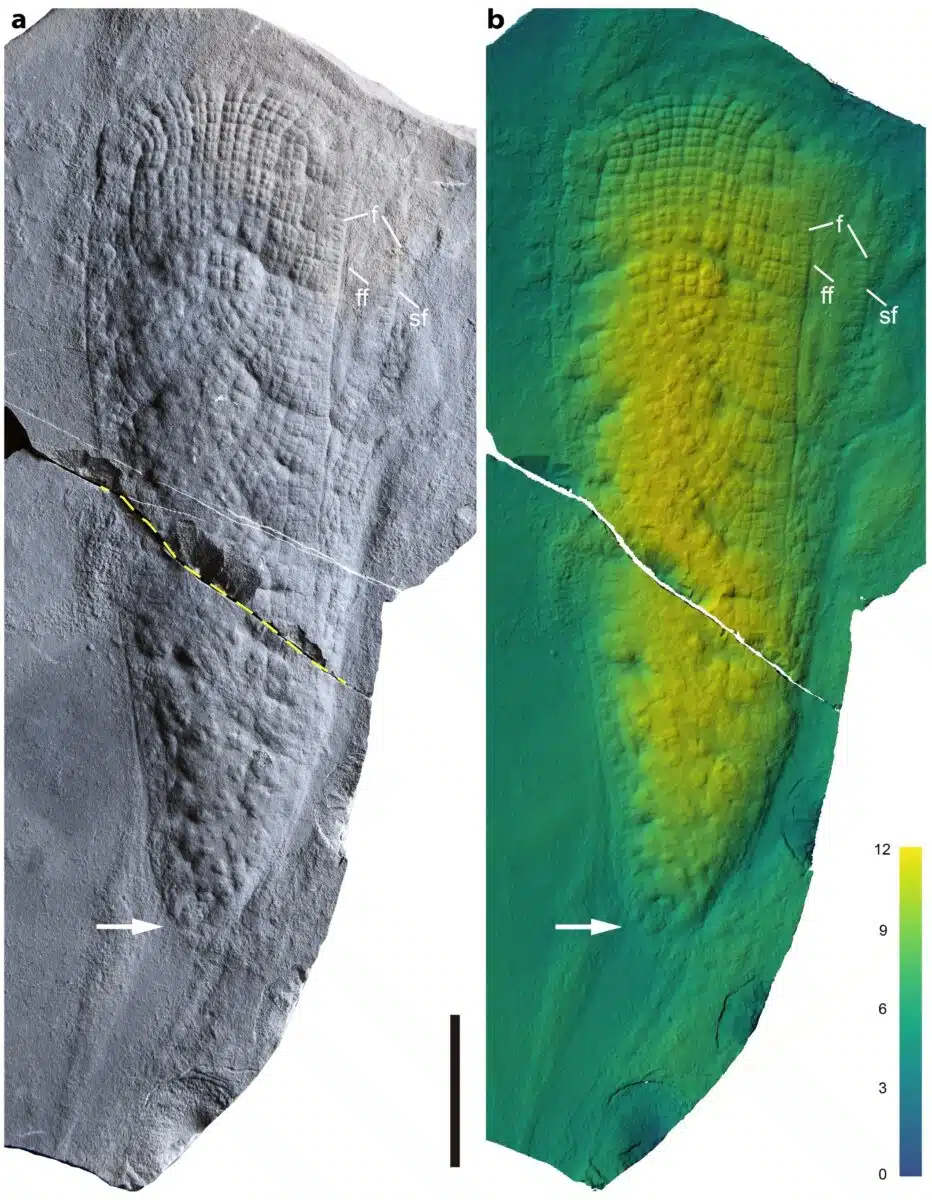 Fossil impression of an ancient sea sponge with 3D rendering highlighting surface features. Credit: Yuan Xunlai
The 160-million-year gap in the sponge fossil record was never really empty. It was populated by creatures too soft and too fragile to leave anything behind under ordinary conditions.