
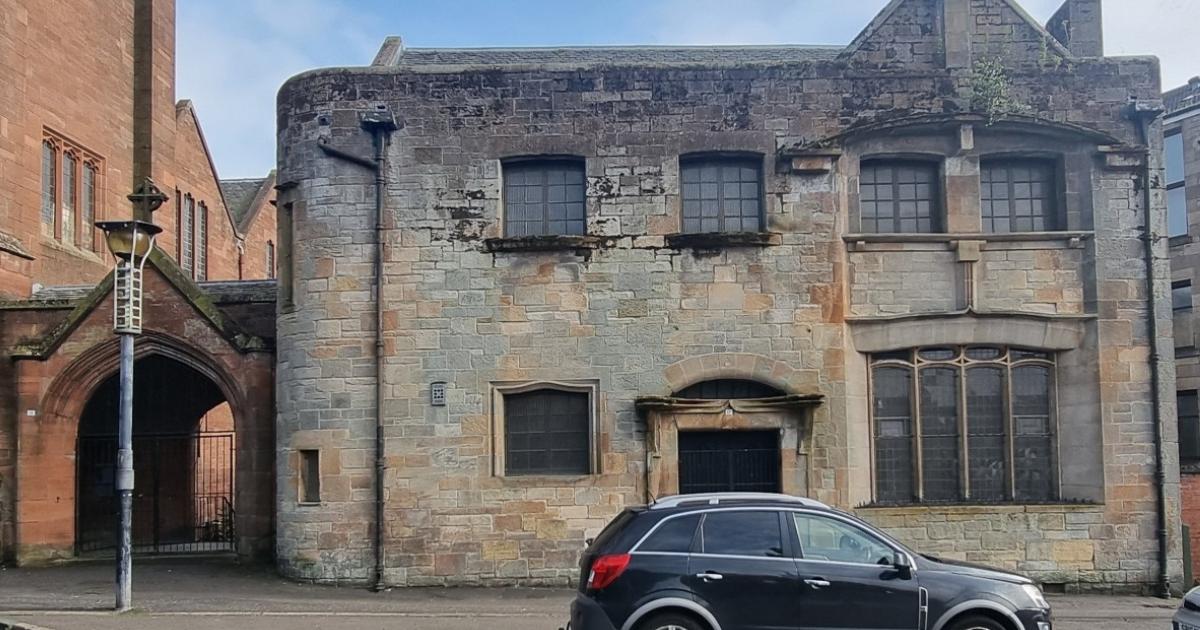
The firm described the sale as “a truly unique opportunity to acquire a ‘Rennie Mackintosh’ designed building”.
It noted various alternative uses for the block of three buildings at 15/17 Shakespeare Street – subject to planning consent – flagging as examples “residential, offices, nursery, gym etc”.
The sale included a former Hall of Worship and an adjoining former janitor’s house, both designed by Mackintosh and Grade A Listed, alongside a red sandstone former Church building which is Grade ‘B’ Listed.
READ MORE:
Restoration of Mackintosh masterpiece ‘at critical stage’
Lease set to be agreed for Mackintosh-designed Lighthouse building
‘Truly unique opportunity’ to buy Charles Rennie Mackintosh buildings
The Hall and janitor’s house contain a number of unique Mackintosh features, including stained glass, carved doors, wall panelling and fireplaces.
The sale followed the union of the Ruchill Kelvinside and Maryhill congregations in 2022.
On Thursday, Maryhill Ruchill Parish Church of Scotland confirmed on social media that the process of the sale of The Mackintosh Halls had been completed.
The post read: “We can announce that have handed over possession of the building to Home Church Scotland and we wish them every blessing.
“As you all know – they are a very special set of buildings. And we want to take a moment to give thanks that ‘we’ as the Church of Scotland have had the privilege of worshipping in, serving from and keeping and looking after them (as part of the rich and wonderful heritage of Glasgow). The keys were handed over on Thursday 16 April 2026.
The interior of the Mackintosh Halls in Glasgow (Image: The Church of Scotland)
“We’re so grateful to all of those who have supported us in our mission to serve the community from these spaces. There will be mixed feelings about this – a sense of loss, the challenge of change, and the hope of a new start – all these feelings and more we share as a community. We give thanks for all those who have used the buildings, for the lives changed, for the hope offered, for the grace found. We give thanks for every key holder, every property convenor, every church officer and steward of the space. We give thank for the Elders of Westbourne Parish Church who saw the need to plant a church in this part of Glasgow just over 125 years ago. We give thanks for the amazing work of the recovery groups, the incredible legacy of the 69th Boys Brigade, the joy of the Big Buzz and youth work still fresh in the memory in the Ministry of my father and all those who gathered here before and after.
“Our hope as we set out to transfer the ownership of the buildings was to ensure that they were used by the community and for the community and we believe that the outcome is as good as we could have hoped for, with the buildings remaining in use as a church and continuing to be used for their intended purpose. We are also pleased to welcome a new church into our community to serve and to work alongside. We have enjoyed working in partnership with all the local churches for as long as any of us can remember and would hope that this relationship is just as positive.”
The Charles Rennie Mackintosh hall and janitor’s house were completed in 1899. The red sandstone adjoining church was designed by Neil Campbell Duff and completed in 1905. These buildings are linked by a red sandstone, Gothic-designed archway.
Speaking in August last year, Stuart Robertson, then director of the Charles Rennie Mackintosh Society, reflected on how the Halls were designed at the start of Mackintosh’s creative period.
He said: “The Ruchill Church Halls display Mackintosh’s trademark style and his art nouveau motifs are scattered throughout the building.
“With stained glass windows and flower patterns etched in the doors, the design resembles that of the Art School.
“Ruchill was designed at the start of Mackintosh’s extraordinary creative period from 1895-1906, which includes nearby Queen’s Cross Church (1897-9), The Glasgow School of Art (1897–9), the Arts and Crafts Exhibition in London and his first work for Miss Cranston.
“The buildings of Charles Rennie Mackintosh form a major component in the nation’s cultural heritage and are celebrated internationally.”
In 2025, a former school designed by Mackintosh was sold off by Glasgow City Council to the Bishops’ Conference of Scotland to be used as a public museum of Scottish Catholic archives, housing artworks and artefacts.
The Martyrs’ School is located on Parson Street in Townhead, on the same street where Mackintosh was born in 1868.
It was designed by Mackintosh for the School Board of Glasgow when he was an assistant at Honeyman and Keppie architectural firm.