
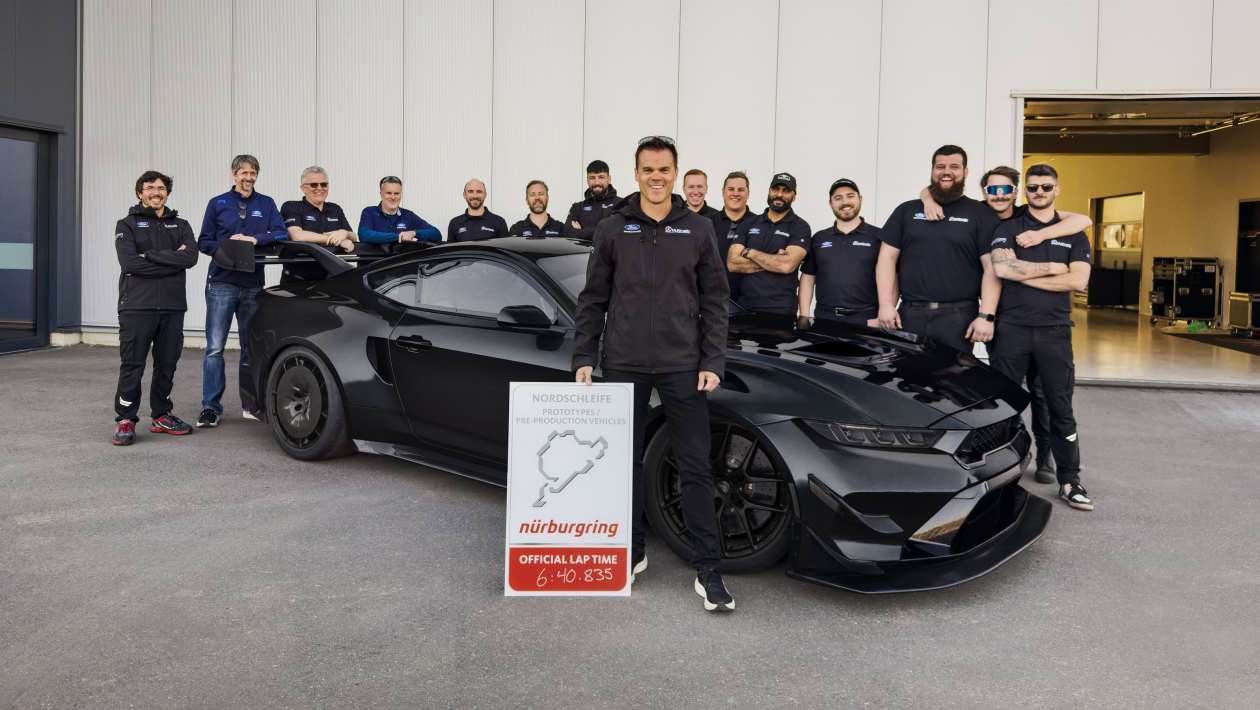
While order books for the ordinary Mustang GTD had already closed, Ford is opening them back up again for the Competition model, albeit for a ‘very limited’ number of customers and just like the standard car, it’s confirmed that it will be sold as a street-legal model.
Ford Mustang GTD powertrain
The GTD is a road-legal Mustang production car like no other. It’s based on the Mustang GT3 racing car (making the GTD a road car developed from a racing car, which itself is an extreme development of the Mustang Dark Horse production car), and features carbonfibre bodywork, active aerodynamics, a bespoke re-engineered rear end and transaxle transmission. Its 5.2-litre supercharged V8 develops 815bhp in standard-form – more than a McLaren Senna GTR – and a 664lb ft peak torque figure. Top speed is stated to be 202mph.
The V8 is a development of the one found in the previous-generation Mustang GT500, though its 7650rpm rev limit is 100rpm higher than before – the Competition takes this higher still. It features a revised intake and exhaust – the latter made from titanium as standard – as well as a smaller supercharger pulley and a dry-sump oil system.
The GTD – which stands for ‘GT Daytona,’ the name of the GT3-equivalent class in the IMSA sportscar championship in North America – is the fruit of a joint development project between Ford’s and Multimatic, which has also engineered the Mustang GT3 racer. Production of the standard car was capped at 1000 units, with every car costing its buyer from £315,000.
Supercharging is banned in GT3 racing, and the GTD takes advantage of the lack of regulations in other ways too, including semi-active suspension and active aerodynamics. That 202mph top speed is aided in part by the GTD’s drag reduction system, which can stall the rear wing, as well as flaps under the front of the car. In place of a practical boot space is the GTD’s semi-active DSSV (Dynamic Suspensions Spool Valve) Multimatic suspension and transaxle cooling system, similar to the system introduced on the Ford GT. The Ferrari Purosangue also makes use of a development of Multimatic’s DSSV dampers. The GTD’s hydraulically controlled system can alter ride height by almost 40mm on the fly, with the driver also able to adjust spring rate to suit the conditions. There’s even a neat window where the rear seats would usually be, putting its high-tech suspension proudly on display.
Chassis
On the front axle, Multimatic has opted for unequal-length wishbones to aid lateral stiffness. The multi-link rear suspension uses a pushrod and rocker arm architecture, arranging its trick inboard shock absorbers and springs in a horizontal cross pattern.
Advertisement – Article continues below