
Tom Holert
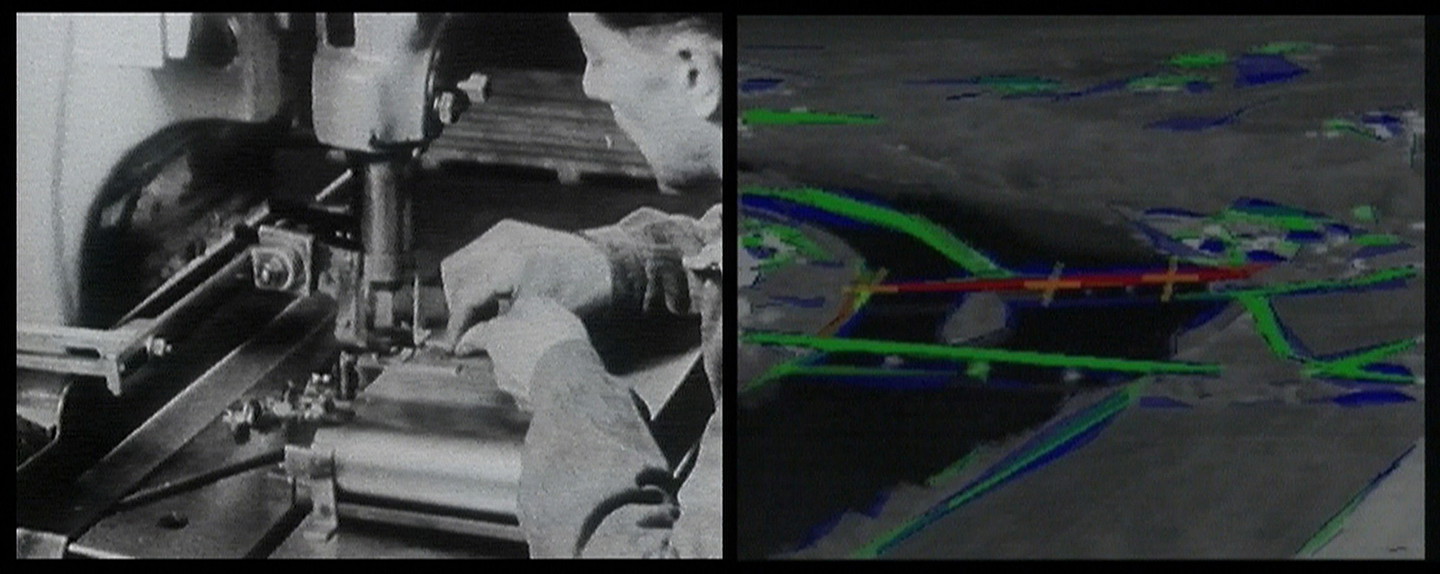
Harun Farocki, Eye/Machine I, film still, 2001. Copyright: Harun Farocki GbR.
Notes
1
Erika Balsom and Harun Farocki, “The New Constructivism: Erika Balsom and Harun Farocki Discuss Parallel I–IV” (2014), in Harun Farocki: Programando o Visível, ed. Jane de Almeida, Priscila Arantes, and Patrícia Moran (CinUSP, 2017), 130.
2
Harun Farocki and Hartmut Bitomsky, Die Teilung aller Tage (1970), in Eine indexikalische Spur: Nachträge und Register (Schriften, vol. 7), ed. Volker Pantenburg with Gerti Fietzek (Harun Farocki Institut, n.b.k., and Verlag der Buchhandlung Walther und Franz König, 2026), 10. My translation.
3
Since he coined it over twenty years ago, the scholarship on the term “operational images,” on Farocki’s deployment of it in writing and audiovisual work, and on its application to current developments in machine vision and algorithmic governance and warfare have continued to evolve. In the following I am indebted to the research by Nora M. Alter, Hannes Bajohr, Martin Blumenthal-Barby, Christoph Brunner, Jimena Canales, Jan Distelmeyer, Ariana Dongus, Anthony Downey, Jake Goldenfein, Aud Sissel Hoel, Ingrid Hoelzl, Rosemary Lee, Rui Matoso, Roland Meyer, Trevor Paglen, Volker Pantenburg, Jussi Parikka, Rebecca Uliascz, and others.
4
Harun Farocki, “Der Krieg findet immer einen Ausweg” (2003/2005), in Harun Farocki, Lerne das Einfachste! Texte 2001-2014 (Schriften, vol. 6), ed. Volker Pantenburg (Harun Farocki Institut, n.b.k., and Verlag der Buchhandlung Walther und Franz König, 2022), 140; an English translation by Brian Poole, titled “Phantom Images,” first appeared in Public: Art, Culture, Ideas, no. 29 (Spring 2004). I deviate slightly from this translation here.
5
Paul Virilio, The Vision Machine (1988), trans. Julie Rose (British Film Institute and Indiana University Press, 1994), 59–60.
6
Harun Farocki, “The Industrialization of Thought,” trans. Peter Wilson, Discourse: Journal of Theoretical Studies in Media and Culture 15, no. 3 (Spring 1993); also included in Harun Farocki, Unregelmäßig, nicht regellos: Texte 1986–2000 (Schriften, vol. 5), ed. Tom Holert (Harun Farocki Institut, n.b.k., and Verlag der Buchhandlung Walther und Franz König, 2021).
7
Harun Farocki, “Dankesrede,” in Eine indexikalische Spur (Schriften, vol. 7), 60. My translation.
8
For an important theorization of the “invisuality” of operational images, see Jussi Parikka, Operational Images. From the Visual to the Invisual (University of Minnesota Press, 2023), 22–24.
9
Serge Daney’s writings became well known to Farocki through his friendship with Christa Blümlinger and Raymond Bellour, close allies of the legendary film critic (who passed away in 1992), but also because Daney and Farocki were both featured in Politics/Poetics, the publication accompanying Documenta X (1997), the former with his 1991 essay “Before and After the Image.” (More on how Daney’s essay informed Farocki’s concept of operational images below.)
10
For more on the latter, see my forthcoming Kunst und Politik zur Einführung (Junius, 2026).
11
Roland Barthes, “Myth Today,” in Mythologies (1957), trans. Richard Howard and Annette Lavers (Hill and Wang, 2012), 254. Barthes’s model case of “a total critique” was “the simultaneously formal and historical, semiological and ideological description of the sacred” in Jean-Paul Sartre’s Saint Genet (see “Myth Today”).
12
Barthes, “Myth Today,” 255. On Barthes’s anti-Stalinist position in the years prior to the publication of Mythologies, see Andy Stafford, “‘L’histoire ne pourra jamais marcher contre l’histoire’: Roland Barthes et l’antistalinisme, 1946–1953,” Littérature, no. 186 (June 2017).
13
Harun Faroqhi (sic), “Der tägliche Mythos,” Spandauer Volksblatt, May 16, 1965, 22. Reprinted in Harun Farocki, Meine Nächte mit den Linken: Texte 1964–1975 (Schriften, vol. 3), ed. Volker Pantenburg (Harun Farocki Institut, n.b.k., and Verlag der Buchhandlung Walther König, 2018). Translated by Ted Fendt as “Everyday Myth,” Grey Room, no. 79 (Spring 2020).
14
Farocki, “Der Krieg findet immer einen Ausweg,” 140.
15
Michel Foucault, interviewed by Gérard Raulet, “Structuralisme et poststructuralisme,” Telos 16, no. 55 (Spring 1983). Translated as “How Much Does It Cost for Reason to Tell the Truth?” in Foucault Live: Collected Interviews, 1961–1984, ed. Sylvère Lotringer, trans. Lysa Hochroth and John Johnston (Semiotext(e), 1996), 348.
16
Devin Fore, Soviet Factography: Reality without Realism (University of Chicago Press, 2024), 79. Fore’s monograph and his publications preceding it represent the most advanced research and writing on the subject of factography and “operativism,” thanks in part to their precision regarding the genealogies of vocabulary and conceptual frameworks. They point out that even if “Tret’iakov popularized operativism in the West, and he certainly thought through its poetological consequences more rigorously than any of his contemporaries, … he hardly invented the phenomenon” (127).
17
Two different versions of the radio script for the Sender Freies Berlin program (broadcast June 26, 1965) are located at Farocki’s private archives in Berlin, courtesy of Antje Ehmann.
18
Barthes, “Myth Today,” 258–59, emphasis in original.
19
Barthes, “Myth Today,” 259, emphasis in original.
20
Barthes, “Myth Today,” 261.
21
Barthes, “Myth Today,” 261.
22
Umberto Eco, A Theory of Semiotics (Indiana University Press, 1976), 7.
23
Charles J. Stivale, “Mythologies Revisited: Roland Barthes and the Left,” Cultural Studies 16, no. 3 (2002): 465.
24
See, e.g., Sven Spieker, Art as Demonstration. A Revolutionary Recasting of Knowledge (MIT Press, 2024), 85–107.
25
See Tom Holert, “Tabular Images: About The Division of all Days (1970) and Something Self-Explanatory (15 x) (1971),” in Harun Farocki: Against What? Against Whom?, ed. Antje Ehmann and Kodwo Eshun (Koenig Books, 2009); and Nora M. Alter, Harun Farocki: Forms of Intelligence (Columbia University Press, 2024), 57–66.
26
“However, there is a better, more positive criterion for evaluating books on class struggle in the Third World: the formula: informative literature–operative literature. Informative literature can inform about anything, and anything can follow from it. Operative literature has ideas about the consequences of the information it provides. In the case of Guatemala, operative literature should help the reader learn something about Guatemala and learn something for Guatemala … Operative literature should analyze the reasons for this and ask: Does Guatemala City have a different significance in Guatemala’s agricultural economy than Havana had in Cuba? It should examine whether the privilege of permanent work in Latin America implies a different form of struggle for the proletariat. It should take its analyses so far as to help the revolution in its struggle against the United Fruit Company, rather than merely describing it.” Franz Putz (Harun Farocki), “Revolution für den Konsum? Vom Anspruch an die Information über Lateinamerika,” Die Zeit, no. 49 (December 6, 1968): 53. Reprinted in Farocki, Meine Nächte mit den Linken (Schriften, vol. 3). My translation.
27
Originally published as Harun Farocki, “die agitation verwissenschaftlichen und die wissenschaft politisieren,” film, no. 3 (March 1969). Reprinted in Farocki, Meine Nächte mit den Linken (Schriften, vol. 3), 63.
28
The first new translations of theoretical texts by Tretyakov appeared in 1971 in the Frankfurt journal Ästhetik & Kommunikation: Beiträge zur politischen Erziehung (Aesthetics & Communication: Contributions to Political Education), and in 1972 the collection Die Arbeit des Schriftstellers (The Work of the Writer), edited by the West German literary scholar Heiner Boencke, was published, as well as Lyrik Dramatik Prosa, edited by East German Slavic scholar Fritz Mierau.
29
Heiner Boencke, “Nachwort,” in Sergei Tretjakov, Die Arbeit des Schriftstellers: Aufsätze— Reportagen—Porträts, ed. Heiner Boencke (Rowohlt, 1972), 211. Concerning Tretyakov’s reception in West Germany, see also Eduard Jan Ditschek and Ewald Schürmann, “Die Zeitschrift Ästhetik und Kommunikation und die Tretjakov-Rezeption der Neuen Linken in der BRD: Interview mit Eberhard Knödler-Bunte (2014)” →; and Eduard Jan Ditschek, “Ein Schriftsteller der Übergangsgesellschaft: Die Tretjakow-Rezeption der Neuen Linken in der BRD,” lecture, University of Zurich, Slavisches Seminar (2014) →.
30
A more intensive examination of the history and prehistory of operations research as a potential context for Farocki’s and other cultural producers’ interest in the trope of “operativity” has to be saved for another occasion. A few references can be found in Parikka, Operational Images, 31–33. Other current overviews of this episode in the history of science, military, and management theory include, e.g., Alexander A. Pechenkin, “Operationalism as the Philosophy of Soviet Physics: The Philosophical Backgrounds of L. I. Mandelstam and His School,” Synthese 124, no. 3 (September 2000); Richard Vahrenkamp, “Mathematical Management: Operations Research in the United States and Western Europe, 1945–1990,” Management Revue 34, no. 1 (2023); and Fotios Petropoulos et al., “Operational Research: Methods and Applications,” Journal of the Operational Research Society 75, no. 3 (2024).
31
Harun Farocki, “Primär-Kommunikation und Sekundär-Kommunikation,” film, no. 11 (December 1969). Reprinted in Farocki, Meine Nächte mit den Linken (Schriften, vol. 3), 91. My translation.
32
On this project with the working title “Moving Bodies,” see Erika Balsom’s excellent essay “Moving Bodies: Captured Life in the Late Works of Harun Farocki,” Journal of Visual Culture 18, no. 3 (2019).
33
Roland Barthes, “Rhétorique de l’image,” Communications, no. 4 (1964). Translated by Richard Howard as “Rhetoric of the Image,” in Barthes, The Responsibility of Forms: Critical Essays on Music, Art, and Representation (Hill and Wang, 1985), 31. The first German translation, “Rhetorik des Bildes,” was published in the leftist West Berlin–based journal alternative, no. 54 (1967).
34
Barthes, “Rhetoric of the Image,” 31–32, emphasis in original.
35
Sergei Tretyakov, “Obrazoborchestvo,” Novyi Lef, no. 12 (1928): 43. Quoted from Fritz Mierau, Erfindung und Korrektur: Tretjakows Ästhetik der Operativität (Akademie-Verlag, 1976), 172. My translation.
36
Harun Farocki, “Auge/Maschine: Kurztexte” (2004), in Lerne das Einfachste! (Schriften, vol. 6), 96. My translation.
37
Harun Farocki, “Erkennen und Verfolgen” (2004), in Lerne das Einfachste! (Schriften, vol. 6), 112. My translation.
38
Farocki, “Der Krieg findet immer einen Ausweg,” 142.
39
Farocki, “Kein Bild das traf—oder: Fernsehbomben” (2003), Lerne das Einfachste! (Schriften, vol. 6), 58.
40
Nicolas Malevé, “The Computer Vision Lab: The Epistemic Configuration of Machine Vision,” in The Networked Image in Post-Digital Culture, ed. Andrew Dewdney and Katrina Sluis (Routledge, 2022).
41
Daney’s reflections on the ontological shifts in visual culture, as observed in the image politics of the Second Gulf War, can be traced throughout Farocki’s theorization of operative images. For a long quotation, see, for example, Farocki, “Kriegstagebuch” (2003), in Lerne das Einfachste! (Schriften, vol. 6), 70. At the Duisburger Filmwoche 24 in 2000, Farocki discussed Von der Welt ins Bild: Augenzeugenberichte eines Cinephilen, a collection of essays by Daney, edited by Christa Blümlinger (Vorwerk 8, 2000), together with Blümlinger, Thomas Elsaesser, and Bert Rebhandl →.
42
Serge Daney, “Avant et après l’image,” Revue d’études palestiniennes 3, no. 40 (1991). Translated by Melissa McMahon as “Before and After the Image,” Discourse 21, no. 1 (Winter 1999), 189, emphasis in original. A German translation (to which Farocki had access, as stills from his and Andrei Ujica’s Videograms of a Revolution, 1992, were printed in the same section of the book) was prominently featured in Poetics/Politics: Das Buch zur documenta X, ed. Catherine David and Jean-François Chevrier (Cantz, 1997).
© 2026 e-flux and the author