
Ever dreamt of being present during the birth of the first galaxies? Perhaps being able to fast-forward through billions of years of cosmic evolution to watch those galaxies grow and shape the universe we know today? Of course, that sadly isn’t possible. But thanks to a revolutionary new and unique audiovisual simulation of “virtual universes,” scientists have developed the best picture of cosmic evolution to date, and you too can see and hear it!
You may like
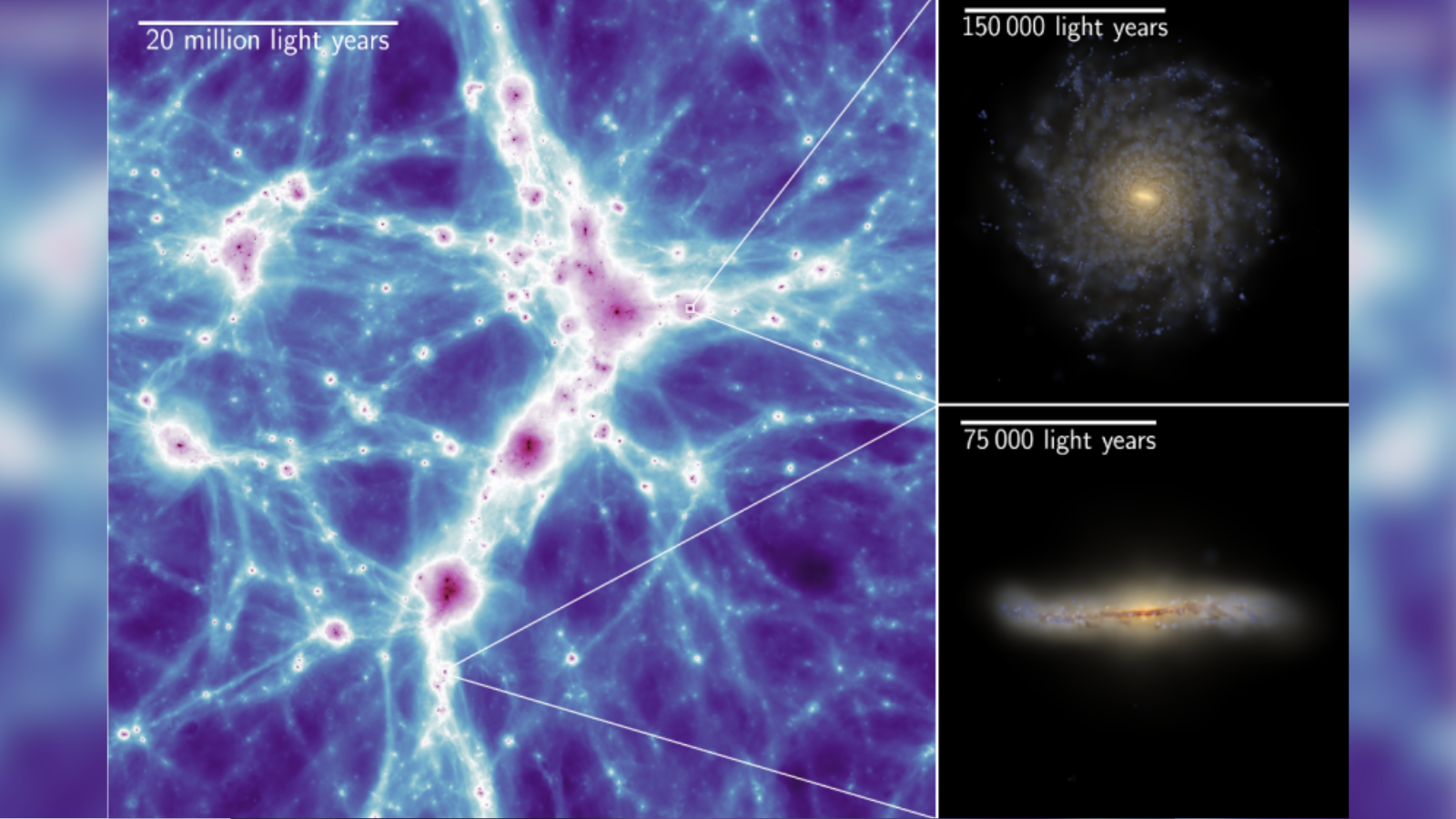
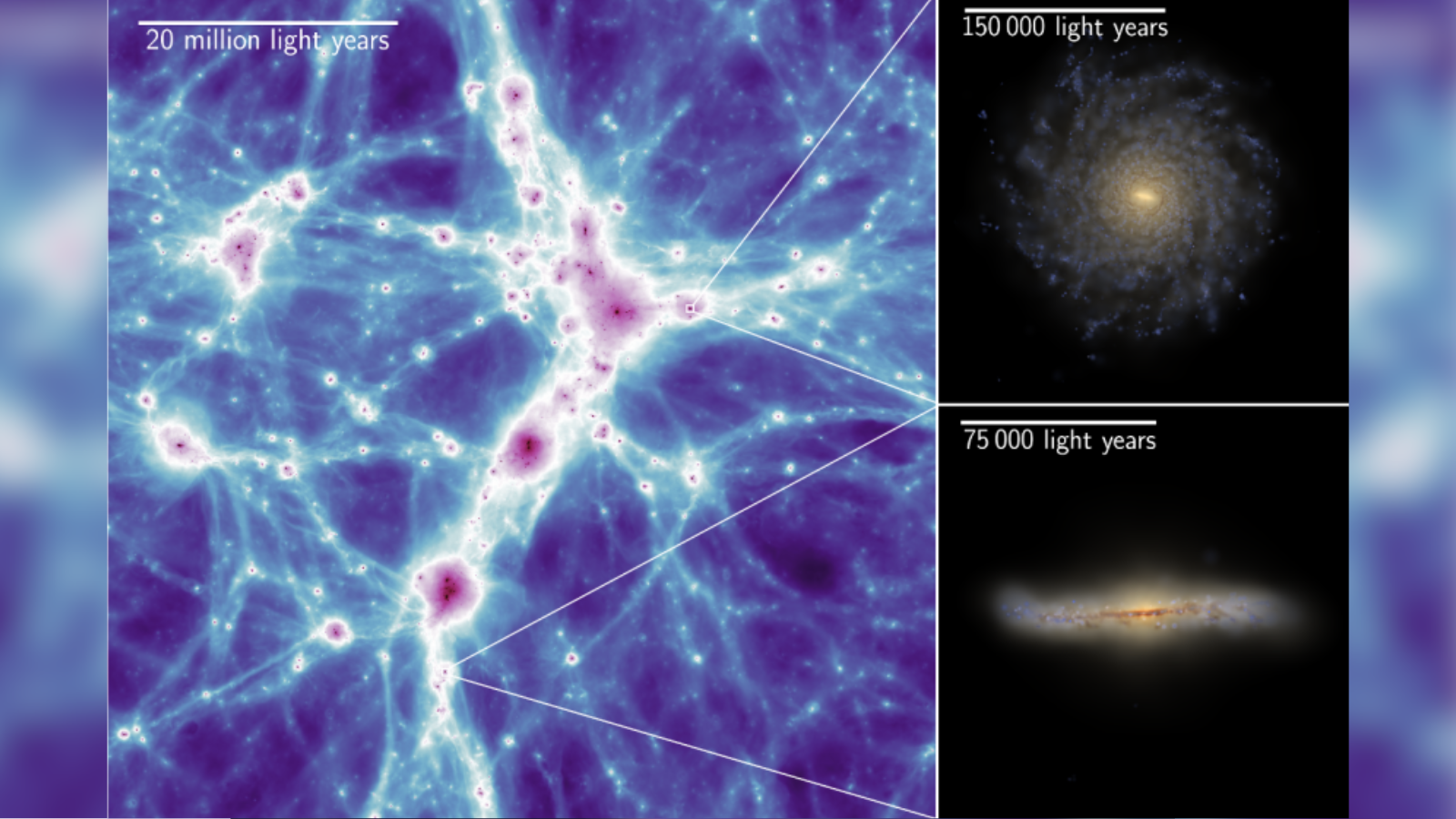
(Left) The so-called cosmic web, where the color encodes the projected density of gas and stars. (Right) Two of the many galaxies formed in the simulations seen face-on (top) and edge-on (right). (Image credit: Schaye et al. (2026))
“It is exhilarating to see ‘galaxies’ come out of our computer that look indistinguishable from the real thing and share many of the properties that astronomers measure in real data, such as their number, luminosities, colors and sizes,” COLIBRE team member Carlos Frenk said in a statement. “I like to tease my observer colleagues by asking, ‘Which galaxy catalogue do you think these images came from?’ What is most remarkable is that we are able to produce this synthetic universe purely by solving the relevant equations of physics in the expanding universe.”
The simulation runs on the COSMA8 supercomputer at Durham University, and has overcome a challenge that others have found insurmountable: the modeling of cold gas. But difficulty with such modeling was a problem because stars form when cold gas and dust collapse under their own gravity — to accurately simulate stars, you need to be able to accurately simulate cold gas movements. COLIBRE was also able to simulate small dust grains and their impact in helping form hydrogen molecules and blocking ultraviolet light that would prevent gas from cooling and birthing stars.
“Much of the gas inside real galaxies is cold and dusty, but most previous large simulations had to ignore this,” COLIBRE leader Joop Schaye, of Leiden University in the Netherlands, said in the statement. “With COLIBRE, we finally bring these essential components into the picture.”
Yet, as good as the synthetic universes are, there is still one cosmic puzzle the JWST has unveiled that they can’t answer. Those are the so-called “little red dots” this instrument has been seeing in abundance during one period of cosmic time.
That could be because these enigmatic objects – which appear in vast numbers 600 million years after the Big Bang but disappear after the universe is around 1.5 billion years old — are heavy black hole seeds.
Though most of the simulations were completed in 2025, some are still running, and the data they have already delivered will take years to analyze.
“We’re excited not just about the science, but also about creating new ways to explore it,” James Trayford, of the University of Portsmouth, U.K., who led the development of COLIBRE’s dust model and the sonification of its visualizations, said in the statement. “These tools could provide new insights, make our field more accessible, and help us build intuition for how galaxies grow and evolve.”
The COLIBRE research was published on Monday (April 13) in the journal Monthly Notices of the Royal Astronomical Society.