
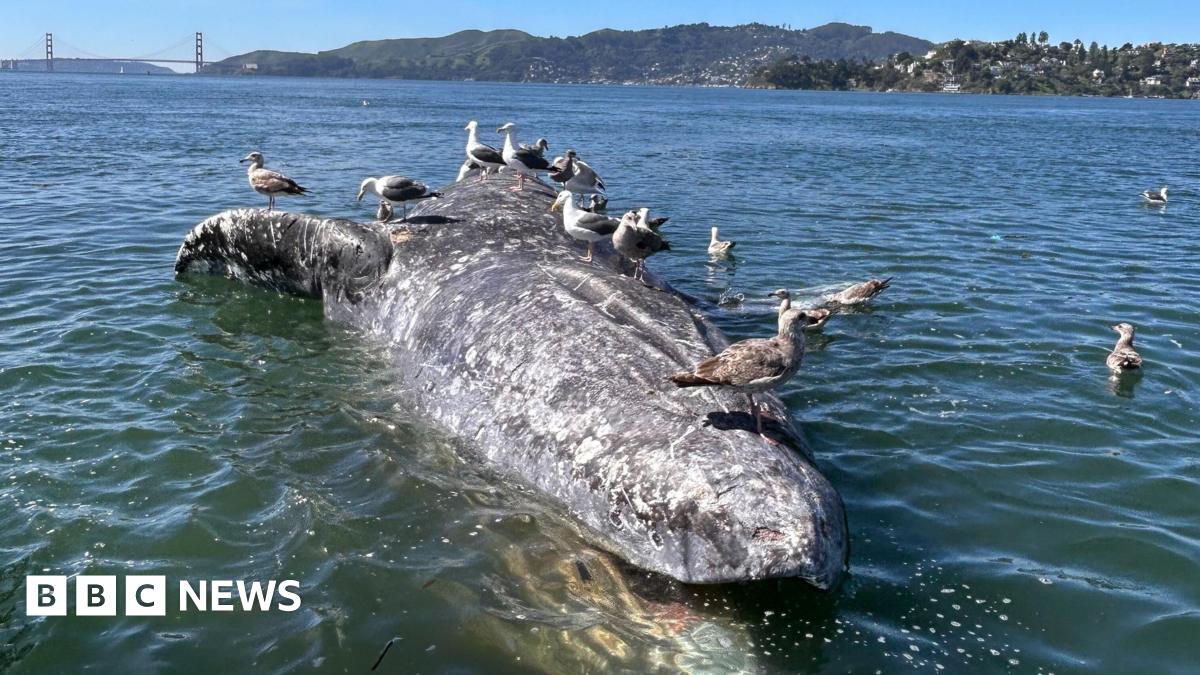
Many of those that turned up in the bay are adult and juvenile males that are heading to the Arctic. Notably, the whales observed are skinnier than they normally would be at this time of year, Slaathaug and several other researchers tell the BBC.
“They don’t have the energy reserves necessary to complete the entire migration back to the Arctic, so they may be driven into the bay by hunger,” she said.
Dead or dying gray whales have also cropped up in Washington state and Oregon. Although they weren’t included in Slaathaug’s study, researchers believe changes in their behaviours could be related.
While a lack of food may be driving whales into the bay, it’s not necessarily starvation that’s killing them. In recent years, nearly one-fifth of the gray whales that have swum into the San Francisco Bay have died there, usually after being struck by ships, according to Slaathaug’s study published in the journal Frontiers in Marine Science, external this week.
Slaathaug’s study examined hundreds of photographs of whales and carcasses found in the bay since 2018. Her team described “a very concerning high rate of death in San Francisco Bay” that continued to grow in 2025, with whales in the bay highly susceptible to vessel strikes.
Still, researchers say the factors that lead to these deaths are worth exploring. The bay is offering a rare opportunity to better understand migratory patterns and how climate change is shifting routes and food supplies.
“It’s sad to see a dead whale. It’s sadder to see a dead whale that you may have recognised from studying that particular whale. But there’s also a lot that we can learn,” said Kathi George, whose team assisted Slaathaug with her research and several necropsies – animal autopsies.
Whales, she said, can be harbingers of bigger changes under the surface of the ocean.
That the whale sightings and strandings have begun earlier in the season this year – beginning with two in January when peak numbers are usually in April – is a cause for concern, indicating that the creatures are in more trouble than initially thought.