

A Neanderthal infant who lived more than 50,000 years ago reached the physical size of a modern toddler in just six months. The discovery, based on a highly complete skeleton, points to a rapid growth pattern in early life.
The fossil, called Amud 7, was found in a cave near the Sea of Galilee and dates back between 51,000 and 56,000 years. Reconstructed from 111 bone fragments, gave to scientists a detailed look at Neanderthal infancy, a stage rarely preserved in the archaeological record.
Growth rates influence energy needs, parental care, and adaptation to climate. In this situation, the findings suggest a faster start to life in a demanding environment.
A Six-Month-Old With Unexpected Proportions
Scientists determined the infant’s age primarily through dental analysis. Growth lines in the enamel and the stage of tooth eruption indicate an age of about 5.5 to 6 months. According to New Scientist, only the two lower milk teeth had begun to emerge at the time of death.
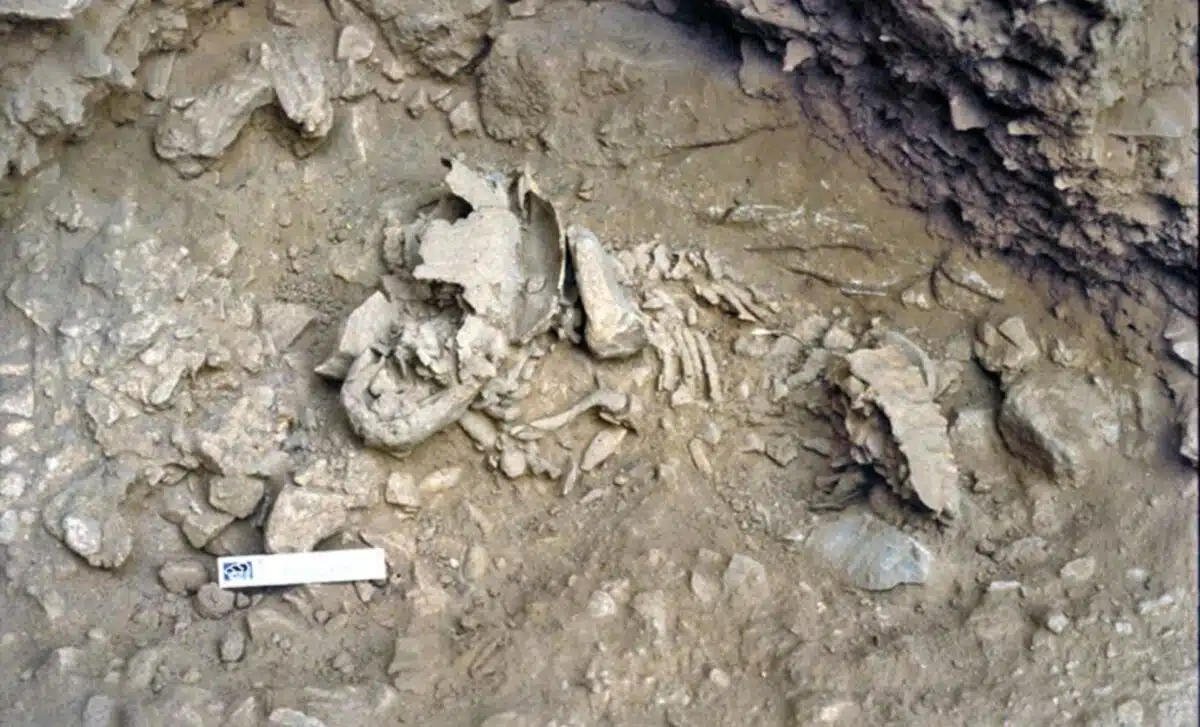 The Amud 7 skeleton. Credit: Yoel Rak
The skeleton presents a different picture. The infant’s long bones match those of a modern human child aged roughly 12 to 14 months, and its brain volume, around 880 cubic centimeters, fits the same range.
And as reported in a study published in Current Biology, researchers describe this discrepancy as an “age paradox,” where dental and skeletal development do not align.
Distinct Features From Early Months
The reconstructed remains clearly show classic Neanderthal traits. These include robust bones, a large endocranium, and specific shoulder and limb orientations. Researcher Ella Been explained that the presence of these features so early suggests they are biologically determined rather than shaped by external factors.
“There are some notable differences: robust bones, a large endocranium, no chin, a highly curved clavicle, a superior inclination of the scapular spine, an inferior orientation of the glenoid cavity, and a relatively short tibia.” She added,“The fact that these differences appear so early in life indicates that Neanderthal morphology is deeply rooted in their biology, and not shaped by the environment or behavior.”
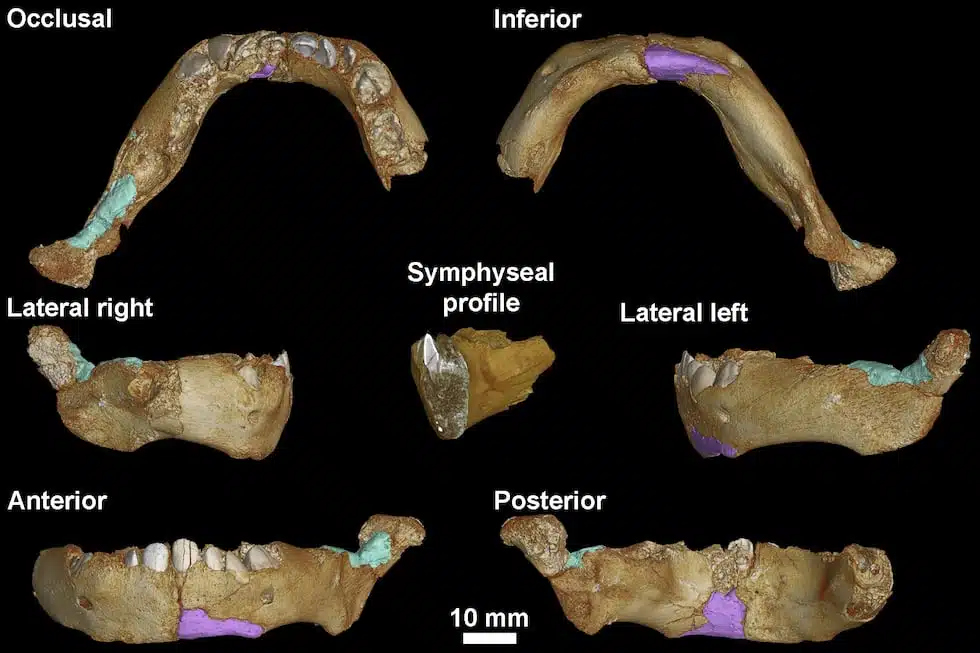 Amud 7 Neanderthal infant jaw reconstruction from multiple angles with highlighted fragments. Credit: Ella Been
This early difference suggests they followed a distinct growth pattern from birth. Neanderthals likely experienced faster physical and brain development during the first years of life.
Rapid Growth Fueled by Early Diet Changes
Such accelerated development required substantial energy. Evidence from previous studies of Neanderthal teeth shows that infants began consuming solid foods at around five to six months. As noted in the study cited in the source, this timing is similar to how modern humans wean their infants and reflects the growing brain’s increasing energy needs.
“I think Amud 7 is closer to 6 months old,” Been tells New Scientist. “I believe that the histological age of the teeth is more accurate than age measured by the volume of the long bones or the endocranial cavity for estimating such a young age.”
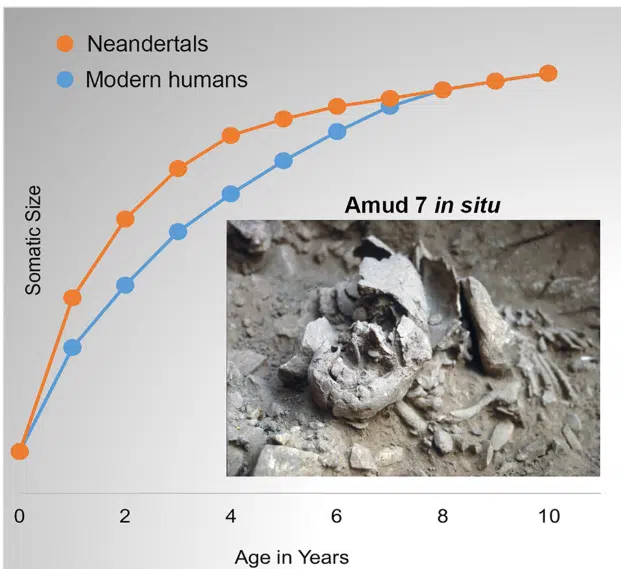 Neanderthal and modern human growth curves with Amud 7 fossil. Credit: Current Biology
The pattern seen in Amud 7 isn’t unique. Other Neanderthal children, including Dederiyeh 1 and Roc de Marsal, show the same kind of growth. As quoted in New Scientist, observing this pattern across several individuals suggests that rapid early growth was typical of the species, not just a one-off. Still, some uncertainties remain. As Been pointed out:
“We cannot say how advanced Neanderthal babies were in their behaviour. We do not know whether they started walking at a different time than modern human babies do.”