
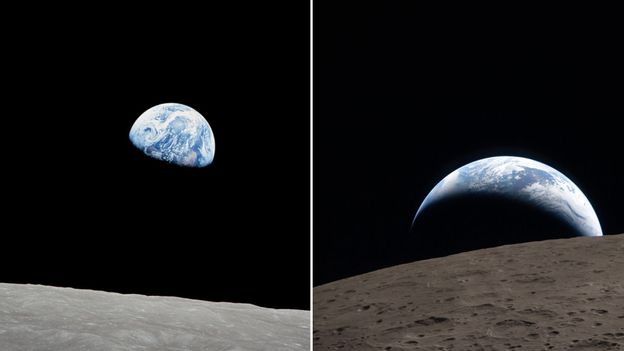
Some of that change can even be seen in the images themselves, even though the Earth is shrouded in cloud.
“Although they’re of different parts of the Earth, the one thing that does show up in both images, although you’re looking at different parts of it, is Antarctica and the Southern Ocean,” says Benjamin Wallis, a glaciologist at the University of Leeds in the UK. “The Antarctic Peninsula is one of the most rapidly warming parts of the Earth and 28,000km of ice shelf have collapsed in between the original image and the latest image.”
Studies suggest these changes in the ice around Antarctica are unprecedented in the last 10,000 years. Other areas of the Earth where water exists in a solid form – known as the cryosphere – have been similarly affected.
“We really have seen some dramatic changes,” says Petra Heil, director of science at the British Antarctic Survey. “We have now seen in both hemispheres a dramatic decrease in the seasonal sea ice cover, and in North America, Eurasia and Asia, we have seen much later seasonal snow cover, and we also see it melting earlier.”
“I think we are pretty confident based on the observations but also the numerical models to assign probably 90-95% of the change to human activities,” Heil says.
But while all this might make for grim reading, it’s worth remembering that in 1968 – despite appearances from deep space – we had already caused damage to the planet.
More like this:
• The images showing 50 years of change on Earth
• Mercury to Artemis: The evolution of mission control
• The astronaut school inside a Swiss mountain
“[Earthrise] left many people enthralled with the idea of how beautiful the Earth was and how much damage was being done,” says Kathleen Rogers, president of the Earth Day network. “I remember at the time you couldn’t see across the street in LA at rush hour because of smog and our rivers were on fire.”
“From so far away, the Earth looks so perfect and so beautiful and then as you drew closer, you could see the ravages of 150 years of, let’s call it, progress,” says Rogers. “But it did inspire a generation of people to really step it up and become part of a movement.”
Borman died in 2023, but the legacy of his Apollo 8 mission still endures and his words are just as relevant today for a new generation of lunar astronauts: “I don’t think any of us have paid any attention to the fact that we would be going all the way to the Moon and be more interested in looking at the Earth”.
—
For essential climate news and hopeful developments to your inbox, sign up to the Future Earth newsletter, while The Essential List delivers a handpicked selection of features and insights twice a week.
For more science, technology, environment and health stories from the BBC, follow us on Facebook and Instagram.