
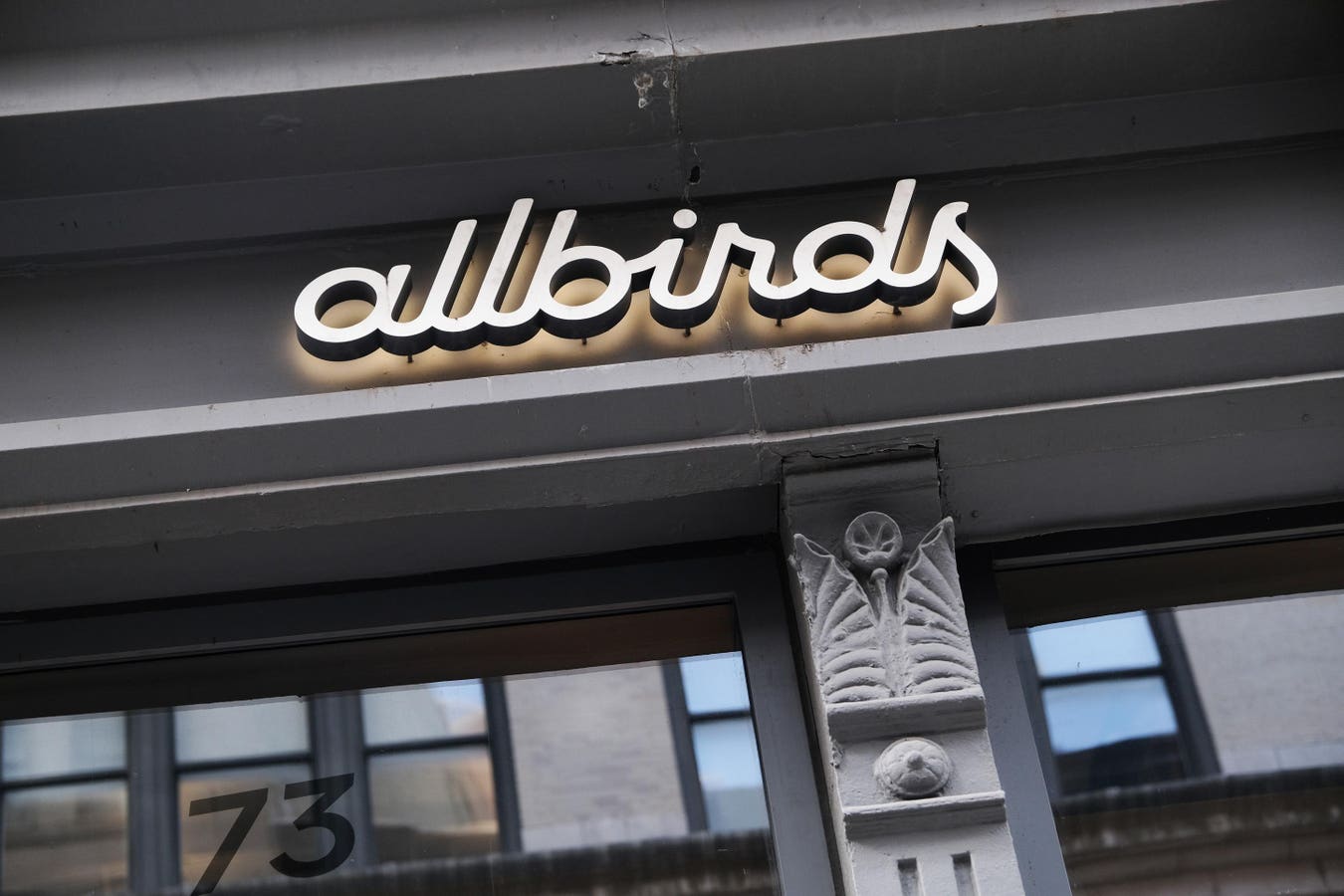
NEW YORK, NEW YORK – AUGUST 31: An exterior view of an Allbirds store, a maker of sustainable shoes, in lower Manhattan on August 31, 2021 in New York City. The shoe company has announced that it is preparing an initial public offering (IPO). The company has lost money and expects it will continue to be unprofitable for the foreseeable future. (Photo by Spencer Platt/Getty Images)
Getty Images
A week ago, Allbirds made wool sneakers. On April 15, it made people rich.
The company surged roughly 600% in a single session, from $2.49 to an intraday high of $24.30, after announcing it would sell its entire footwear business to American Exchange Group for $39 million, rebrand as NewBird AI, and pivot to leasing GPUs. The next day, the stock gave back 30 to 35%. No customers. No named partners. No hardware yet. Just a press release and a new name.
A company that two years ago held a $4 billion valuation on the back of merino wool runners, endorsed by Barack Obama and Leonardo DiCaprio, is now describing itself as a “fully integrated GPU-as-a-service and AI-native cloud solutions provider.” That is not a strategy. That is a Mad Libs.
And it is the clearest picture you will get of where the actual AI bubble lives.
How a Shoe Company Became an AI Stock In One Day
The ground under the trade is worth understanding, because the trick only works on a company this broken.
Allbirds went public in November 2021 at $15 per share and briefly traded above $4 billion in market cap. By the Tuesday before the announcement, the stock closed at $2.49 and the company was worth about $20.8 million. Revenue had fallen to $152 million on a trailing basis. Losses were $77 million. Most of the physical stores had been closed. The only thing still trading was the ticker itself.
Then came the filing. In late March, Allbirds sold the brand, the product line, the name on the shoe, everything, to American Exchange Group, an acquirer best known for reviving dormant consumer brands like Aerosoles and Ed Hardy. The price: $39 million. Two weeks later, on April 15, Allbirds announced it had lined up a $50 million convertible financing facility from an undisclosed institutional investor, placed by Chardan. The money would be used, pending shareholder approval, to buy GPUs. The company would change its name to NewBird AI. And it would ask shareholders to revoke its status as a public benefit corporation and strip environmental conservation language out of its charter, because leasing GPUs is an energy-intensive business and the B Corp commitment had become inconvenient.
That press release hit a stock with 18% to 21% of its float sold short. The shorts were right about the underlying business. They were positioned for a company whose revenue was collapsing and whose stores were papering over their windows. They were not positioned for the company to exit the business entirely and reappear as an AI infrastructure play.
When the news broke, those shorts had to cover. Covering means buying, which pushes the price up, which forces more shorts to cover, which pushes it up again. Retail piled in on top of that. More than $5 million in retail net buying flowed in during the surge, and trading volume hit 288 million shares on a company whose average daily volume was a tiny fraction of that. The 600% move was not investors rewarding a business plan. It was a mechanical short squeeze feeding on retail enthusiasm, wrapped around a press release.
And what does the press release actually describe. The company plans to use $50 million to buy high-performance GPUs and lease them to AI developers under long-term contracts. Here is what $50 million actually buys at today’s prices:
A single NVIDIA H100: $25,000 to $40,000A single NVIDIA B200: $30,000 to $70,000A fully configured 8-GPU H100 server: $200,000 to $320,000CoreWeave, which actually does this for a living, raised $1.5 billion in its 2025 IPOGlobal data center spend on AI infrastructure in 2026: over $450 billion
Spent carefully, $50 million is a few hundred GPUs. NewBird AI is bringing a squirt gun to a tank battle.
The company has disclosed no customer pipeline. No hardware procurement timeline. No named technology partners. The shareholder vote that has to approve all of this is scheduled for May 18. Until then, NewBird AI is not a company. It is a filing.
Where The Real Bubble Is Hiding
The Allbirds trade is not a weird one-off. It is the bubble showing you its face.
The public infrastructure names are not the bubble. Nvidia, Microsoft, Google, Amazon, and Oracle generate real revenue from real AI demand. Their customers are signing contracts, spending capex, and building data centers. Oracle alone is sitting on hundreds of billions in backlog. These companies are not cheap, but they are backed by documented commitments.
The bubble is one layer down, in the private venture market, where thousands of companies with “AI” in their name are valued on the premise that they will capture some piece of the AI market without owning any of the infrastructure underneath.
Graham Weaver, the founder of Alpine Investors, laid out the mechanism on a recent episode of the My First Million podcast that was specifically about which moats survive AI disruption and which do not. Weaver’s point is that most AI startups are paying rent to the foundation model providers. They build an interface or a workflow on top of an OpenAI or Anthropic or Google API, capture a thin margin on top of someone else’s intelligence layer, and call it a business. This works until the landlord adds the feature. Then the tenant has nothing.
Weaver’s firm is worth listening to on this. Alpine was ranked #1 in the 2025 HEC Paris-Dow Jones Upper Mid-Market Buyout Performance Ranking out of 695 PE firms globally and currently manages $18.8 billion in assets. His portfolio companies see pitches from these wrapper startups every week. He is not speculating. He is describing what he watches in real time.
The Distinction That Matters
The failure of rent-paying apps does not invalidate AI infrastructure. This is the part most investors miss, in both directions.
A shoe company rebranding as a GPU lessor is not the same thing as Anthropic building a model that finds 27-year-old vulnerabilities in operating systems. A wrapper startup putting a chat interface on an API call is not the same thing as GE Vernova carrying a turbine backlog that takes years to fulfill. The hype layer and the infrastructure layer are different markets with different economics, different customers, and different outcomes.
Companies like CrowdStrike, which built its entire architecture on AI from day one instead of pivoting toward it when the cycle turned, are the opposite of the Allbirds trade. They own the endpoints. They own the datasets. They have something the foundation model cannot simply absorb next quarter. That is what a moat looks like in this environment. Naming yourself after a technology you do not yet possess is not.
The Allbirds pop will not be the last one. Expect more shell-company rebrands, more announcements, more one-day moves of 500% on the news and 30% down the next morning. The bubble is real. It is just not where the headlines say it is. It lives in the private venture vault and in microcaps desperate enough to trade their environmental charter for a press release.
You do not want to own the shoe company playing dress-up in a data center. You want to own the thing it is pretending to be.