

An international team of astronomers, headed by Maltese researchers, have discovered where the edge of the Milky Way galaxy’s star-forming disc lies.
In a study published Tuesday in the international journal Astronomy & Astrophysics, they mapped the boundary of the galaxy’s star-forming disc for the first time.
By analysing the ages of over 100,000 stars, the group discovered that the bulk of our galaxy’s new star production is confined within 40,000 light-years of its centre.
Light travels at approximately 300,000 kilometres per second, which totals about 9.46 trillion kilometres in one year. This means that 40,000 light years is equivalent to approximately 378,400,000,000,000,000 kilometers away.
How they did it
The Milky Way is a massive, spiral-shaped collection of stars, gas, and dust that houses our own solar system.
For decades, defining exactly where the galaxy’s disc ends has been difficult because it does not decline abruptly but fades out gradually.
To find the limit of the star-forming disc, the researchers looked at how galaxies grow inside-out, where stars form first in the dense centre, and later in the outer reaches. This means stars get younger the further they are from the centre.
The team, however, also confirmed a reversal. At roughly 35,000 to 40,000 light-years out, the stars begin getting older again. They found that the minimum in the age pattern coincides with the point where the galaxy’s efficiency at creating new stars drops off sharply.
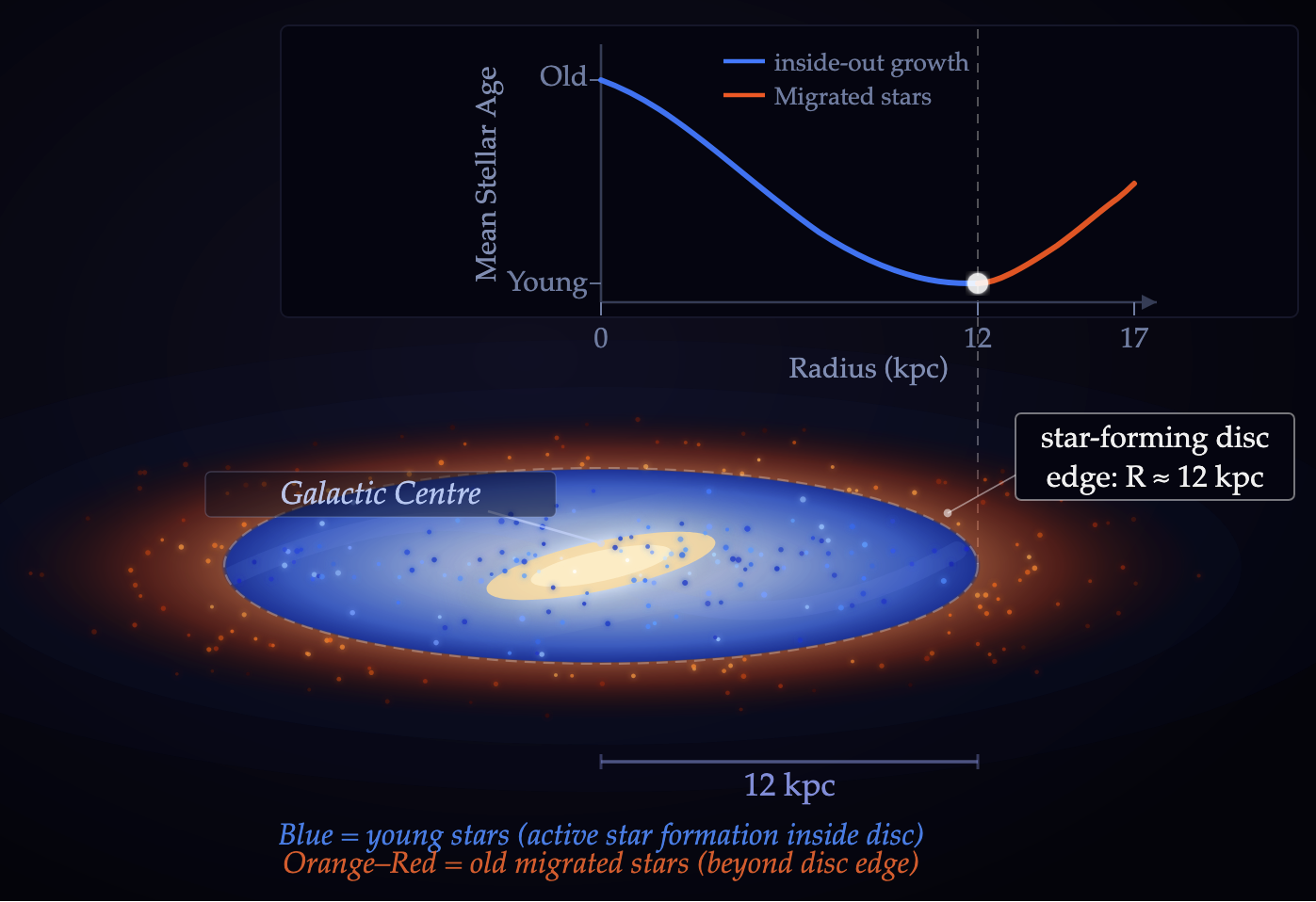 Inside the star-forming disc abundant cold gas fuels star formation, producing young stars. Beyond this break radius, star formation drops sharply. The outer regions are instead dominated by stars that formed in the inner disc and later migrated outward.
The study was led by Dr Karl Fiteni from the University of Insubria, who conducted the research during his doctoral studies at the University of Malta. In a statement on Tuesday he explained why the find is significant.
“The extent of the Milky Way’s star-forming disc has long been an open question in galactic archaeology. By mapping how stellar ages change across the disc, we now have a clear, quantitative answer,” he said.
Professor Joseph Caruana from the University of Malta, who co-authored and supervised the project, added: “The data now available allow increasingly precise stellar ages to serve as powerful tools for decoding the story of the Milky Way, ushering in a new era of discovery about our home galaxy.”
 Professor Joseph Caruana from the University of Malta supervised the study.
Mapping thousands of stars
The scientists reached their conclusions through a combination of several high-tech methods. Among them, they used data from the Gaia satellite, which has mapped around two billion objects — mostly stars — in our galaxy.
The team also compared their observations using advanced computer simulations of galaxy evolution. These simulations confirmed that the pattern is caused by older stars surfing on spiral waves and migrating outward to areas beyond the edge of the star-forming disc.
Stars born in the inner disc interact with spiral arms throughout their lifetimes. These repeated gravitational encounters gradually push them outward, causing them to migrate into the outer disc regions beyond the star-forming edge.
They also verified that these distant stars move in nearly circular orbits, proving they were born within the Milky Way and did not end up there on account of a collision with another galaxy.
Another key researcher in the project, co-supervisor Prof. Victor P. Debattista from the University of Lancashire, said: “A key point about the stars in the outer disc is that they are on close to circular orbits, meaning that they had to have formed in the disc. These are not stars that have been scattered to large radii by an infalling satellite galaxy.”
 Professor Victor P. Debattista from the University of Lancashire co-supervised the study.
While the discovery confirms where the edge is, it remains a question why star formation drops off at that specific point.
It could be that the gravitational influence of the galaxy’s bar at the centre makes gas accumulate at some given radius. Or it could also be due to the warp in the Galaxy’s disc, which may disrupt the gas needed to fuel new stars. But this part remains a mystery yet to be uncovered.
The study involved the collaboration of institutions in Malta, the UK, Italy, China, Switzerland, the United States, Brazil, and Chile.