
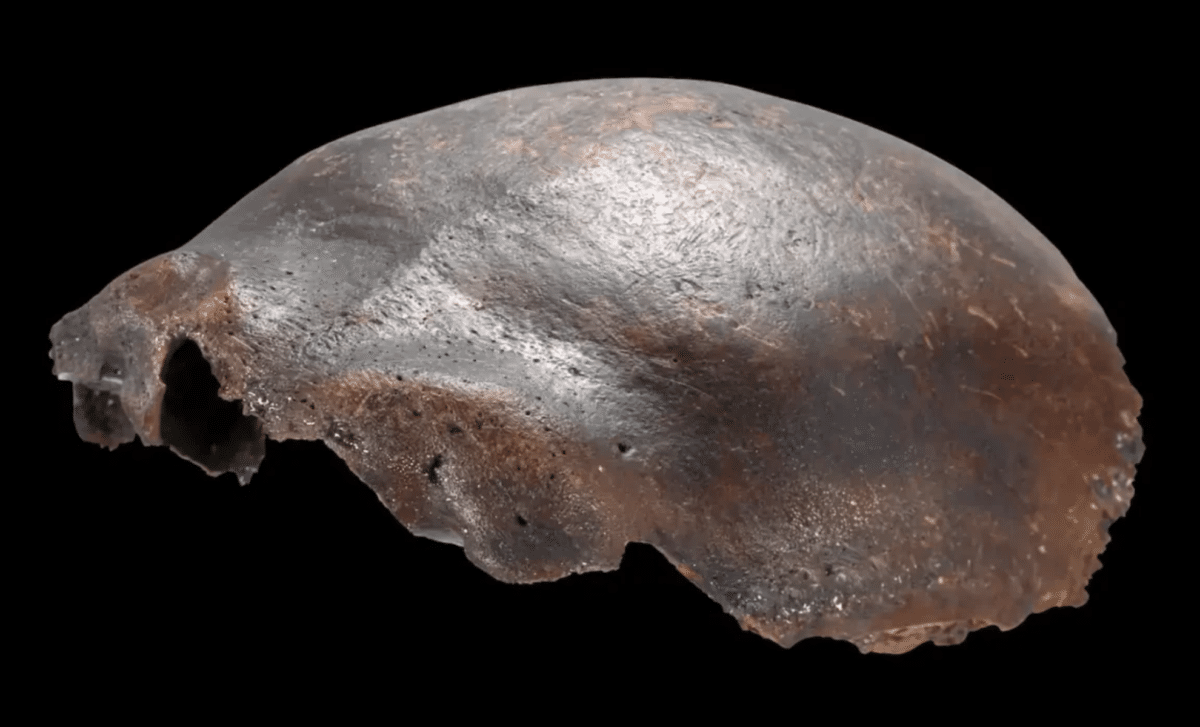
A skull once thought to represent a rare Neanderthal-human hybrid has now been reclassified, reshaping a long-standing narrative in paleoanthropology. In a study published in Scientific Reports, researchers reveal that the 7,500-year-old Hahnöfersand skull from Germany is not a hybrid at all, but fully consistent with modern human anatomy, challenging decades of assumptions about human evolution in post-Ice Age Europe.
A Fossil Once Seen As A Missing Link Now Reconsidered
For years, the Hahnöfersand skull held a peculiar place in the study of human evolution. Discovered in northern Germany, its unusual features led some scientists to propose that it represented a rare hybrid between Neanderthals and early modern humans. That interpretation carried weight, as it seemed to offer visible anatomical evidence of interbreeding—something already supported by genetic data. The idea of a hybrid skull captured attention because it provided a tangible, physical manifestation of a complex evolutionary story.
Yet, the new analysis applies far more advanced techniques than were available at the time of its original classification. Researchers used detailed morphometric comparisons, examining the shape and structure of the skull against a wide dataset of both ancient and modern human remains. The results dismantle the hybrid hypothesis.
“Multivariate analyses show a clear and unequivocal morphological affinity between Hahnöfersand and H. sapiens,” write the researchers.
This statement leaves little ambiguity. Rather than occupying an intermediate position between species, the skull aligns squarely within the variation expected for modern humans of the Holocene period.
The implications extend beyond a single fossil. It highlights how earlier interpretations, often based on limited comparative material, can be overturned by new methodologies. The Hahnöfersand skull is no longer a symbol of hybridization but an example of how human variation can be misread when context is incomplete.
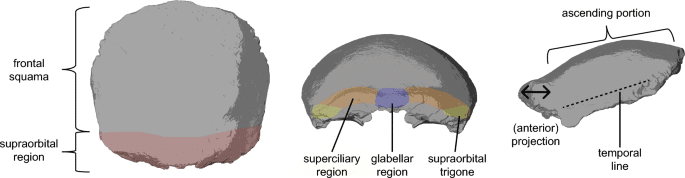 Illustration of key terminology. Illustrations were made based on the anatomical area captured in our dataset, i.e., the entire reconstructed external morphology of the frontal bone from Hahnöfersand (cf. Materials and Methods, Figure 2).
Credit: Scientific Reports
A New Examination Changes The Skull’s Place In History
The study published in Scientific Reports does more than correct a classification, it recalibrates the historical timeline attached to the skull. Initially believed to be much older, the fossil has now been firmly dated to the Mesolithic period, a time when only modern humans inhabited Europe. This temporal revision alone raises serious doubts about the hybrid theory, as Neanderthals had already disappeared thousands of years earlier.
“Our results show that the frontal bone from Hahnöfersand, Germany, is most similar to Holocene H. sapiens, consistent with its revised Mesolithic date,” conclude the study authors. This alignment between anatomical traits and chronological data strengthens the argument. The skull no longer sits in an evolutionary gray zone; instead, it fits cleanly into the known record of human populations after the last Ice Age.
What makes this reassessment particularly striking is how it resolves a long-standing anomaly. For decades, the Hahnöfersand specimen stood out as an exception, an oddity that did not fully match either Neanderthals or modern humans. Now, with improved dating and analytical precision, that ambiguity disappears. The fossil is not an evolutionary puzzle piece bridging two species, but rather a reminder of the diversity within our own.
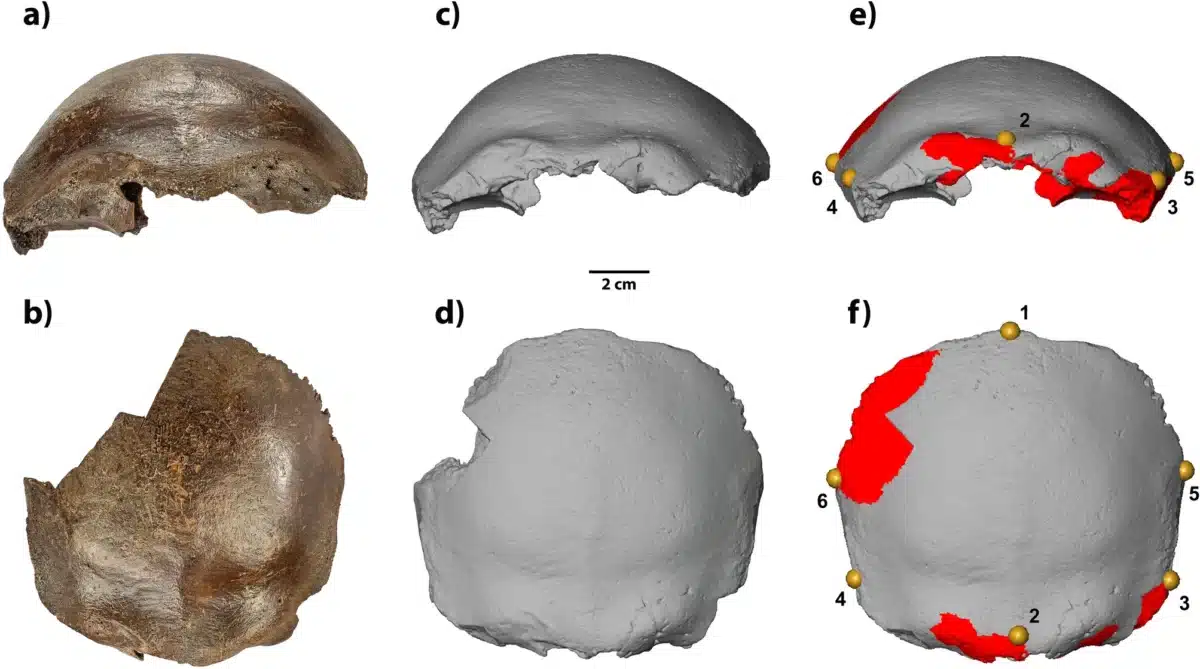 The frontal bone from Hahnöfersand. A) and b) show the fossil in its current state, c) and d) a three-dimensional model of the surface scan generated in the early 2000s, and e) and f) a virtual reconstruction of the frontal bone based on the surface scan with reconstructed elements shown in red. In addition, e) and f) illustrate the landmark set used in the initial registration of the surface registration method. Numbers refer to landmark definitions provided in Supplementary Table S2. In the upper row, the frontal bone is shown in anterior view (a, c, e), and in the bottom row in superior view (b, d, f). Additional views are shown in Supplementary Figures S1 and S2.
Credit: Scientific Reports
No Evidence Of Hybrid Traits Challenges Previous Assumptions
One of the most decisive aspects of the study is its rejection of any intermediate morphology in the skull. Earlier interpretations leaned heavily on the idea that certain features appeared “in-between,” suggesting a blending of Neanderthal robustness and modern human gracility. That notion has now been thoroughly tested, and dismissed.
“Hahnöfersand does not exhibit an intermediate morphology between Neanderthals and H. sapiens, contrary to previous assessments of its morphology,” the researchers add. This conclusion directly confronts the hybrid narrative, showing that what once appeared to be mixed traits are better explained as normal variation within modern humans.
This finding has broader consequences for how scientists interpret fossil evidence. It underscores the risk of over-interpreting unusual features without sufficient comparative data. Human anatomy, especially in ancient populations, can vary in ways that mimic what might superficially appear as hybridization. Without rigorous statistical analysis, such interpretations can persist for decades.
By firmly placing the Hahnöfersand skull within the spectrum of Homo sapiens, the study removes one of the most cited examples of a supposed physical hybrid. It reinforces the idea that while interbreeding between Neanderthals and modern humans did occur, identifying it in skeletal remains is far more complex than once believed.