
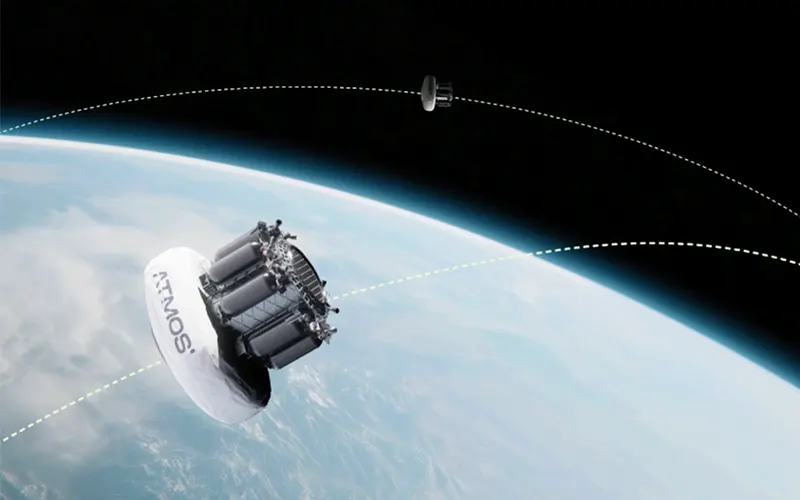
 Credit: ATMOS Space Cargo
German space logistics company ATMOS Space Cargo has closed a €25.7 million Series A funding round, enabling it to begin initial operations of its space return service. The funding is also expected to support the creation of a subsidiary for institutional and defence clients, as well as the development of its larger PHOENIX 3 capsule.
ATMOS Space Cargo is developing a recoverable in-orbit research capsule called PHOENIX 2. The capsule will be capable of hosting payloads of up to 100 kilograms on missions lasting up to three months. Once its mission is complete, an inflatable atmospheric decelerator acts as both a heat shield and a high-velocity parachute.
On 22 April, ATMOS announced that it had secured €25.7 million in Series A funding, co-led by European venture capital firms Expansion and Balnord, with contributions from the European Innovation Council and several other investors. The funding will primarily be used to build an initial fleet of three PHOENIX 2 capsules, enabling the company to move from its testing phase, which included the launch of its PHOENIX 1 demonstrator in April 2025, to routine operations.
“A structured campaign of three vehicles establishes Europe’s first routine orbital return infrastructure,” said ATMOS CEO Sebastian Klaus. ”ATMOS Space Cargo’s PHOENIX 2 is the first step in building a scalable European return infrastructure that will demonstrate our ability to access, operate, and return materials, data, and hardware from orbit independently.”
To date, there have been several demonstrations of European orbital return vehicles, including ESA’s Intermediate eXperimental Vehicle and Advanced Reentry Demonstrator, The Exploration Company’s Mission Bikini and Mission Possible demonstrators, Orbital Paradigm’s KID demonstrator, and, as stated, ATMOS’ own PHOENIX 1 demonstrator. There are, however, no examples of capsules moving from demonstrations to performing routine Earth-return operations.
While ATMOS is moving forward with offering its commercial service, it’s not alone. ESA is moving toward a 2028 test flight of its Space Rider vehicle, a timeline similar to that of The Exploration Company’s Nyx capsule, which will be capable of docking in low Earth orbit and returning to Earth. Other efforts include Orbital Paradigm’s Kestrel vehicle, Space Cargo Unlimited’s REV1, Space Forge’s ForgeStar, and ArianeGroup’s SpaceCase service. While the retirement of the International Space Station in early 2030 is likely to create some demand for commercial operators, whether that demand will be sufficient to support a growing number of competing European return services remains uncertain.
As ATMOS moves toward commercial operations, it is also preparing to launch ATMOS WORKS, which the company describes as a “dedicated entity for European government and defence institutions.” While the company explained that the new funding would support the creation of this dedicated entity, it said further details would be shared in a separate announcement.
In addition to the company’s near-term strategy, the funding is intended to kick-start development of its more capable PHOENIX 3 capsule. The upgrade will increase the capsule’s payload capacity from 100 kilograms to 1,000 kilograms. It will also be more capable, with the company describing it as a multi-use orbital transfer vehicle with an Earth-return capability. Here again, the company referred to a future separate announcement for additional details.
Keep European Spaceflight Independent
Your donation will help European Spaceflight to continue digging into the stories others miss. Every euro keeps our reporting alive.