
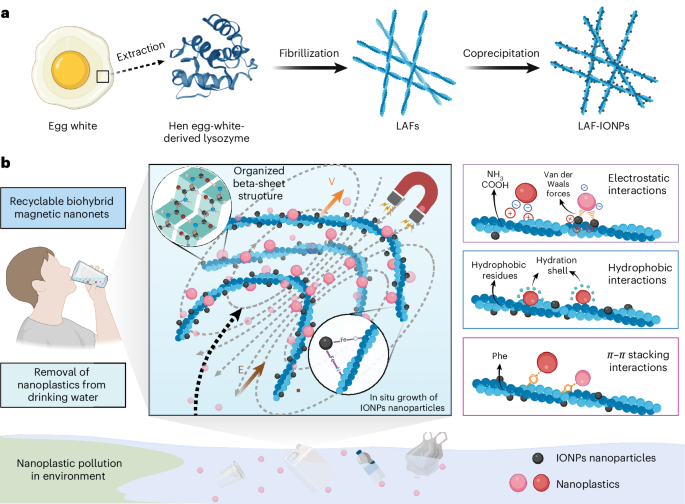
Alimi, O. S., Farner Budarz, J., Hernandez, L. M. & Tufenkji, N. Microplastics and nanoplastics in aquatic environments: aggregation, deposition, and enhanced contaminant transport. Environ. Sci. Technol. 52, 1704–1724 (2018).
ten Hietbrink, S., Materic, D., Holzinger, R., Groeskamp, S. & Niemann, H. Nanoplastic concentrations across the north atlantic. Nature 643, 412–416 (2025).
Zhao, S. et al. The distribution of subsurface microplastics in the ocean. Nature 641, 51–61 (2025).
Liu, X. et al. The threats of micro- and nanoplastics to aquatic ecosystems and water health. Nat. Water 3, 764–781 (2025).
Thompson, R. C. et al. Twenty years of microplastic pollution research-what have we learned? Science 386, 395 (2024).
Vethaak, A. D. & Legler, J. Microplastics and human health. Science 371, 672–674 (2021).
Mitrano, D. M., Wick, P. & Nowack, B. Placing nanoplastics in the context of global plastic pollution. Nat. Nanotechnol. 16, 491–500 (2021).
Chen, L. et al. Size-dependent pulmonary toxicity and whole-body distribution of inhaled micro/nanoplastic particles in male mice from chronic exposure. Environ. Sci. Technol. 59, 6993–7003 (2025).
Qiana, N. et al. Rapid single- particle chemical imaging of nanoplastics by SRS microscopy. Proc. Natl Acad. Sci. USA 121, e2300582121 (2024).
Yang, B. et al. Nanonet trapping for effective removal of nanoplastics by iron coagulation. Nat. Commun. 16, 5998 (2025).
Liu, M., Graham, N., Gregory, J., Elimelech, M. & Yu, W. Towards a molecular-scale theory for the removal of natural organic matter by coagulation with trivalent metals. Nat. Water 2, 285–294 (2024).
Ali, I. et al. Innovations in the development of promising adsorbents for the remediation of microplastics and nanoplastics-a critical review. Water Res. 230, 119526 (2023).
Urso, M., Ussia, M. & Pumera, M. Smart micro- and nanorobots for water purification. Nat. Rev. Bioeng. 1, 236–251 (2023).
Nie, G. et al. Mechanical agitation accelerated ultrasonication for wastewater treatment: sustainable production of hydroxyl radicals. Water Res. 198, 117124 (2021).
You, M., Chen, C., Xu, L., Mou, F. & Guan, J. Intelligent micro/nanomotors with taxis. Acc. Chem. Res. 51, 3006–3014 (2018).
Wang, J., Xiong, Z., Zheng, J., Zhan, X. & Tang, J. Light-driven micro/nanomotor for promising biomedical tools: principle, challenge, and prospect. Acc. Chem. Res. 51, 1957–1965 (2018).
Zarei, M. & Zarei, M. Self-propelled micro/nanomotors for sensing and environmental remediation. Small 14, 1800912 (2018).
Soler, L., Magdanz, V., Fomin, V. M., Sanchez, S. & Schmidt, O. G. Self-propelled micromotors for cleaning polluted water. ACS Nano 7, 9611–9620 (2013).
Zou, Y. et al. Core-shell magnetic particles: tailored synthesis and applications. Chem. Rev. 125, 972–1048 (2024).
Chen, Y. & El-Ghazaly, A. Self-assembly of magnetic nanochains in an intrinsic magnetic dipole force-dominated regime. Small 19, 2205079 (2023).
Zhang, X. et al. Well-designed protein amyloid nanofibrils composites as versatile and sustainable materials for aquatic environment remediation: a review. Eco-Environ. & Health 2, 264–277 (2023).
Peydayesh, M. & Mezzenga, R. Protein nanofibrils for next generation sustainable water purification. Nat. Commun. 12, 3248 (2021).
Knowles, T. P. J. & Mezzenga, R. Amyloid fibrils as building blocks for natural and artificial functional materials. Adv. Mater. 28, 6546–6561 (2016).
Teng, J. et al. Amyloid-templated palladium nanoparticles for water purification by electroreduction. Angew. Chem. Int. Ed. 61, e202116634 (2022).
Xuan, Q. et al. Amyloid-templated ceria nanozyme reinforced microneedle for diabetic wound treatments. Adv. Mater. 37, 2417774 (2025).
Shen, Y. et al. Amyloid fibril systems reduce, stabilize and deliver bioavailable nanosized iron. Nat. Nanotechnol. 12, 642–647 (2017).
Su, J. et al. Single-site iron-anchored amyloid hydrogels as catalytic platforms for alcohol detoxification. Nat. Nanotechnol. 19, 1168–1177 (2024).
Peydayesh, M. et al. Sustainable removal of microplastics and natural organic matter from water by coagulation-flocculation with protein amyloid fibrils. Environ. Sci. Technol. 55, 8848–8858 (2021).
Jin, T. et al. Amyloid fibril-based membranes for PFAS removal from water. Environ. Sci. Water Res. Technol. 7, 1873–1884 (2021).
Gass, H. et al. Magnetic removal of micro- and nanoplastics from water-from 100 nm to 100 μm debris size. Small 20, 2305467 (2024).
Ussia, M., Urso, M., Oral, C. M., Peng, X. & Pumera, M. Magnetic microrobot swarms with polymeric hands catching bacteria and microplastics in water. ACS Nano 18, 13171–13183 (2024).
Peng, X., Urso, M., Kolackova, M., Huska, D. & Pumera, M. Biohybrid magnetically driven microrobots for sustainable removal of micro/nanoplastics from the aquatic environment. Adv. Funct. Mater. 34, 2307477 (2024).
Li, W. et al. Self-driven magnetorobots for recyclable and scalable micro/nanoplastic removal from nonmarine waters. Sci. Adv. 8, eade1731 (2022).
Urso, M., Ussia, M., Novotny, F. & Pumera, M. Trapping and detecting nanoplastics by MXene-derived oxide microrobots. Nat. Commun. 13, 3573 (2022).
Yan, R. et al. Effect of aggregation behavior on microplastic removal by magnetic Fe3O4 nanoparticles. Sci. Total Environ. 898, 165431 (2023).
Kaur, M., Zhang, H., Martin, L., Todd, T. & Qiang, Y. Conjugates of magnetic nanoparticle-actinide specific chelator for radioactive waste separation. Environ. Sci. Technol. 47, 11942–11959 (2013).
Lu, W. et al. Fluoride adsorption studies on different amyloid fibrils hybrids: spectroscopic analysis and molecular docking analysis. Chem. Eng. J. 476, 146561 (2023).
Yuan, M. et al. A novel magnetic Fe3O4/cellulose nanofiber/polyethyleneimine/thiol-modified montmorillonite aerogel for efficient removal of heavy metal ions: adsorption behavior and mechanism study. Int. J. Biol. Macromol. 253, 126634 (2023).
Marshall-Roth, T. et al. A pyridinic Fe-N4 macrocycle models the active sites in Fe/N-doped carbon electrocatalysts. Nat. Commun. 11, 5283 (2020).
Schwaminger, S. P. et al. Nature of interactions of amino acids with bare magnetite nanoparticles. J. Phys. Chem. C 119, 23032–23041 (2015).
Wang, C. et al. Atomic Fe hetero-layered coordination between g-C3N4 and graphene nanomeshes enhances the ORR electrocatalytic performance of zinc–air batteries. J. Mater. Chem. A 7, 1451–1458 (2019).
Henthorn, J. T., Cutsail, G. E. III, Weyhermueller, T. & DeBeer, S. Stabilization of intermediate spin states in mixed-valent diiron dichalcogenide complexes. Nat. Chem. 14, 328–333 (2022).
Shui, J.-L., Karan, N. K., Balasubramanian, M., Li, S.-Y. & Liu, D.-J. Fe/N/C composite in Li-O2 battery: studies of catalytic structure and activity toward oxygen evolution reaction. J. Am. Chem. Soc. 134, 16654–16661 (2012).
Lin, J. et al. Highly dispersed single-atom Fe and Fe3O4 clusters anchored hierarchical-pore carbon as efficient persulfate activation catalyst. Sep. Purif. Technol. 358, 130346 (2025).
Frey, L. et al. A structural rationale for reversible vs irreversible amyloid fibril formation from a single protein. Nat. Commun. 15, 8448 (2024).
Chen, Y.-W. et al. Magnetite nanoparticle interactions with insulin amyloid fibrils. Nanotechnology 27, 415702 (2016).
Liu, Y., Wu, Y., Chen, Y., Zhang, P. & Zheng, X. Capturer of emerging contaminants: potentials and perspectives of amyloid protein nanofibrils as the novel adsorbents. Chem. Eng. J. 493, 152819 (2024).
Shi, X., Zhang, X., Gao, W., Zhang, Y. & He, D. Removal of microplastics from water by magnetic nano-Fe3O4. Sci. Total Environ. 802, 149838 (2022).
Monclus, L. et al. Mapping the chemical complexity of plastics. Nature 643, 349–355 (2025).
Ho, Y.-S. Review of second-order models for adsorption systems. J. Hazard. Mater. 136, 681–689 (2006).
Li, X. et al. Effective removal of microplastics by filamentous algae and its magnetic biochar: performance and mechanism. Chemosphere 358, 142152 (2024).
Li, H. et al. Theoretical and experimental investigation on rapid and efficient adsorption characteristics of microplastics by magnetic sponge carbon. Sci. Total Environ. 897, 165404 (2023).
Zhuang, J., Pan, M., Zhang, Y., Liu, F. & Xu, Z. Rapid adsorption of directional cellulose nanofibers/3-glycidoxypropyltrimethoxysilane/polyethyleneimine aerogels on microplastics in water. Int. J. Biol. Macromol. 235, 123884 (2023).
Wu, Y. et al. Revivable self-assembled supramolecular biomass fibrous framework for efficient microplastic removal. Sci. Adv. 10, eadn8662 (2024).
Chen, L. et al. Biomass waste-assisted micro(nano)plastics capture, utilization, and storage for sustainable water remediation. Innovation 5, 100655 (2024).
Yan, Y. et al. Dibutyl phthalate release from polyvinyl chloride microplastics: influence of plastic properties and environmental factors. Water Res. 204, 117597 (2021).
Choudhary, A., Dong, D., Tsianou, M., Alexandridis, P. & Bedrov, D. Adsorption mechanism of perfluorooctanoate on cyclodextrin-based polymers: probing the synergy of electrostatic and hydrophobic interactions with molecular dynamics simulations. ACS Mater. Lett. 4, 853–859 (2022).
Kleshchonok, A. & Tkatchenko, A. Tailoring van der Waals dispersion interactions with external electric charges. Nat. Commun. 9, 3017 (2018).
Luo, G. et al. Determining the contribution of micro/nanoplastics to antimicrobial resistance: challenges and perspectives. Environ. Sci. Technol. 57, 12137–12152 (2023).
Naqash, N., Prakash, S., Kapoor, D. & Singh, R. Interaction of freshwater microplastics with biota and heavy metals: a review. Environ. Chem. Lett. 18, 1813–1824 (2020).
Zhou, Z., Zhang, C., Xi, M., Ma, H. & Jia, H. Multi-scale modeling of natural organic matter-heavy metal cations interactions: aggregation and stabilization mechanisms. Water Res. 238, 120007 (2023).
Yu, Z., Wang, J.-J., Liu, L.-Y., Li, Z. & Zeng, E. Y. Drinking boiled tap water reduces human intake of nanoplastics and microplastics. Environ. Sci. Technol. Lett. 11, 273–279 (2024).
Khu, S.-T., Li, F. & Zhao, W. Microplastics in drinking water distribution systems: occurrence, environmental behavior, and human health concerns. Environ. Pollut. 382, 126666 (2025).
Li, Z. et al. Functional properties and extraction techniques of chicken egg white proteins. Foods 11, 2434 (2022).
Xuan, Q. et al. Photo-reversible amyloid nanoNETs for regenerative antimicrobial therapies. Nat. Commun. 16, 11025 (2025).
Zhou, J. et al. Oat protein nanofibril-iron hybrids offer a stable, high-absorption iron delivery platform for iron fortification. Nat. Food 6, 1164–1175 (2025).
Xu, D. et al. Food amyloid fibrils are safe nutrition ingredients based on in-vitro and in-vivo assessment. Nat. Commun. 14, 6806 (2023).
Brancolini, G. & Tozzini, V. Multiscale modeling of proteins interaction with functionalized nanoparticles. Curr. Opin. Colloid Interface Sci. 41, 66–73 (2019).
Feng, R. et al. The kinetic mechanism of acetylene hydrogenation to prepare ethane over FexOy clusters: a DFT study. Chem. Eng. Sci. 230, 116170 (2021).
Lefebvre, C. et al. Accurately extracting the signature of intermolecular interactions present in the NCI plot of the reduced density gradient versus electron density. Phys. Chem. Chem. Phys. 19, 17928–17936 (2017).
Lu, T. & Chen, F. Multiwfn: a multifunctional wavefunction analyzer. J. Comput. Chem. 33, 580–592 (2012).
Boys, S. F. & Bernardi, F. The calculation of small molecular interactions by the differences of separate total energies. Some procedures with reduced errors. Mol. Phys. 100, 65–73 (2002).
Abraham, M. J. et al. GROMACS: high performance molecular simulations through multi-level parallelism from laptops to supercomputers. SoftwareX 1-2, 19–25 (2015).
Hornak, V. et al. Comparison of multiple amber force fields and development of improved protein backbone parameters. Proteins 65, 712–725 (2006).
Wang, J. M., Wolf, R. M., Caldwell, J. W., Kollman, P. A. & Case, D. A. Development and testing of a general amber force field. J. Comput. Chem. 25, 1157–1174 (2004).
Deserno, M. & Holm, C. How to mesh up Ewald sums. I. A theoretical and numerical comparison of various particle mesh routines. J. Chem. Phys. 109, 7678–7693 (1998).
Li, H., Kim, Y., Jung, H., Hyun, J. Y. & Shin, I. Near-infrared (NIR) fluorescence-emitting small organic molecules for cancer imaging and therapy. Chem. Soc. Rev. 51, 8957–9008 (2022).
Zhang, Z.-Q. et al. Surface-hydroxylated single-atom catalyst with an isolated Co-O-Zn configuration achieves high selectivity in regulating active species. Nat. Commun. 16, 2376 (2025).