
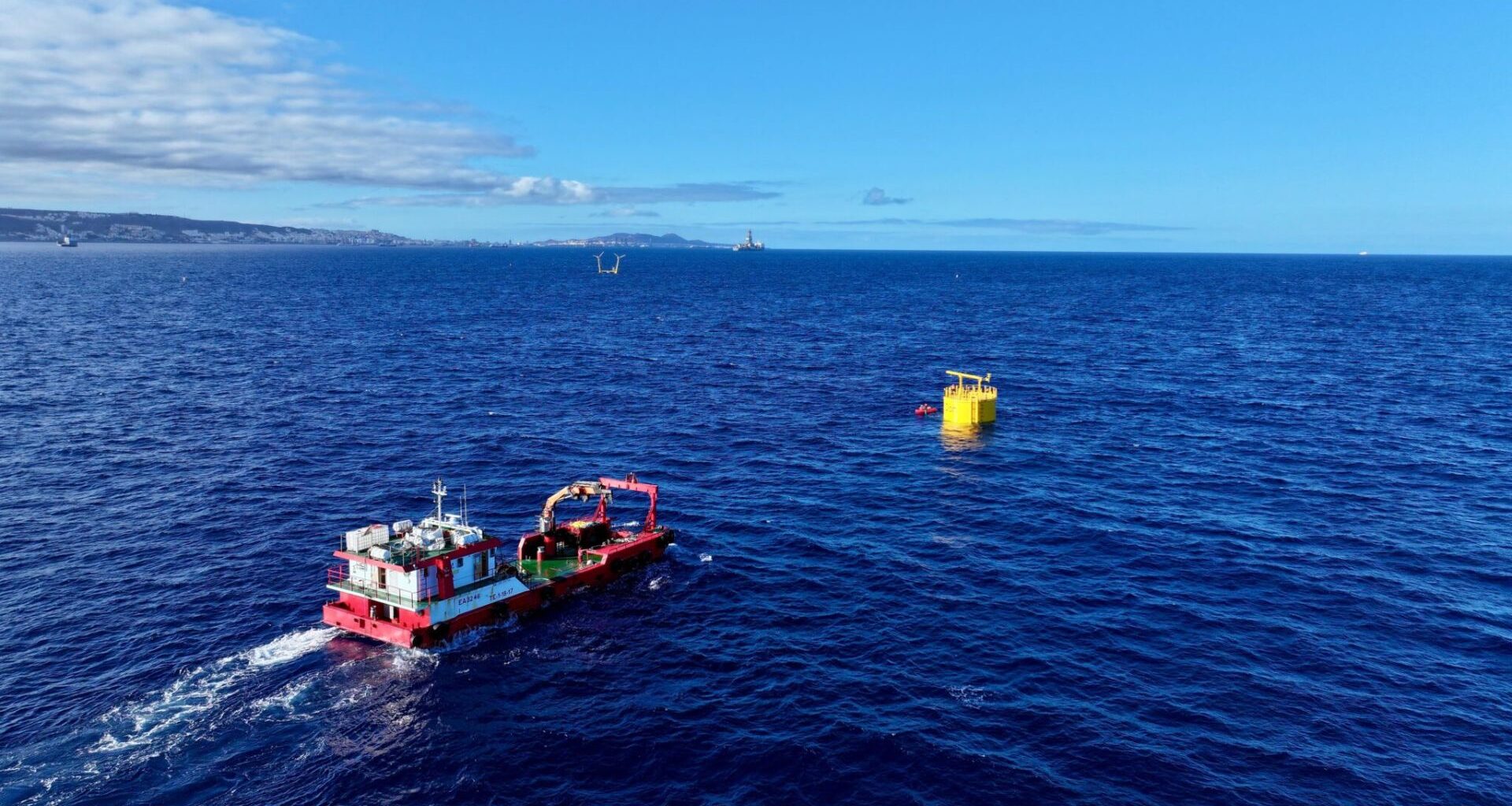
A UK clean energy firm, Global OTEC, on Wednesday announced it has completed the offshore installation of a floating prototype platform in the Canary Islands.
This marks the first purpose-built system designed to generate continuous electricity from ocean temperature differences at sea.
Floating system moves from concept to ocean trials
The newly installed platform sits off the coast of the Canary Islands, at the Oceanic Platform of the Canary Islands (PLOCAN), a marine testing site in Spanish waters. Engineers deployed and connected a vertical seawater intake riser, a key structure that draws cold water from deep below the surface. This step is widely seen as the most complex part of building an offshore Ocean Thermal Energy Conversion system.
The project, called PLOTEC, reached this milestone after years of simulation and tank testing. The floating unit now allows researchers to assess real-world performance, including how the system behaves in open-ocean conditions and its interactions with the surrounding environment.
The installation forms part of a €3.5 million program backed by the European Union’s Horizon Europe initiative. The effort is led by Global OTEC, along with a group of European partners, to move the technology from controlled environments to commercial readiness.
Using ocean heat differences to generate power
Ocean Thermal Energy Conversion works by using the natural temperature difference between warm surface water and cold deep-sea water. Warm water heats a low-boiling-point working fluid, producing vapor that drives a turbine. Cold water from depths of up to about 3,280 feet then condenses the vapor back into liquid, allowing the cycle to repeat and generate electricity continuously.
Small-scale versions of this system have been tested onshore, where deep-sea water pipelines already exist. However, those setups face limits because the long pipes required to bring cold water inland are expensive and restrict system size.
By placing the plant directly above deep water, the required pipe length can be reduced by around 80 percent. This makes larger systems more practical and opens the door to utility-scale power generation.
Islands seek stable alternatives to fuel imports
Many tropical island regions still rely heavily on diesel and heavy fuel oil for electricity. These fuels have to be imported, which makes energy prices susceptible to market price changes. This usually leads to energy becoming costly and unpredictable.
Solar and wind energy sources are already available, though further development may prove challenging. There could be limited land for energy generation, as well as unfavorable seabed conditions near shorelines. Such factors might make it difficult for islands to transition to renewable energy.
OTEC, on the other hand, provides another option through energy derived from the ocean. Because it operates continuously, it can provide baseload power around the clock rather than depending on weather conditions. Global OTEC estimates that more than 25 gigawatts of existing fossil fuel capacity across tropical islands could eventually be replaced by systems like this.
Industry eyes scalable offshore deployment
Until now, offshore deployment has been the main hurdle for OTEC. The successful installation is being seen as a turning point for the sector.
“This is the moment where OTEC moves away from controlled environments into the real world,” said Dan Grech, Founder and CEO of Global OTEC.
“Conventional onshore intake systems, while great resources for aquaculture and testing equipment, are low-capacity and expensive. Offshore, OTEC can scale in a modular way, transitioning it from a niche technology to a powerful resource. We now have a new class of standardized and replicable baseload power on a learning curve akin to wind, solar, and batteries.”
With testing now underway, the company plans to deploy its first OTEC Power Module in Hawai’i. That next phase will focus on proving that offshore systems can deliver steady, 24/7 electricity at a scale suitable for island grids.