
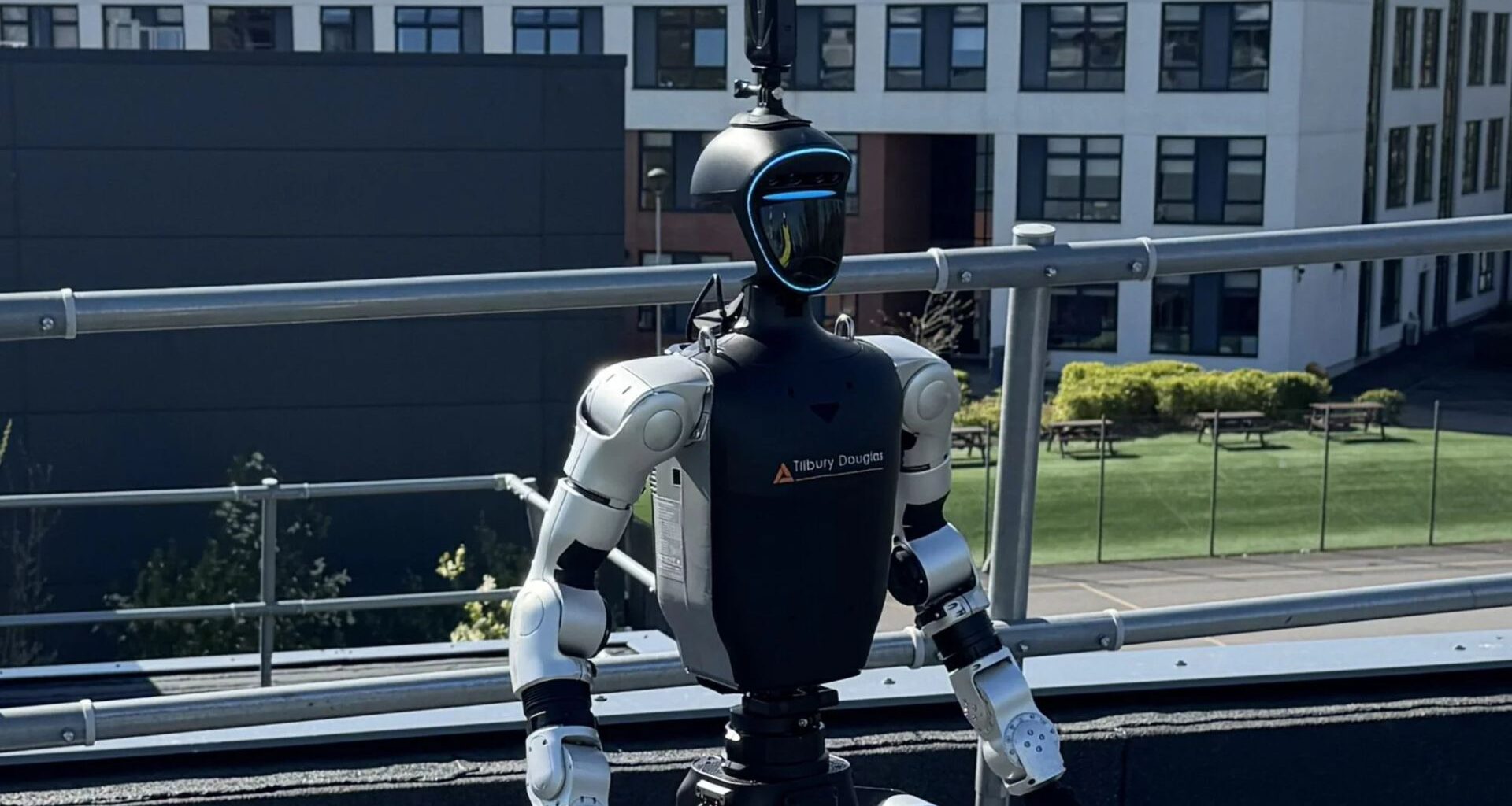
Construction firm Tilbury Douglas has become the first major UK builder to use a humanoid robot on a real site.
The robot doesn’t carry bricks or pour concrete.
Named Douglas, the robot handles time-consuming data collection and administrative chores at a construction site. This allows the human crew to stop worrying about paperwork and focus on the actual technical and building work.
The next-gen robot navigates the site independently to capture 360-degree photos and track project progress, thereby supporting safety monitoring.
It boosts efficiency without sacrificing quality or safety standards, saving about 40 hours of work each month by automating these tasks.
Reportedly, Douglas is a product of Unitree, a leading developer in the competitive humanoid robot market. The bot has already spent 10 weeks proving its worth during a live site trial.
“This trial marks an important step in Tilbury Douglas’ digital transformation journey, demonstrating how emerging technologies can enhance operational performance while supporting the industry’s evolving workforce needs,” the company stated in the press release.
360-degree imagery
For site managers, the site walk is a daily ritual. It involves wandering through skeletons of steel and half-finished rooms to snap 360-degree photos and log progress. It is essential, yet exhausting.
Douglas has been designed to take over this responsibility.
Equipped with advanced LiDAR sensors and 360-degree cameras, the humanoid autonomously traverses the site, capturing high-definition data and feeding it directly into health and safety workflows.
Compared to humans, Douglas captures photos from the exact same coordinates every day, allowing AI software to track progress and spot any deviations.
According to Construction News, the robotic worker also performs laser scanning to create a detailed “point cloud” that automatically flags building defects the human eye might miss.
Tilbury Douglas estimates this mechanical intern will save site teams roughly 40 hours of administrative labor every month. That is a full working week returned to the people who build our hospitals and roads.
The timing isn’t accidental. The construction industry is currently grappling with a massive skills gap, struggling to recruit the next generation of engineers and project managers.
“The construction industry continues to face a skills shortage and ongoing resource challenges. By utilizing innovative technology such as this robot, we can automate key processes, assist our teams, and enable our people to focus their expertise where it adds the greatest value,” said Mark Buckle, Technical Director at Tilbury Douglas.
High-safety
The 30kg (66-pound) robot is agile enough to climb stairs, use elevators, and open doors, though it is kept away from edges to prevent falls.
Tilbury Douglas has tested the bot across various project stages but plans to deploy it even earlier, starting with foundations and groundworks.
To ensure safety around heavy machinery during these early phases, the robot will be equipped with high-visibility markings and a warning beacon.
Douglas serves as a clear sign that AI and robotics are disrupting blue-collar industries just as much as office-based roles.
Despite its affordable £15,000 price tag, the company insists the robot is a tool to empower workers rather than replace them, handling routine tasks so humans can tackle more complex, collaborative challenges.