
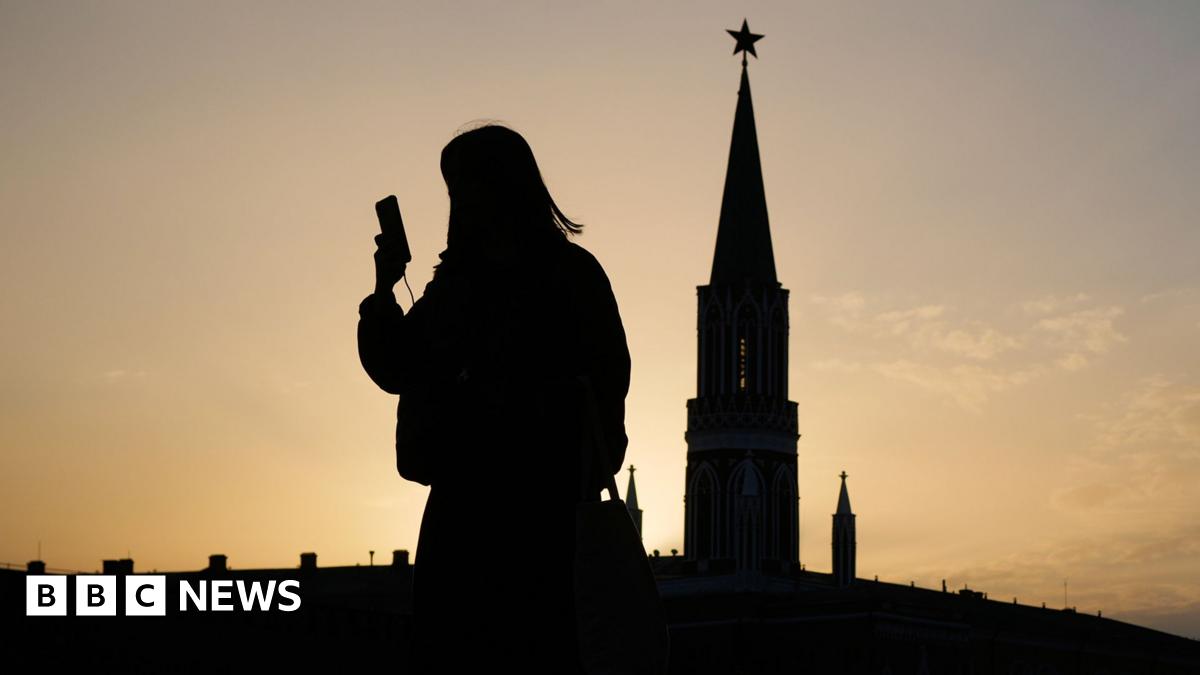
Is Russia’s internet crackdown a road to the past?
“No, it’s not,” Putin’s spokesman Dmitry Peskov assures me back in Moscow.
“In the current situation, security considerations dictate the need for certain measures,” Peskov continues. “These are being taken and most of our citizens understand the need for them.
“It’s clear that internet restrictions inconvenience many people. But this is the period we’re in. Once the need for such measures disappears, services will be fully restored and return to normal.”
But restrictions and repression are beginning to feel like the new normal.
“I don’t think that this regime is ready to go back,” concludes journalist Andrei Kolesnikov. “They can only go forward in terms of more repressions.
“What is bad for the authorities is an accumulation of discontent and it could play out in the future. We don’t know in what shape. But it’s evident that irritation and discontent are accumulating.”
And bubbling to the surface.
Recently Russian celebrity blogger Victoria Bonya posted an “address to Russia’s president” on Instagram. She slammed the internet crackdown and other controversies in Russia.
The video went viral with tens of millions of views. In her monologue Victoria Bonya didn’t blame Putin directly. But addressing him she declared: “There is a huge, thick wall between you and us, the ordinary people.”
On Thursday the Kremlin leader claimed he could not help but “pay attention” to the problems Russians have been experiencing as a result of internet disruption.
He instructed law enforcement bodies to show “ingenuity and professionalism” and to “accommodate the vital interests of citizens”.
This was no U-turn from Putin. There was no hint of an end to the restrictions.
Recent surveys in Russia suggest that his ratings have fallen to their lowest level since the full-scale Russian invasion of Ukraine in 2022.
It’s not just internet restrictions fuelling public unease. Russians are worried about the economy and there is growing fatigue with the war on Ukraine.
“People begin to understand there is a direct connection between their everyday problems, like healthcare, food prices, problems with internet, and the politics of Vladimir Putin,” Boris Nadezhdin tells me.
“And this is a new situation in Russia.”