
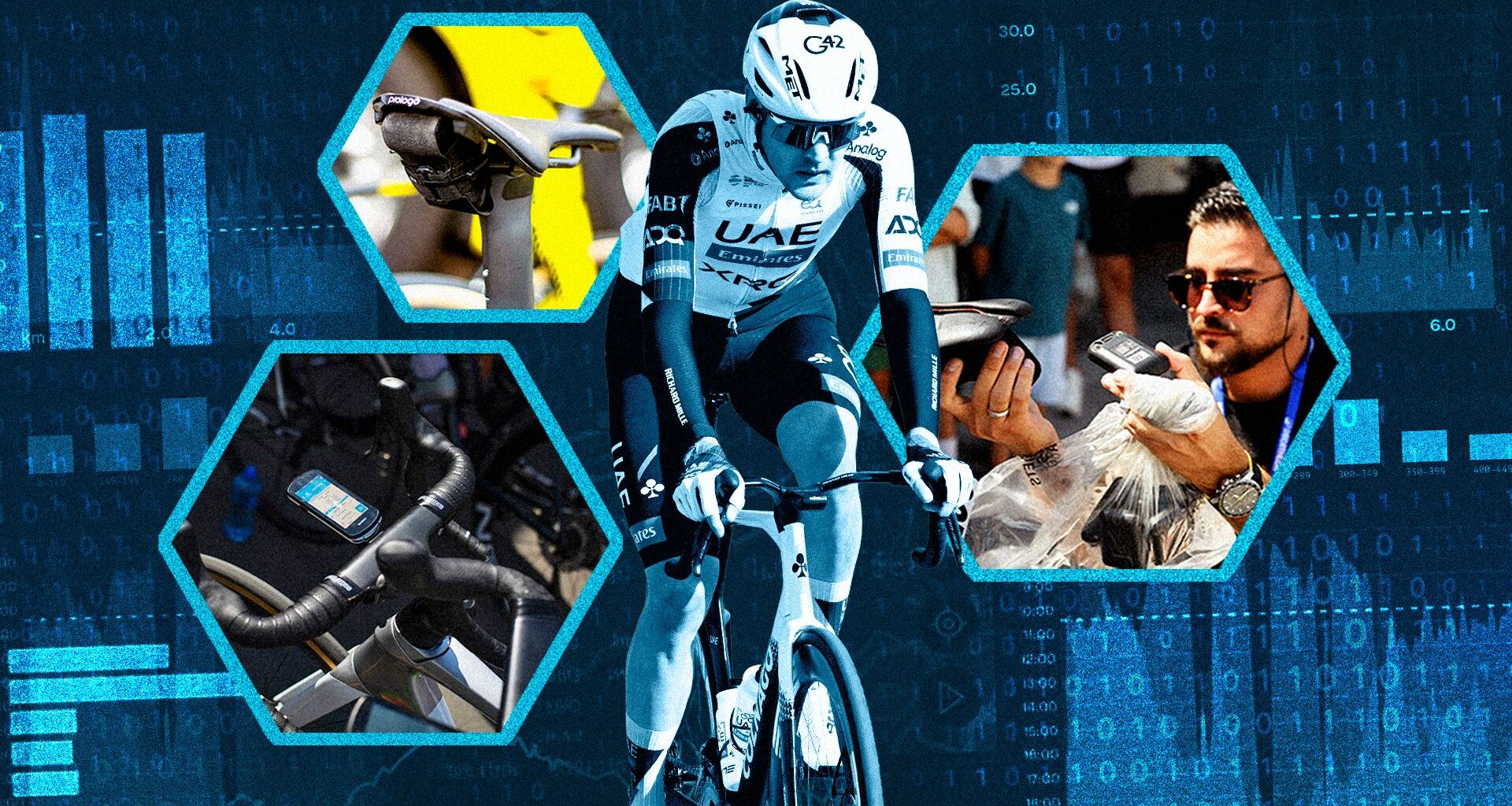
Data. It’s a big, all-encompassing buzzword that is everywhere you turn in cycling nowadays, controlling the narrative and generating discussion. Power passports, GPS trackers, and even Tadej Pogačar inadvertently – or deliberately? – sharing his power files on Strava. Numbers are everywhere.
But this proliferation of data is causing a problem. Or better said, numerous problems, spawning ever more political footballs. Something that ought to be relatively uncomplex – harvest the data, crunch it into something digestible, and then use it to enhance understanding of performance or the storytelling of a race – is being bogged down by concerns over ownership, privacy and fears over who would profit from monetising it. Data is now even being used to find possible dopers.
A really quite geeky area of technology is blowing up into one of cycling’s trickiest dilemmas for both the sport’s governors and protagonists. The expectation is that things aren’t going to be settled any time soon.
What is data?
Over the past two decades, especially as cycling computers and wearables like sports watches have become ubiquitous, performance data has evolved from laboratory figures mostly available only to the professionals to something that every single amateur now has easy access to.
Power numbers, heart rate and cadence are data points that form the basis of objectively analysing performance, with heart rate variability, glucose monitoring and analysis of sleep considered as the next step-up in performance metrics. Then there are more advanced data points that tend to only concern professional athletes or the most hardcore of racing amateurs: coefficient of aerodynamic drag (CdA) and rolling resistance of tyres.
More basic than any of the above is location, better known as GPS data: where a rider is physically at – it’s so simple, but it’s causing one of the biggest headaches right now. But before we get into that, Cyclingnews has seen a copy of a rider contract from a WorldTour team which highlights what a rider’s ‘personal data’ refers to. Beyond generic identity and contact information, data includes “laboratory test results for evaluation of physical potential, race data through platforms like TrainingPeaks and Strava and 3D Scanning results to evaluate aerodynamic potential.”
Medical data is also listed, but can only be collected and processed by the team and the UCI, cycling’s governing body, if it’s “pertinent to the rider’s health and necessary for the purpose of the ‘Programme of obligatory tests for UCI medical monitoring’ – the objective of which is to safeguard the health and safety of riders.”
Who owns data?
Who owns all this data depends on each individual team. “A lot of rider contracts hand data over to the team so the teams own all of the data,” said Adam Hansen, the president of the riders’ union, the CPA. “But if data is not signed across, then riders own their private data.”
Ask a rider who owns their data, though, and they’ll likely not know. “The sad thing is most riders aren’t interested,” Hansen laments. “Some care, but most aren’t aware who owns their data.” To illustrate the point, UAE Team Emirates-XRG’s Pavel Sivakov – one of a few elite riders who openly and regularly shares his power files online to the masses – said: “I’m not so sure if the team completely owns my data or not.”
This probably shouldn’t be viewed as naive on the riders’ part – it’s more representative of the fact that riders have no reason to believe that teams would exploit their data or use it maliciously. After all, they’re paid employees. Indeed, Sivakov said that “it’s not really a topic. What riders are more concerned about is privacy, in that you don’t want people to see where you live via Strava.”
That aforementioned contract (similar to most other WorldTour contracts but not replicated across the board) states that the team “uses personal data for the purpose of reviewing and evaluating the rider’s physical potential.” It adds that the team will “process and store the personal data securely, for no longer than necessary… and in no event longer than the duration of this contract.”
Crucially, a rider can remove consent “at any time” and can “object to the paying agent [team – ed] using their personal data for direct marketing purposes”. They can also request that their data be restricted or that the team delete the data. In summary, the rider gives teams access to and ownership of their data, but they have the ultimate authority on whether that data is used.
As in certain broadcasts of races, it’s not uncommon for a rider’s speed, cadence, and power to be shown on TV. This is only possible with a small 60-gram device from Velon – an organisation owned by nine teams. Each of the 15 WorldTeams and the number of ProTeams who have an agreement with Velon consent to the use of “live power data” (power figures) on behalf of the rider, and they – not anyone else, including the broadcaster – continue to own that data. ASO, the promoters of the Tour de France, have its own partnership with Capgemini, but their speeds are approximated using the following motorbikes.
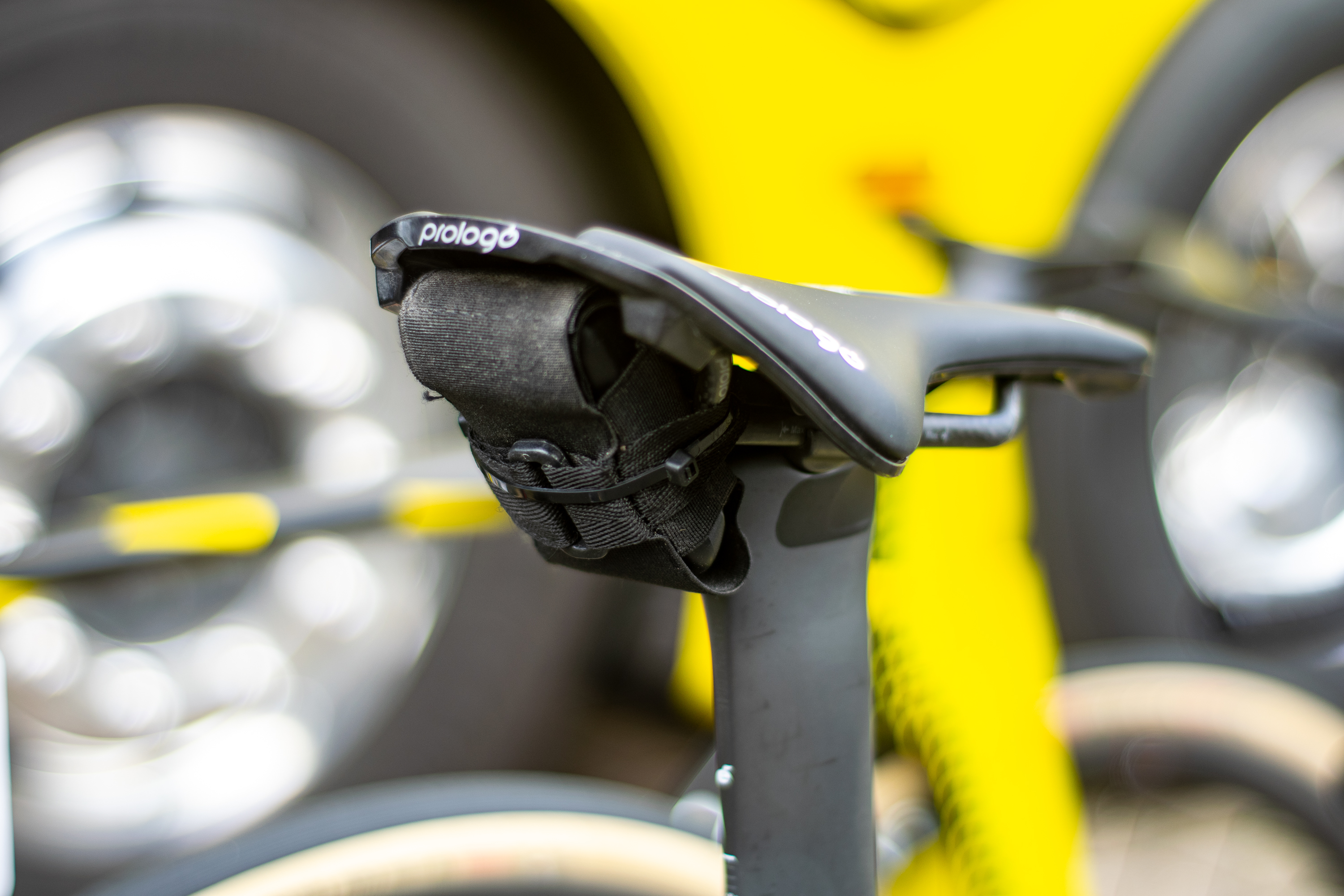
Velon’s data device neatly fastened to a Visma-Lease a Bike rider’s saddle at Kuurne-Brussel-Kuurne (Image credit: Tom Wieckowki)
How that data is monetised is a topic of debate within the sport. “It’s not that we don’t want data to be shared, we just want to be sure that the revenue goes to the right people,” Hansen said. “What we don’t want is for the organisers to supply the trackers, and then they own all the data and teams and riders are again on the back foot and not making money from it.” Sivakov concurs with Hansen. “If teams own our data, we don’t want to just give it away for free. It’s a way for the teams to earn some money, and some guys would be keen to do that.”
Who shares data?
Aside from the odd power file shared on TV, most riders don’t tend to make their performance data public information. Although most male and female WorldTour riders have public Strava accounts and upload files from racing and possibly training rides, most restrict what data is visible to location and speed.
The main reason for this is that riders – often at the request (or demand) of their employers – don’t wish to give away what could be termed ‘team secrets’. By publishing their physiological files, people can analyse their performance, look for signs of fatigue or weakness during a race setting that could dictate rival tactics, or pull apart a rider’s training plan.
For the most part, the risks of performance data being used advantageously by third parties (read: rival teams) are probably slightly overblown: training plans are mostly the same across the board with a few small exceptions, and it’s easy enough to estimate a rider’s watts per kilogram figures going off their speed and weight. But the fear of giving too much away certainly prevails.
Sivakov, along with a number of riders from EF Education-EasyPost like Ben Healy and Neilson Powless, does share his physiological data on Strava – though since this year, due “to team protocols”, he only does so in races. “They don’t want everyone to copy or look too much into what we do [in training],” he explained.
“It’s a personal choice to make it open during races, and I don’t mind, really,” he said. “From my perspective, it’s a chance to show the amateurs and fans what it takes to be a pro, what type of power we are pushing, all that kind of stuff.”
The demand from fans for more transparency and to see rider data remains high, and there has long been a call in some quarters to use power files to determine possible cases of doping. This past winter, the International Testing Agency (ITA), the organisation that oversees anti-doping control in cycling and Olympic sports, began a two-year trial of a ‘power data passport’ with four WorldTour teams. But the initial response to the pilot scheme has been largely negative.
What is the power data passport?
Outlining the defence of its project, the ITA said that “power data is at the core of professional road cycling” and highlighted how it is routinely “scrutinised” by riders and fans alike. “Paradoxically,” the Switzerland-based organisation added, “the ITA does not have access to it.”
Its venture, therefore, is aimed at using data as a “supplementary [intelligence] tool to help identify potential indicators of doping.” It added that the tools, if deployed on a wide-scale basis at a later date, would “only be used if they prove to be reliable… The analysis is simply intended to highlight performance progressions or gains that fall outside the statistically expected ‘normal’ range for that rider and compared with their peers.”
If anomalies were found in the data, a rider wouldn’t be sanctioned for doping as there “may be entirely legitimate reasons for their performance change,” but rather the ITA would “follow up by reviewing additional data” to build a more complete picture of whether a rider is potentially using performance-enhancing substances and methods.
CPA president Hansen is strictly against power data passports. “Speak to any mechanic, and they’ll tell you how unreliable power meters are – some brands can be 10% off. And now we’re using this unbelievably unreliable device to monitor possible doping,” he fumed.

CPA president Adam Hansen in conversation with Lidl-Trek’s Jacopo Mosca at the 2025 Tour Down Under (Image credit: Dario Belingheri/Getty Images)
Hypothetically speaking, if the accuracy of power meters was improved to within one per cent, would Hansen support the passport’s rollout? “Even if it’s super reliable, what then happens if a rider forgets to upload their training ride? They [the ITA] might think if I’ve not uploaded my data for two days, I must be cheating, but the reality can be so different. It’s not the rider going against the system, but there could be multiple factors why they’ve not uploaded the data. You also need the coaching plan to go alongside the data, and all other details to make sure the power files are in line.”
Sivakov is also not in favour, for similar reasons. “There’s always a margin of error with power meters – sometimes an overreading, other times an underreading. That’s why it doesn’t make sense,” the Frenchman said. “If someone is good in training, it doesn’t matter – it only matters in races. If a guy is suddenly performing out of their normal range, you see it during the race; you don’t need power files to see that kind of stuff.
“It’s not like we’ve got something to hide. But what you’d need is for everyone to have the same power meter and to use that same device throughout the whole season. I think they’re looking in the wrong place. There are better issues to think about in cycling at the moment.”
Nevertheless, Hansen fears that the ITA, with the blessing of the UCI, will push for this project to become mandatory at the end of the trial period. “I really believe they’re going to do this,” he said.
What’s the latest on GPS trackers?
The other contentious matter right now relates to GPS trackers. Not because riders don’t agree that they are necessary for safety purposes. They do, especially since the tragic death of Muriel Furrer at the 2024 World Championships. “We should have them and the technology is there – it’s not something crazy,” Sivakov said.
So what’s the issue? Politics, of course. Or partly. ASO uses the most reliable location tracking device from a coverage point of view at the Tour de France, but its system of requiring a high-altitude plane to transmit an uninterrupted signal at all times is the most expensive, said to cost €500,000 over the course of a three-week Grand Tour. That can clearly not be rolled out across all WorldTour races where organisers already face a battle just to break even.
Velon’s SAVE system, as well as the UCI’s own device, relies on mobile phone coverage that can be patchy in the mountains, but they are far cheaper to operate and have been successfully used at a number of races in the past year.
In March, the UCI said that it would make the use of GPS trackers mandatory in the near future (without setting out a timeline), calling on all stakeholders to present possible options. At present, 15 of the 18 men’s WorldTour teams use the Velon device, but the UCI said that “if a reasonable and satisfactory solution is not accepted by all stakeholders in the context of our upcoming discussion, the UCI will have no option but to enforce effective GPS tracking for the safety of the riders as shall be deemed the most appropriate.”
“All we do is talk about it, but we don’t do anything,” Hansen said. “This prompted the UCI to send this letter to say we have to work on it. Some teams are saying that they control what they put on their bikes, but this shouldn’t block safety. It should be possible for teams to decide what tracking system they use. Every rider has to submit [their] location, and if they want to submit heart rate and power too, they can. All the CPA wants is for riders to be tracked.”

A UCI technician fits a GPS tracker to a rider’s bike at last season’s Tour de Romandie Féminin (Image credit: Dario Belingheri/Getty Images)
What’s the future?
Guessing how these various ongoing debates will be settled is a brave man’s game – cycling politics is notoriously complicated and fiercely divided. GPS trackers will likely have to be mandatorily installed on every rider’s bike within the next year, but what system – or systems – will be used is up for discussion.
Will riders and teams profit from selling their data? TeamCo, the latest team-led attempt at economic reform, certainly hopes to do so, with its leaders believing that rider power and heart rate data can significantly enhance the broadcast spectacle. The likelihood, however, is that the landscape remains fragmented, with no universal strategy imposed.
It’s often said that amateur and professional riders alike shouldn’t get too hung up on the numbers and data, and let their training and racing be more influenced by how they feel. It’s a piece of advice that the sport’s governors could do with heeding, too. They’re stuck in various quagmires over something seemingly so easy to solve: make GPS trackers mandatory, and let riders and teams profit from selling their own personal data. In cycling, though, nothing is ever straightforward. Not even a bunch of easily understandable numbers on a screen.