
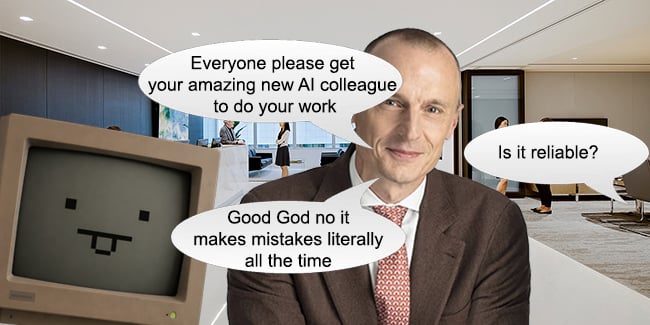
Andrew (r) and an AI which would now be on a performance improvement plan if it was human.
Sullivan & Cromwell, one of the world’s most prestigious – and expensive – litigation firms, has apologised to a judge in the US for submitting a document strewn with errors hallucinated by AI.
Andrew Dietderich, co-head of the elite firm’s global restructuring group, wrote a letter to New York federal judge Martin Glenn this week explaining that another firm had spotted several mistakes in Sullivan & Cromwell’s motion dealing with a high-profile bankruptcy case, and brought them to his attention.
“The inaccuracies and errors in the Motion include artificial intelligence (‘AI’) ‘hallucinations’”, Dietderich admitted.
“We deeply regret that this has occurred”, said the lawyer, and not just because he knew how the legal press would seize on news that a firm where partners charge $2k an hour was thoughtlessly feeding jobs into a chatbot.
Dietderich insisted that Sullivan & Cromwell had all sorts of measures in place to stop just this sort of global embarrassment, but implied that his pesky associates somehow found a way.
“The Firm maintains comprehensive policies and training requirements governing the use of AI tools in legal work. These safeguards are designed to prevent exactly this situation”, he wrote.
Staff access to AI tools was “conditioned on completion of mandatory training” which “repeatedly emphasizes the risk of AI ‘hallucinations’”, he said.
However, the firm’s policies on AI handling “were not followed in connection with the preparation of the Motion” and, “regrettably”, its review process “did not identify the inaccurate citations generated by AI”.
Dietderich told the judge that “I take responsibility for the failure”, but it seems highly likely that someone on his team is about to miss out on their massive bonus and get fired out of a cannon into Wall Street traffic instead: “Failure to independently verify AI-generated output constitutes a violation of Firm policy”, he informed the judge.
Although Sullivan & Cromwell’s AI hallucinated erroneous case citations and summaries, there was some good old human error in the motion, too. Dietderich said the firm’s re-review “did identify non-substantive and/or clerical errors in other filings in this matter” which “we do not believe to be the result of AI usage”.
Achieving a level of irony that would challenge even the latest AI processing chip, Sullivan & Cromwell’s website reveals that it has advised OpenAI on how to ensure the “safe and ethical deployment” of AI.