
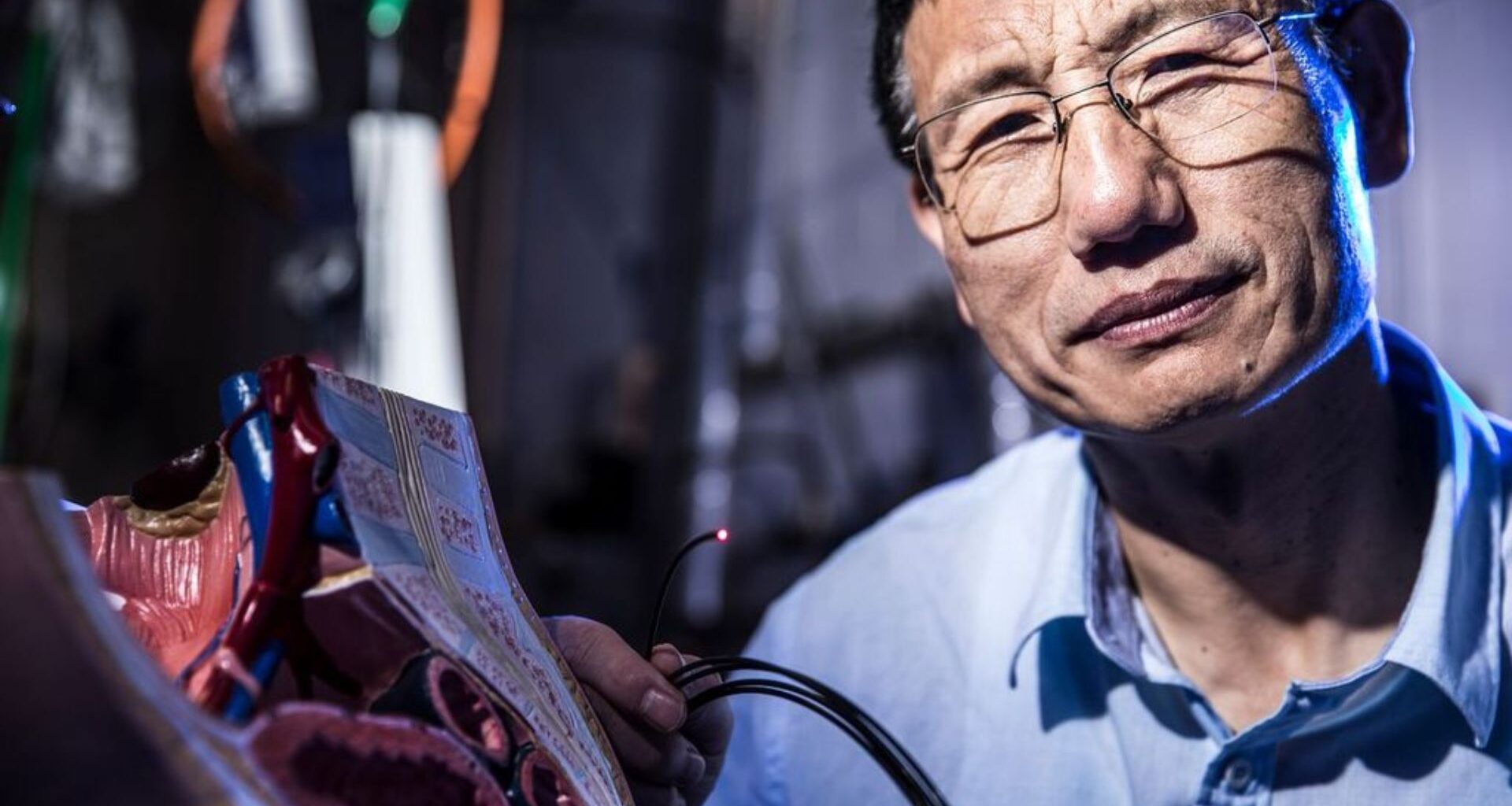
Enbang Li, a senior lecturer at the University of Wollongong’s School of Physics, has developed a simple yet effective technique for bending light using gravity. By doing so, Li has challenged an assumption made by Albert Einstein that the speed of light is constant and independent of the observer’s motion.
Astrophysicists have long used the term gravitational lensing to explain the phenomenon where a distant star’s light is bent by the gravity of the dense celestial bodies in its path. This is an example of the particle-wave duality of light, but bending light on the planet has been difficult.
Now, Enbang Li’s simple, three-foot-long device can bend light and could open up multiple new applications for mapping, monitoring, and navigation systems.
How does the device work?
The device developed by Li is quite small, rising no more than three feet (one meter) tall. It consists of two coils of fiber-optic cable that, if unspooled, would extend to over six miles (10 km).
The device works by comparing the time lag between two beams of light traveling through the fiber optic cable in the spiraling coils and back. The time delays are very small, often just a few picoseconds. However, these data points are scalable and help record the laser light’s disturbance due to gravity.
“Tiny shifts in gravity can reveal critical changes beneath or around us from underground water levels to magma build-ups below volcanoes that could indicate future eruptions,” explained the researcher in a press release. “Our research suggests light-based sensing technologies may one day provide a new way to detect and monitor those changes with very high precision.”
New applications, new perspectives
Gravity sensing is something that is already in use in mining, defense, and geoscience, as it helps ‘see’ beneath the surface by detecting differences in the density of rocks, minerals, water, and tunnels under the ground.
Most of these sensors rely on mechanical systems that detect vibrations and movements, which limits their use on platforms that move, such as submarines and planes.
Light-based detectors, on the other hand, can overcome these limitations and deliver improved sensitivity and stability while occupying a small footprint. Li noted that his device was working under controlled laboratory conditions, which helped calibrate it. His work is still in its early stages, but it can be used to further explore interactions between light and gravitational fields.
The researcher acknowledges that much more work is needed to identify the sources of fluctuations in the time-delay signals detected by the device. While work progresses in this direction, the device also calls into question some fundamental assumptions in physics.
In 1905, Einstein had postulated that the speed of light is constant in a vacuum and independent of the observer’s motion. “Our experimental results suggest that photons can interact with the Earth’s gravitational field in ways that may influence how light transmits, which provides a new perspective on this longstanding assumption,” Li said in a press release.
The research findings were published in Scientific Reports.