
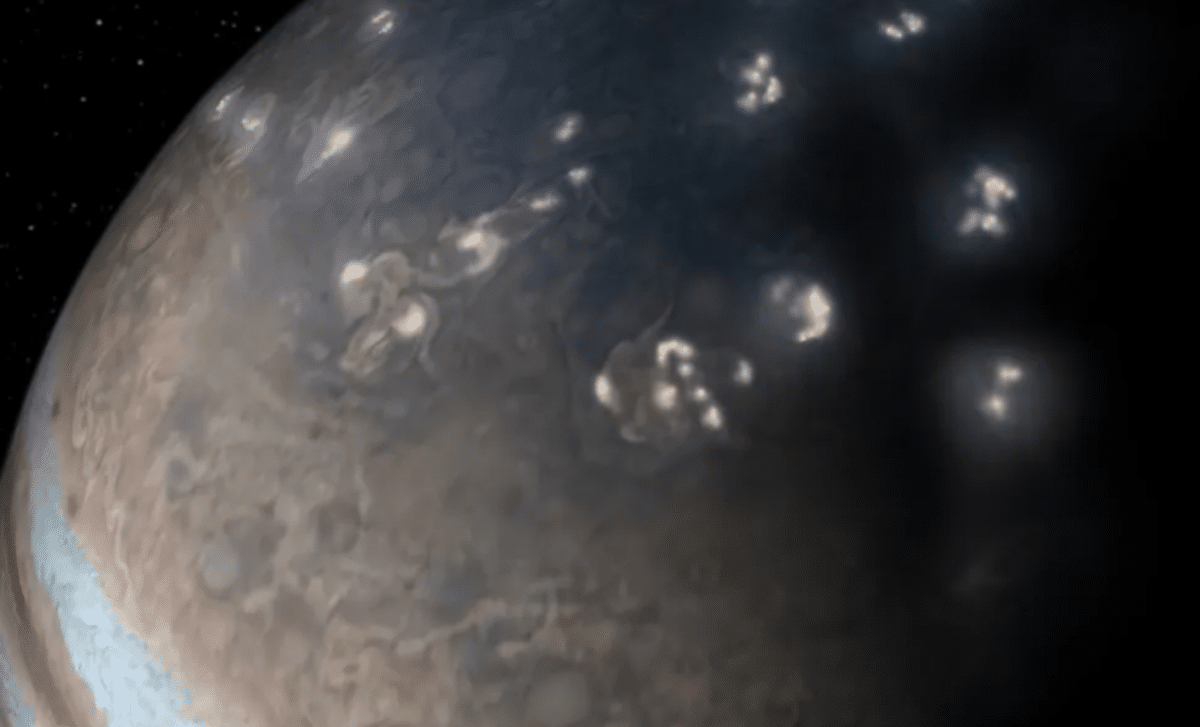
A new study published in AGU Advances reveals that lightning inside Jupiter’s towering storms carries energies that dwarf anything recorded on Earth, opening a new window into how extreme weather behaves on giant planets.
A New Look At Lightning In Jupiter’s Atmosphere
For decades, scientists have observed flashes on Jupiter, yet the true intensity of these events remained uncertain. The latest research changes that by combining precise spacecraft measurements with advanced analysis, allowing researchers to directly estimate the power of Jovian lightning. These findings suggest that storms on the gas giant are not only larger but fundamentally different in how they generate and release energy.
Lead author Michael Wong, a planetary scientist at UC Berkeley’s Space Sciences Laboratory, emphasized how much remains unknown even about lightning at home. “There’s so much we don’t know about lightning on Earth,” he said. That uncertainty makes Jupiter an even more compelling target, as its atmosphere offers a natural laboratory for studying electrical storms under extreme conditions.
By isolating specific lightning events and measuring their energy output, the team gained an unprecedented level of precision. “Because we had a precise location, we were able to just say, ‘OK, we know where it is. We’re directly measuring the power,’” Wong explained. This approach marks a shift from indirect estimates to direct observation, sharpening the scientific picture of how these storms behave.
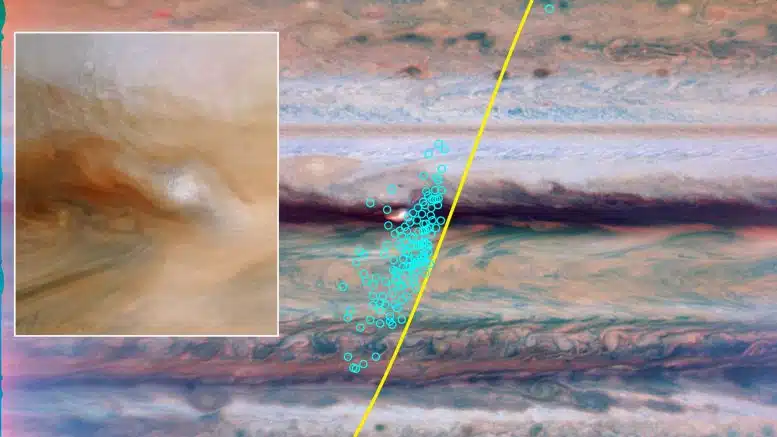 NASA’s Juno spacecraft flew from north to south over Jupiter on August 17, 2022, where it detected a series of lightning-generated radio pulses. Using a background map from the Hubble Space Telescope, scientists traced these signals to a single, isolated “stealth superstorm” in Jupiter’s atmosphere. Inset shows a previous stealth superstorm plume (12 January 2022; 3x greater magnification) from JunoCam data.
Credit: NASA/JPL-Caltech/SwRI/MSSS/Björn Jónsson (JunoCam), Wong et al. (2026, AGU Advances; HST and Juno MWR).
Why Jupiter’s Storms Are So Much More Intense
The scale of Jupiter’s storms is one of the most striking differences compared to Earth. While terrestrial storm systems typically rise about 10 kilometers into the atmosphere, Jupiter’s can extend beyond 100 kilometers. That vertical reach plays a major role in how electrical charges build up and discharge.
“This is where the details start to get exciting, where you can ask, ‘Could the key difference be hydrogen versus nitrogen atmospheres, or could it be that the storms are taller on Jupiter and so there’s greater distances involved?’” Wong said.
The composition of Jupiter’s atmosphere, dominated by hydrogen, contrasts sharply with Earth’s nitrogen-rich air, potentially altering how lightning forms and propagates.
These towering storm systems create longer pathways for electrical discharge, which may allow energy to accumulate to far greater levels before being released. The result is lightning that is not just bigger in scale but potentially governed by entirely different physical processes.
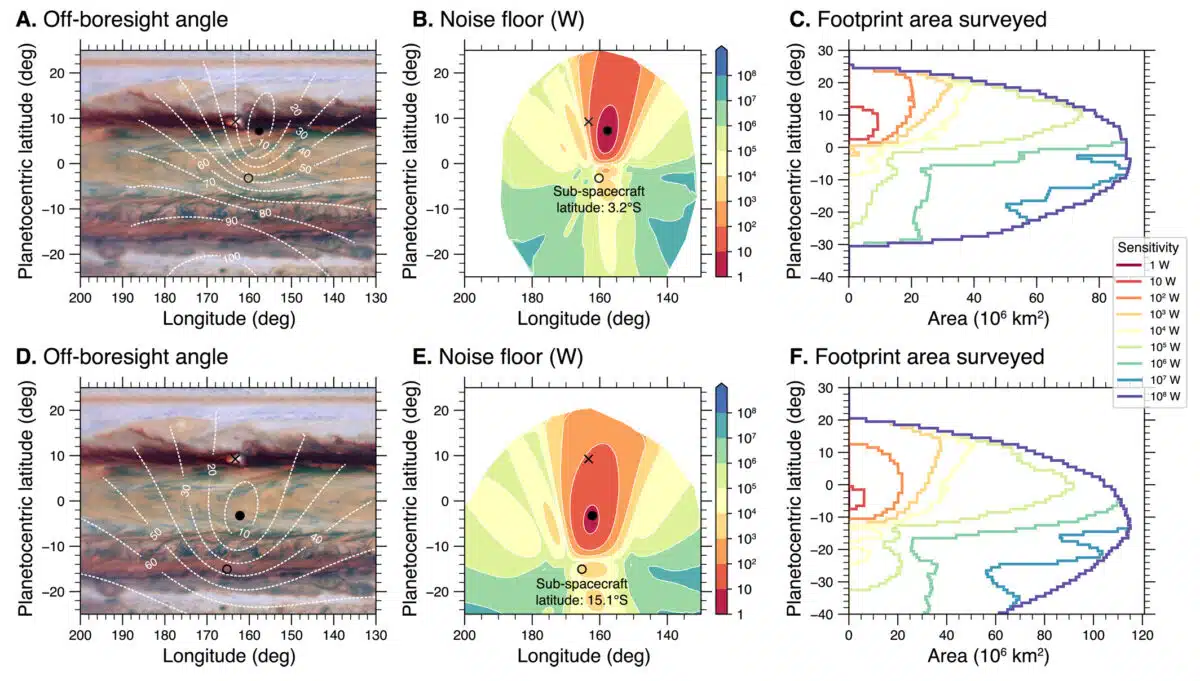 Geometric information corresponding to two individual lightning pulse detections (shown on two rows) during PJ44. The center of the MWR beam (the boresight location) has the highest sensitivity to lightning radio pulses, but pulses can be detected from any location on the planet within view of the spacecraft, just at lower sensitivity. (a, d) Symbols mark key locations for the two pulse detections: filled circle is the boresight location, black × (near the isolated stealth superstorm cloud) is the assumed lightning source, and open black circle is the sub-spacecraft location. Dashed lines show contours of the off-boresight angle, θ, projected onto Jupiter’s 1-bar level. (b, e) The noise floor, or noise-equivalent lightning power (NELP) varies over the full area of Jupiter in view within the horizon. Near the boresight, source power as small as 1 W is above the noise floor, with sensitivity decreasing (noise floor increasing) as the off-boresight angle increases. Spacecraft range to the source also affects the NELP: both detections correspond to approximately the same NELP of 100 W, although the storm is at θ≈20° in panel (a, b), and smaller
θ ≈15° in panel (d, e), because the spacecraft range is greater in panel (d, e) (see Figure 3 if needed). (c, f) For unknown lightning source positions (not the case here), each pulse detection corresponds to a footprint area surveyed (binned per 1° of latitude). The area surveyed is important for understanding lightning flash rates per unit area on Jupiter. In the case of a known (or assumed known) source location, it is the integrated time on the source location that leads to flash rates. For example, each sample here adds 0.1 s (the MWR integration time) to the time that Juno surveyed the PJ44 stealth superstorm at a sensitivity of 100 W NELP.
Credit: AGU Advances
The Role Of Heat And Energy In Giant Planet Storms
Another key factor lies in how storms are fueled. On Earth, lightning forms in clouds driven by relatively moderate heat differences. On Jupiter, the process involves massive buildups of energy tied to moist convection in a deep, dense atmosphere.
“Or could it be that greater energy is available because with moist convection on Jupiter, you have a bigger buildup of heat needed before you can generate the storm to create lightning?” Wong added. “It’s an active area of research.”
This suggests that before lightning even occurs, Jupiter’s storms may store far more energy than their Earth counterparts. That stored energy is then released in powerful bursts, producing flashes that surpass terrestrial lightning in both scale and intensity. The study, published in AGU Advances, highlights how these mechanisms remain only partially understood, pointing to the need for further exploration.