
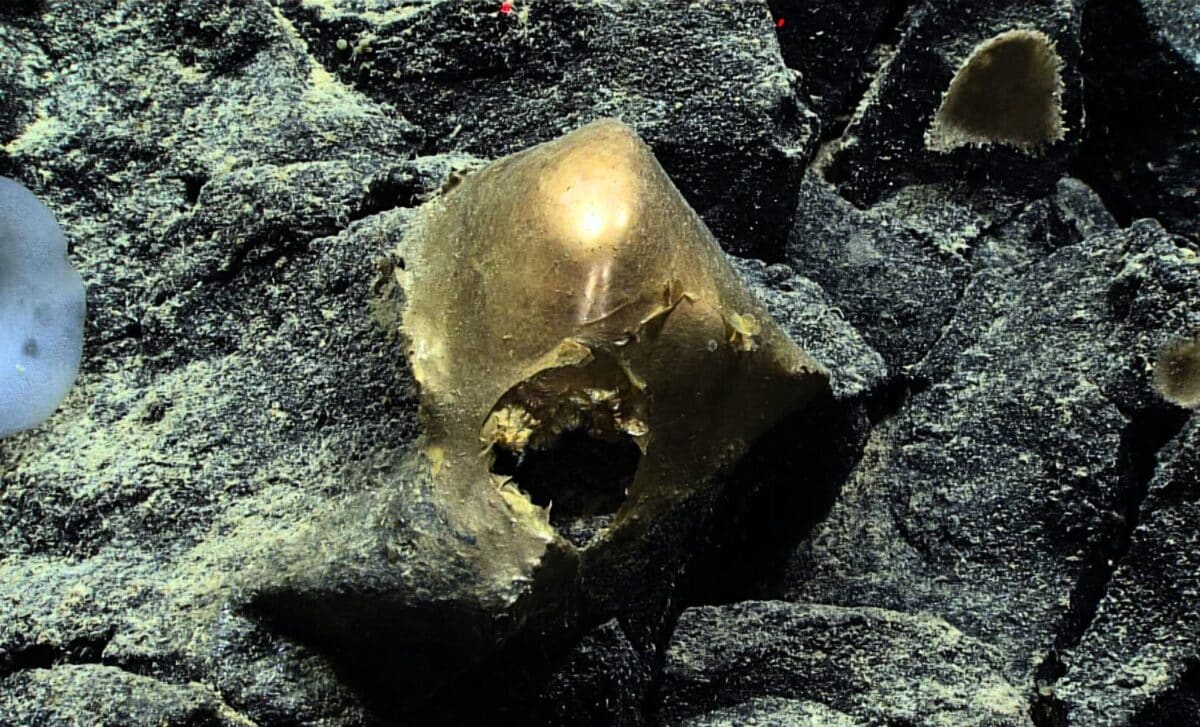
In 2023, a remote-controlled vehicle exploring the Gulf of Alaska seafloor spotted a smooth, golden sphere shimmering in its floodlights. It was glued to a rock, no bigger than a softball, with a single tear near its base. No one on the expedition could identify it. After three years of laboratory work, scientists finally revealed this week the real nature behind the so-called “golden orb”.
The specimen, described in NOAA’s announcement on April 22 and detailed in a preprint posted to bioRxiv, was confirmed as a cuticle shed by Relicanthus daphneae, a deep-sea cnidarian whose tentacles can stretch longer than a car.
The hunt began on August 30, 2023, when NOAA’s remotely operated vehicle Deep Discoverer encountered the orb roughly 3,300 meters below the surface in the Gulf of Alaska. It glowed pale gold in the ROV’s lights. A small hole near its base revealed an interior of the same color.
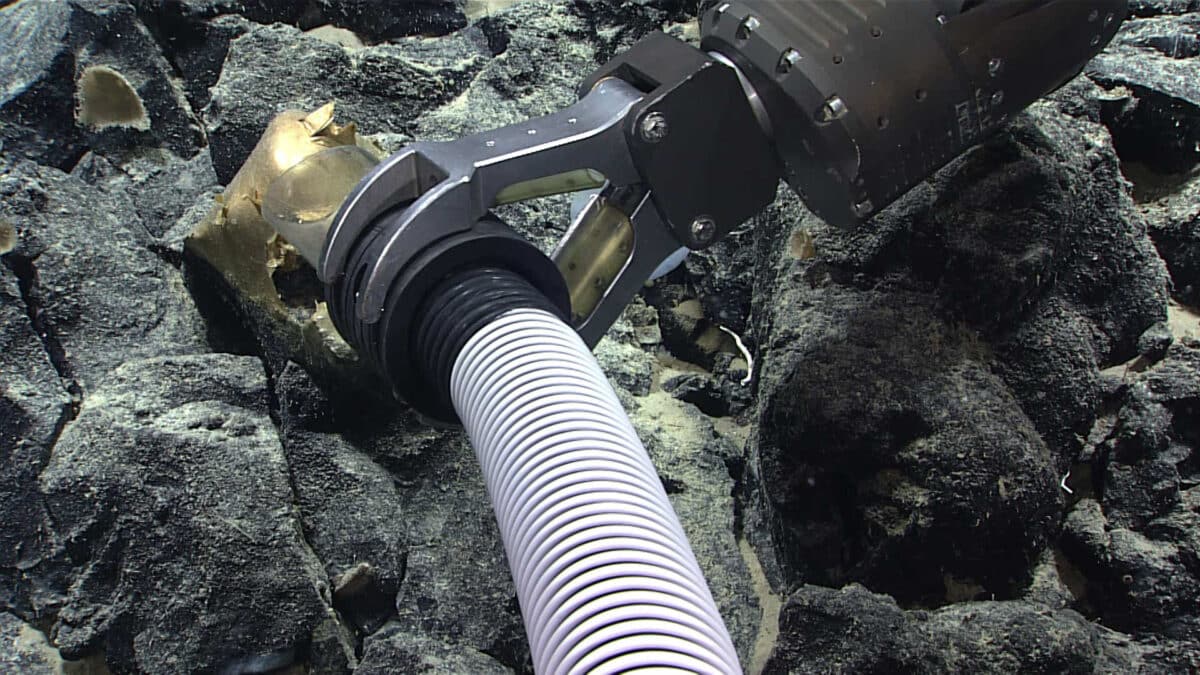 This gold specimen was collected using a suction sampler on remotely operated vehicle Deep Discoverer. Credit: NOAA Ocean Exploration/Seascape Alaska
“I don’t know what to make of that,” one researcher said on the expedition’s live feed, a clip that ricocheted through media outlets. Another voice added, “I just hope when we poke it, something doesn’t decide to come out. It’s like the beginning of a horror movie.”
The team collected the specimen with the ROV’s robotic arm and sent it to the Smithsonian Institution’s National Museum of Natural History. There it entered the Invertebrate Zoology Collection under accession number USNM_IZ_1699903.
Initial DNA Screens Failed
Zoologist Allen Collins of NOAA Fisheries‘ National Systematics Laboratory expected routine processes to crack the case quickly. They didn’t.
“We work on hundreds of different samples, and I suspected that our routine processes would clarify the mystery,” Collins said. “But this turned into a special case that required focused efforts and expertise of several different individuals.”
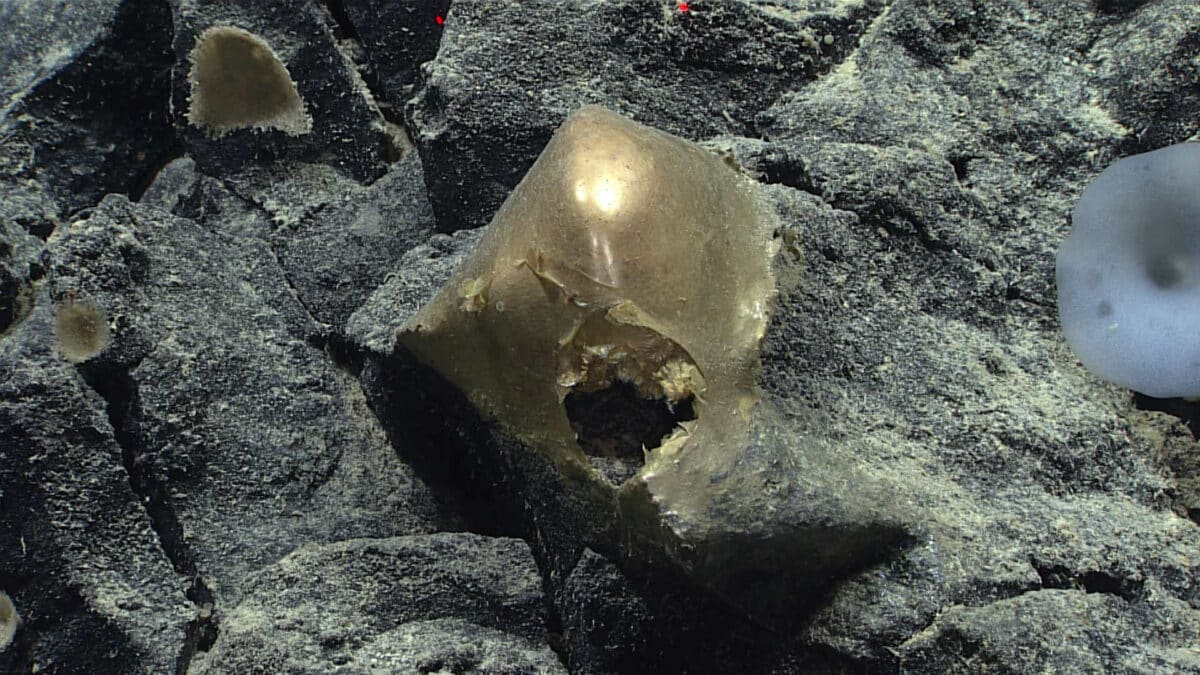 This gold specimen seen in situ on a rocky outcropping at a depth of about 3,300 meters (2 miles). Credit: NOAA Ocean Exploration/Seascape Alaska
The orb defied easy analysis. It had no recognizable internal anatomy. Under a microscope, it was a fibrous mass. The first DNA tests failed outright because the sample was swarming with microscopic organisms whose genetic material drowned out the target signal.
Collins and his colleagues shifted to whole-genome sequencing, stripping away the contamination until a single species emerged: R. daphneae, a giant anemone first described from the East Pacific Rise in 2006 and later reclassified into its own genus in 2014 via a study in the journal PLOS ONE.
Stinging Cells Pointed the Way
While geneticists worked, a histological clue narrowed the path. The orb was packed with spirocysts, a specialized type of stinging cell found only in Hexacorallia, the class that includes stony corals and sea anemones. The spirocysts inside the golden orb ranked among the largest ever measured for a deep-sea cnidarian, matching the oversized adhesive cells that R. daphneae uses to ensnare prey.
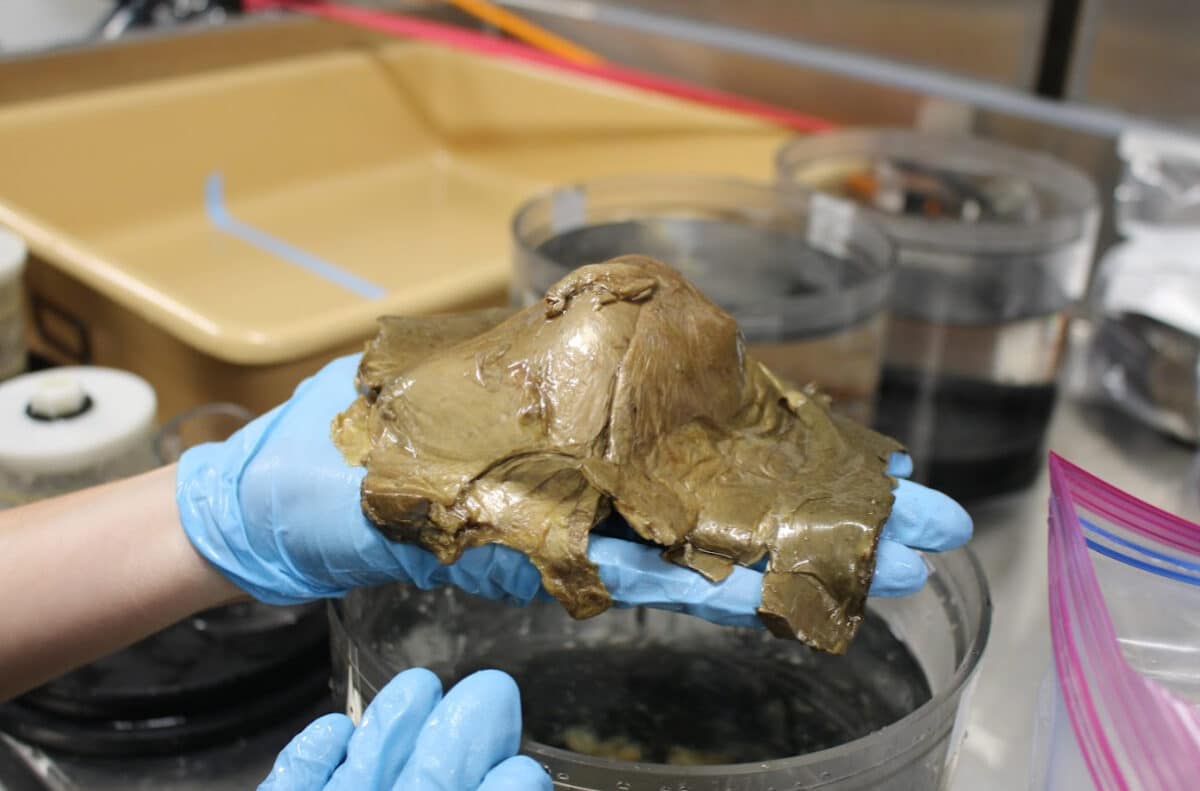 This gold specimen photographed in the wet lab on NOAA Ship Okeanos Explorer. Credit: NOAA Ocean Exploration/Seascape Alaska
The living animal looks nothing like the orb. Its body is pale pink to purplish-red, up to a meter across, with thin, tapered tentacles that can reach more than 2 meters in length. Adults anchor themselves on basalt near hydrothermal vents, manganese nodule fields, and cold seeps at depths between roughly 2,400 and 4,400 meters, according to the 2006 species paper in Marine Biology.
A January 2025 record published in the Journal of the Marine Biological Association expanded the known range of R. daphneae to the Indian Ocean. That paper, led by Dalhousie University researcher Monika Neufeld, also captured the first direct footage of the anemone feeding, showing a tentacle coil around a shrimp and tighten.
A Piece of Skin Left Behind
The golden orb, Collins and his colleagues explain, is a cuticle: a thin, multilayered coating that some anemones secrete from their outer tissues. Its main ingredient is chitin, the same tough polysaccharide found in beetle shells and fungal cell walls. Earlier expeditions noted that collected specimens of R. daphneae rarely carried a cuticle, which suggests the animal can peel free and leave it behind as it moves across the seafloor.
The research team offers a second possibility. Certain sea anemones reproduce asexually through pedal laceration: the polyp abandons its lower body, creeps away, and regrows from the remaining tissue. The golden orb, with its central opening and fibrous structure, may be the remnant of an incomplete reproductive attempt. This behavior has not yet been confirmed in R. daphneae.
A Meal for Microbes, Miles Down
Even as dead tissue, the shed cuticle appears to serve a role. The density of microorganisms that colonized the orb before it reached the lab suggests these cast-off skins create small-scale hotspots for deep-sea bacteria. In an environment starved of energy, chitin-rich debris feeds the nitrogen cycle and can sustain microbial communities for months.
“This is why we keep exploring,” said NOAA Ocean Exploration acting director Captain William Mowitt in the April 22 announcement, “to unlock the secrets of the deep and better understand how the ocean and its resources can drive economic growth, strengthen our national security, and sustain our planet.”
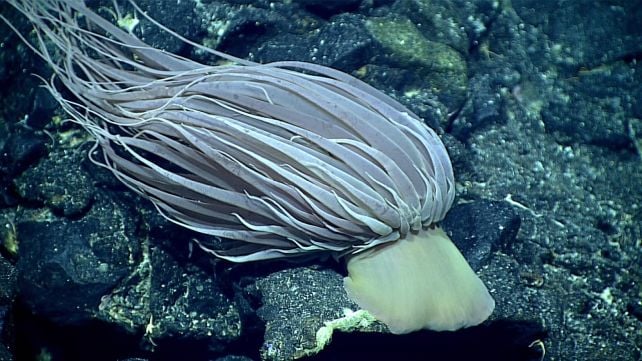 A specimen of R. daphneae clinging to a rock, observed during a 2016 NOAA expedition to the Mariana Islands. Credit: NOAA Ocean Exploration/Deepwater Exploration of the Marianas
The identification closes a case that started with a joke about horror movies and ended with a biological strategy the surface world is only beginning to grasp.
Suggested image: A close-up photograph of the golden orb specimen under laboratory lighting at the Smithsonian Institution, showing its smooth dome, central hole, and the pale golden coloration visible during the 2023 NOAA expedition.