
He could tell from my initial reaction I was sceptical. I’m used to people mistaking, for example, buzzards for golden eagles in the Highlands of Scotland. Another neighbour once assured me they had an eagle owl living in the back garden – until I showed her a photograph of a tawny owl. ‘Aah, yes. That was it,’ she decided.
But I made a few enquiries and I think it quite possible the neighbour this time had in fact seen a sea eagle (white-tailed eagle, to give it its more proper name). Because this extraordinary bird is coming back. They are being tracked using the latest technology, so we can see where they are turning up, and when, and how they are adjusting to life in our world once again. And Norfolk is one of the places the eagles seem drawn to.
Recently, I received a message from Zoe Smith, who is one of the trackers, working for the Roy Dennis Foundation. Zoe told me that a young female eagle, released this summer in the Isle of Wight, was making her first excursion to the mainland and had made a beeline for north Norfolk. Zoe is Norfolk-based and agreed to take me to see if we could find this bird – and maybe even follow its movements more closely.
A young white-tailed eagle (Image: Debbie Pain)
It was a sunny and quite blustery late summer day, and the eagle – leg ring code G735 – was moving about quite a bit, between patches of trees. Zoe’s readings were telling her where the bird was, every half hour or so, and to begin with we were playing catch-up. We followed the eagle trail to Ringstead Downs, the Norfolk Wildlife Trust’s lovely nature reserve near Hunstanton. Parked up on a quiet roadside, we scanned the horizon from a safe vantage point. In truth, I wasn’t confident. Eagles can spend a long time ‘loafing’ in treetops, out of sight.
I have tried before to see birds reported locally, without success.
‘They are very well camouflaged when young,’ Zoe explained. ‘And very unpredictable in their movements. She might hang around here for some days, or she might just up and fly all the way to Dorset. You never know!’
What’s clear is just how wonderfully mobile the eagles are, even at a young age. White-tailed eagles only reach full adulthood at about five years old, usually. But this year the first birds from the Isle of Wight-centred reintroduction programme have bred in Dorset. Following the successful nesting of birds in Sussex in the last two years, it shows that the scheme is working well.
The eagles are satellite-tracked so that the team can monitor the progress of the young birds and how they are exploring the landscapes of southern Britain. The species has been absent from here since the last pair bred on the Isle of Wight way back in 1780 (nearly 250 years ago). Such magnificent creatures were prized as trophies and often fell victim to private collectors, who would pay great sums for a specimen to stuff and mount and show off to friends.
I ponder all of this as we continue to scan the Norfolk horizon, so far seeing only buzzards and red kites to briefly kindle my hopes. And then she appears, a great flapping shape low over the trees at the far end of a vast, recently harvested field. ‘That’s her!’ Zoe announced, eye pressed to the telescope. As if to help us get a scale on this eagle, a buzzard was following, dwarfed by her. We followed the eagle’s progress as she flew against the wind, before settling again in another patch of trees. She was probably trying to find a spot where she could loaf in peace, according to Zoe. The pestering by other birds can become tedious.
Zoe patiently watched the spot where the eagle went down. Eventually it rose again and continued its expedition. I managed to get a photo of her, a distant dark outline over Heacham Tower, with now a red kite close by, again so much smaller and giving some sense of the immense size of the eagle. When she dropped out of sight again, we followed. She was heading south again, in the direction of the very place where my neighbour had reported seeing one, a year earlier. You might say I’m a little less sceptical now.
This has been my first English eagle sighting and it was great to have it so close to home. I have known these birds in Scotland, where they were also extinct until reintroduction began in the 1970s. There are now around 200 pairs there.
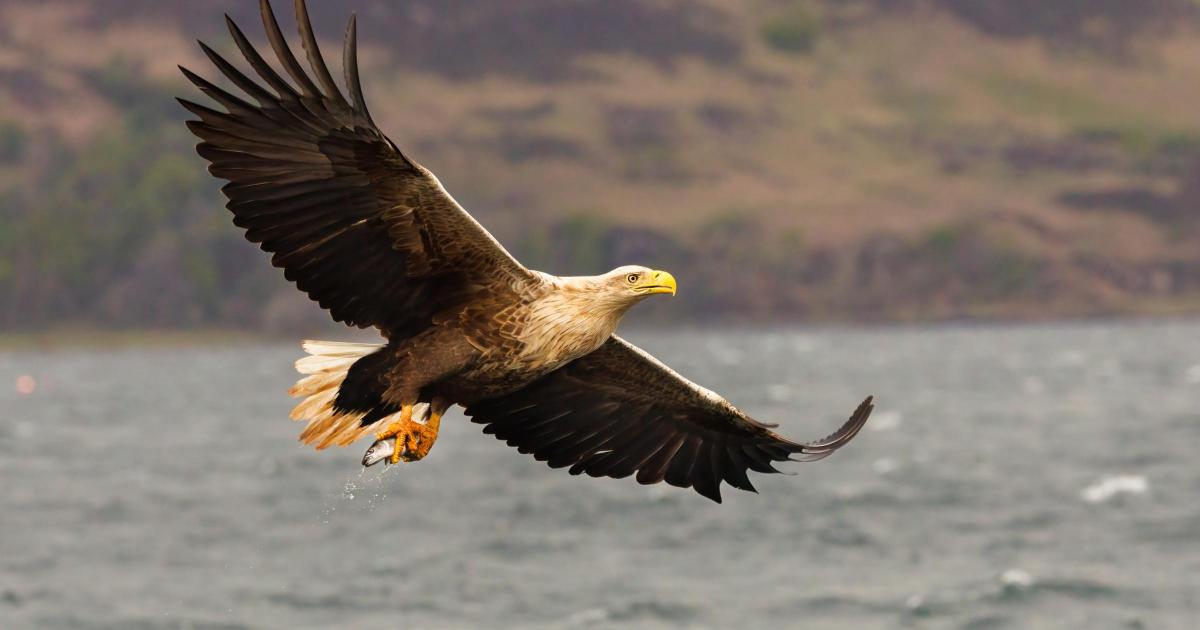
A white-tailed eagle in flight (Image: Chas Moonie)
The economics of eagles
The island of Mull has been one of the focal points of this story. A study of the economic impact of white-tailed eagles in the Isle of Mull has revealed the scale of the financial benefits they bring to the island. Eagle tourism accounts for between £4.9million and £8million of spend every year here. This money supports between 98 and 160 full-time jobs, and between £2.1million and £3.5million of local income annually.
White-tailed eagles are versatile in their choice of food. They often scavenge carrion, but are adept at plucking fish from both the sea and inland water bodies, as well as catching gulls, wildfowl, rabbits and hares, where they can. They have a wingspan of up to 8 feet – basically the dimensions of a door. And they usually nest in tall trees, which can be inland as well as near coastal habitats.
It will be some years before young visiting birds like G735 might settle to breed in Norfolk, from the Isle of Wight releases, but in the meantime, we can expect more visits to the rich natural habitats of our coasts here.
Excitingly, white-tailed eagles from continental Europe have also been recorded recently visiting East Anglia, identifiable by the tags placed on them by researchers, and demonstrating that these birds can and do also cross the North Sea. In the future, the populations here and overseas should become continuous. Rewilding projects are happening in many places now and it is clear that species like the white-tailed eagle are fundamental to repairing and restoring healthy ecosystems, for wildlife and for people. They are the crowning glory of wild places, so beloved of local people and visitors alike..
Visit roydennis.org