
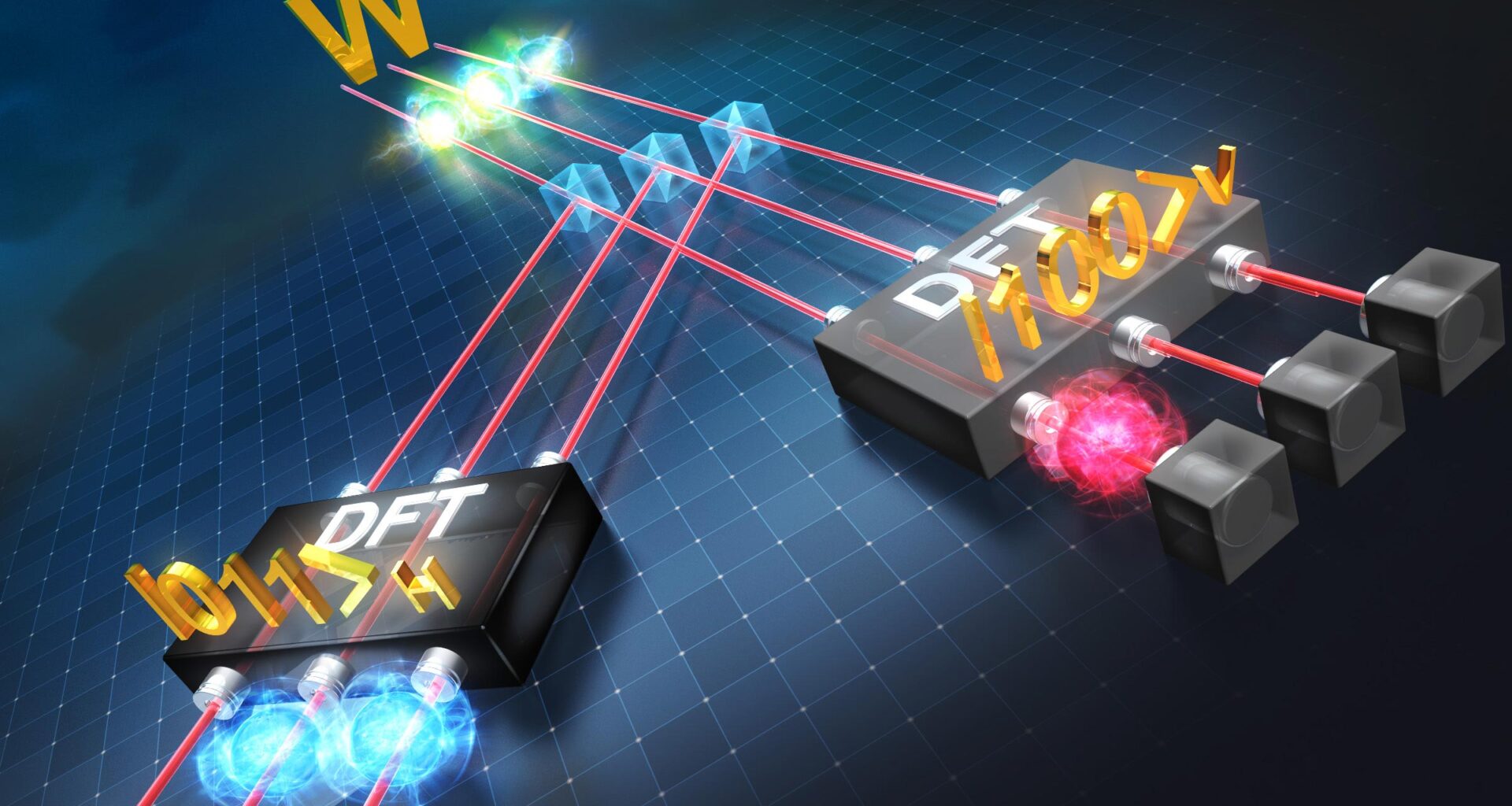
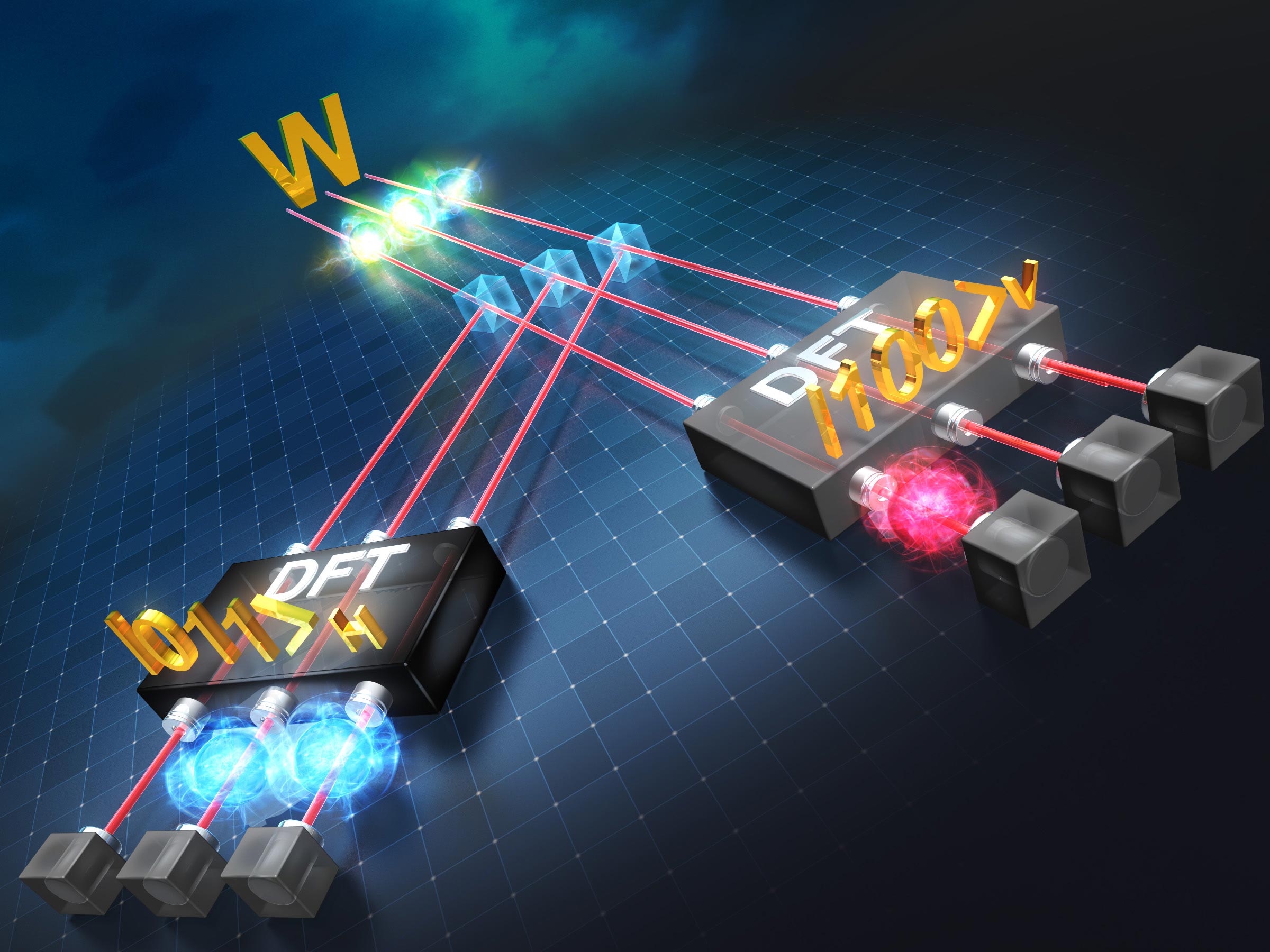
 Achieving the entanglement measurement of the W state. Credit: KyotoU / Takeuchi lab
A new method reveals hidden order in quantum systems, potentially transforming how they are measured and used.
A long-standing challenge in quantum physics may finally have a practical solution. Researchers in Japan have developed a new way to identify complex quantum states in a single step, potentially removing one of the biggest bottlenecks in building real-world quantum technologies.
The advance centers on a specific type of entanglement known as a W state. Unlike other well-known quantum states, W states are more resilient. Even if one particle is lost, the remaining particles can stay entangled. This makes them especially attractive for quantum communication systems, where losses are unavoidable.
Why W States Are Difficult to Measure
Despite their advantages, W states have been difficult to measure. Traditional methods rely on quantum tomography, which requires a huge number of repeated measurements. As more photons are added, the workload grows exponentially, making the process slow and impractical.
Scientists have long known that a more efficient method exists in principle. Entangled measurements can reveal the full state in a single operation. These have already been demonstrated for simpler systems and for Greenberger-Horne-Zeilinger, or GHZ, states. But until now, no one had successfully applied the idea to W states.
A team from Kyoto University and Hiroshima University set out to close that gap.
A New Approach Using Symmetry
“More than 25 years after the initial proposal concerning the entangled measurement for GHZ states, we have finally obtained the entangled measurement for the W state as well, with genuine experimental demonstration for 3-photon W states,” says corresponding author Shigeki Takeuchi.
Instead of tackling the problem head-on, the researchers focused on a hidden pattern within W states called cyclic shift symmetry. This property means the overall state remains unchanged when the positions of the photons are rotated. By designing an optical system that detects this symmetry, they found a way to directly identify the state.
Their device uses carefully prepared photons sent through a network of optical components that perform a type of transformation known as a Fourier transform. The way the photons exit the system reveals which W state was present, eliminating the need for large-scale data collection.
Experimental Validation
To test the idea, the team built a stable three-photon setup that could run for extended periods without adjustment. The system successfully distinguished between different W states, confirming that the approach works in practice.
This breakthrough opens the door to advances such as quantum teleportation, along with more secure communication and new forms of distributed quantum computing. By making entanglement easier to measure, the method could also help enable more reliable and scalable quantum networks made up of many connected systems.
“In order to accelerate the research and development of quantum technologies, it is crucial to deepen our understanding of basic concepts to come up with innovative ideas,” Takeuchi says.
The next step is scaling the technique to larger systems and integrating it into compact photonic chips. If that succeeds, it could help move quantum technology out of the lab and into everyday use.
Reference: “Entangled measurement for W states” by Geobae Park, Holger F. Hofmann, Ryo Okamoto and Shigeki Takeuchi, 12 September 2025, Science Advances.
DOI: 10.1126/sciadv.adx4180
Never miss a breakthrough: Join the SciTechDaily newsletter.
Follow us on Google and Google News.