
This time last year, The Oldham Times reported on the finding of an American signal crayfish and there have been several sightings since then.
Curious to spot one myself, I decided to take a stroll along the Huddersfield Canal and River Thame to see what I could find.
The weather was perfect for a walk, and the route offered peaceful views and plenty of other wildlife, with ducks, geese and even the odd squirrel spotted.
The crayfish found last year (Image: Dominic Bamber)
I parked at King George Playing Fields car park and headed up to the Huddersfield Canal first.
I walked for about 20 minutes in one direction along the canal before looping back to my starting point and heading the other way for another 20 minutes.
While I could see into the few shallow parts of the canal, much of the water was too deep to spot anything below the surface.
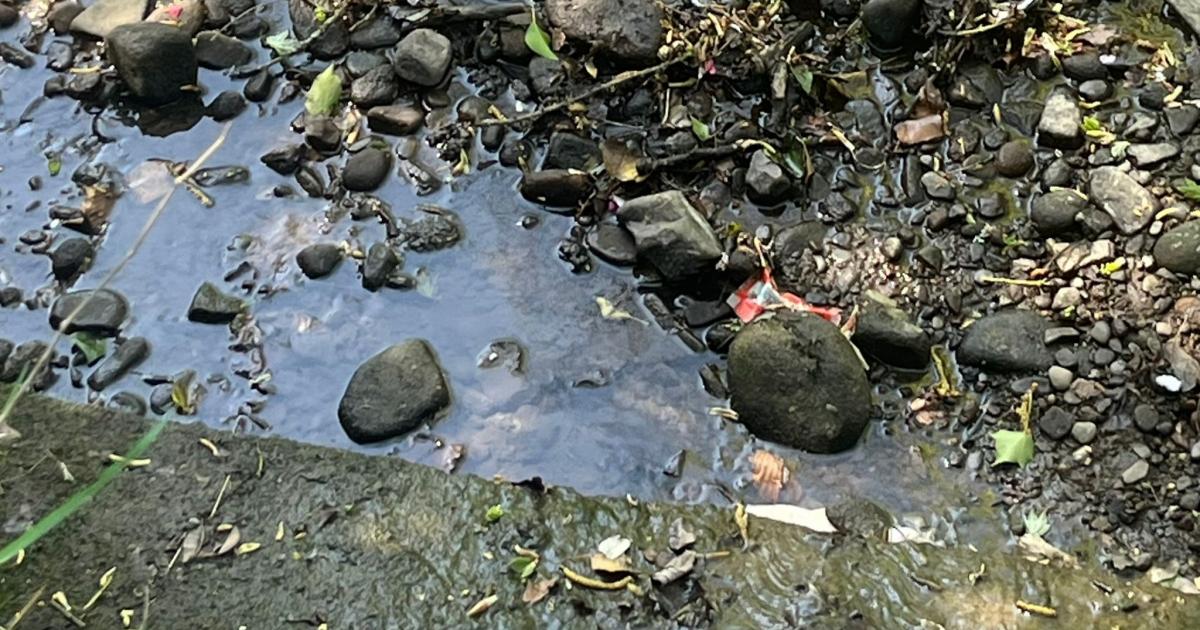
Part of the river I searched (Image: NQ)
I then explored the river as far as I could, stopping only when the path ended.
Hoping for better luck near the stepping stones in Uppermill Park, I peered into the water but saw nothing unusual.
I must have looked a bit weird, to be honest, walking up and down with my eyes glued to the water.
Especially so when I risked jumping down onto the rocky riverbank and crawled under the bridge which carries Uppermill High Street above the river.
Despite my efforts, no crayfish made an appearance during my walk.
The bridge I went looking under (Image: Google)
That said, it was a relaxing outing with beautiful scenery, even if it didn’t result in a sighting.
Since then, I’ve looked through social media posts about past crayfish discoveries and made a list of suggested spotting locations.
I’ll be heading to those spots on my next outing in the hope of better luck.
River Thame (Image: NQ)
For those unfamiliar, the signal crayfish is an invasive species that has caused serious environmental damage across the UK.
While I didn’t manage to spot any, there’s still some weight to the claims they can be found, considering in the two years I have worked at The Oldham Times, there have been three sightings we’ve reported on.
The one last April was the first, followed by one discovered during an attempt to clean up the River Beal in September, and then another in October, spotted by children at the same stepping stones I looked at.
Before these, one was also found in Daisy Nook Country Park.
According to the Canal and River Trust (CRT), signal crayfish are larger and more aggressive than the native white-clawed crayfish.
These red-brown crustaceans, identified by a white or turquoise mark near the claw hinge, are present as England’s native crayfish are in a state of fast decline, with their numbers having reduced by more than 50 per cent since the 1970s.
An American signal crayfish in the River Tame (Image: Supplied)
Originally introduced from North America in the 1960s to be farmed for restaurants, signal crayfish escaped into the wild and quickly spread through British waterways.
The CRT warns that signal crayfish can burrow up to two metres into banks, causing severe erosion and potentially leading to canal collapses.
They also pose a direct threat to native wildlife.
The creature, which is thought to be an American (Image: Cllr Sarah Hince)
The CRT said: “The American signal is larger and more aggressive, outcompeting its docile cousin for habitat and preying on its young.
“It also carries a fungal disease called ‘crayfish plague’, which is fatal for the white-clawed, and can be spread by wet footwear and equipment.”
Armed with my trusty list of locations and with another walk on the schedule, I’m determined to spot one of these invasive crustaceans.