
Like Ben Lerner, I have undergone major heart surgery. Unlike Lerner, I was only a few months old when it happened, so I didn’t have the ability to write about it in the New York Review of Books, as the celebrated American novelist and poet did last year, not long after his operation to replace a diseased section of his aorta, the largest artery in the body.
Since almost all my life has taken place after a by-all-accounts excellent repair of Tetralogy of Fallot – a certain set of problems with the heart’s valves, basically – I couldn’t give you an insightful before-and-after of it. But Lerner’s heartbeat felt different to him once he was sewn back up. The physical rhythm of sentences felt different too. “It intensified my sense of writing as recording the vicissitudes of the body,” he says. His fourth and latest novel, Transcription, “was pretty done when all the medical stuff happened”. But when he had recovered enough to do the final edits, everything about the book seemed “a little changed”.
Though not even the pushiest publicist would add heart surgery to a client’s marketing campaign, Lerner’s lesson about the physicality – the humanity – of writing was right on theme for Transcription, and for the technological moment it’s been published into. “AI can [produce] writing we can’t tell apart from human writing, for sure,” Lerner says. “But I think this book is an argument that there’s some kind of miracle of transmission that happens when a human encodes their voice and heartbeat in a sentence. And that’s not something AI does.”
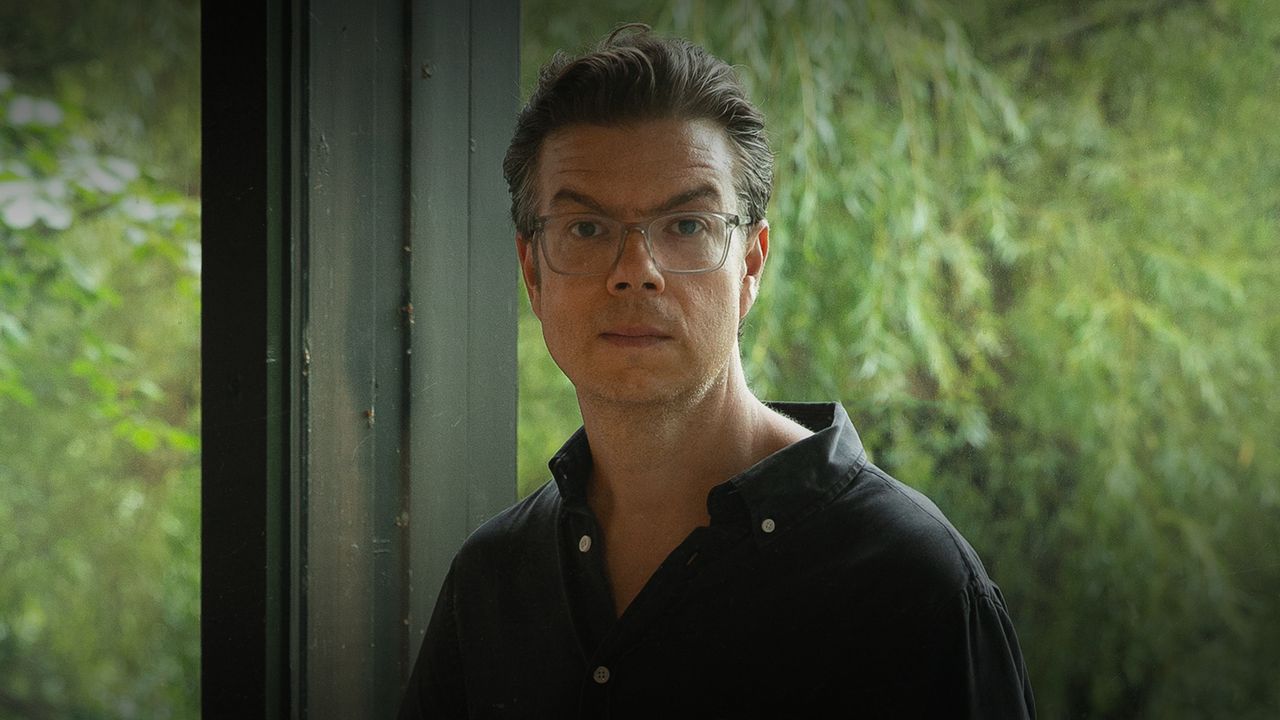
Lerner, when we meet in a pub in central London, is dressed in a modest uniform of black boots, skinny-ish jeans and a jumper. His eyebrows, sloping dramatically downwards towards his nose as if they’re perpetually furrowed, are just as impressive in person. He’s now 47, and has a bit of grey at his temples, as well as two daughters, aged 13 and 10; earlier today he was out buying them stuffed toy pigeons.
His previous three novels, Leaving the Atocha Station, 10:04 and The Topeka School, are autofictional versions of his younger years: born to two psychologist parents in Kansas; a champion debater at school; moving to Madrid on a scholarship to write poetry, then coming back to America to write in full sentences. Pyrotechnic prose and metafictional subtleties won these books a lot of praise, and Lerner won a lot of awards – including, in 2015, a MacArthur Fellowship, the so-called “genius grant” bestowed on brilliant people of any field. But to me, and certain dissenting critics, these novels sometimes get too pleased with their own intricacies and ambiguities. Their narrators can sometimes be anxious and misanthropic to the point where they stop being nuanced and compelling and instead become plain bad company on the page.
Transcription silences any doubts about the Lerner hype. In three parts, and not much more than 100 pages, it’s both more disciplined and more moving than its predecessors. In contrast to The Topeka School, which has an ending very pointedly about the first Donald Trump presidency, Lerner wanted his narrator’s opinions to be “quiet and around the edges” here, he says. “I didn’t want more essayistic interrogations into the prehistory of the American present.”
Nevertheless, the novel does take on modern technology: in the opening section, a writer’s phone breaks just before he’s due to interview his old academic mentor. “Since at least 2008, to be where I was was too much for me, or too little,” he thinks – being stuck in the physical world without a digital escape hatch in his pocket is both too overwhelming and too boring at once. Rather than confess he’s unable to record the conversation, the unnamed narrator simply pretends he still can, then writes up a semi-fictionalised account of it.
This premise could end up a gimmick, but what Transcription actually blooms into is a story of fatherhood. Thomas, the mentor character, is a good teacher to the narrator but a terrible father to the narrator’s friend, Max. Fatherhood, Lerner says, “intensifies your experience of how your voice is not your own. You open your mouth and this ‘father’ stuff comes out. It might be your father’s voice, or what you wish your father is, or a literary representation of the father.”