
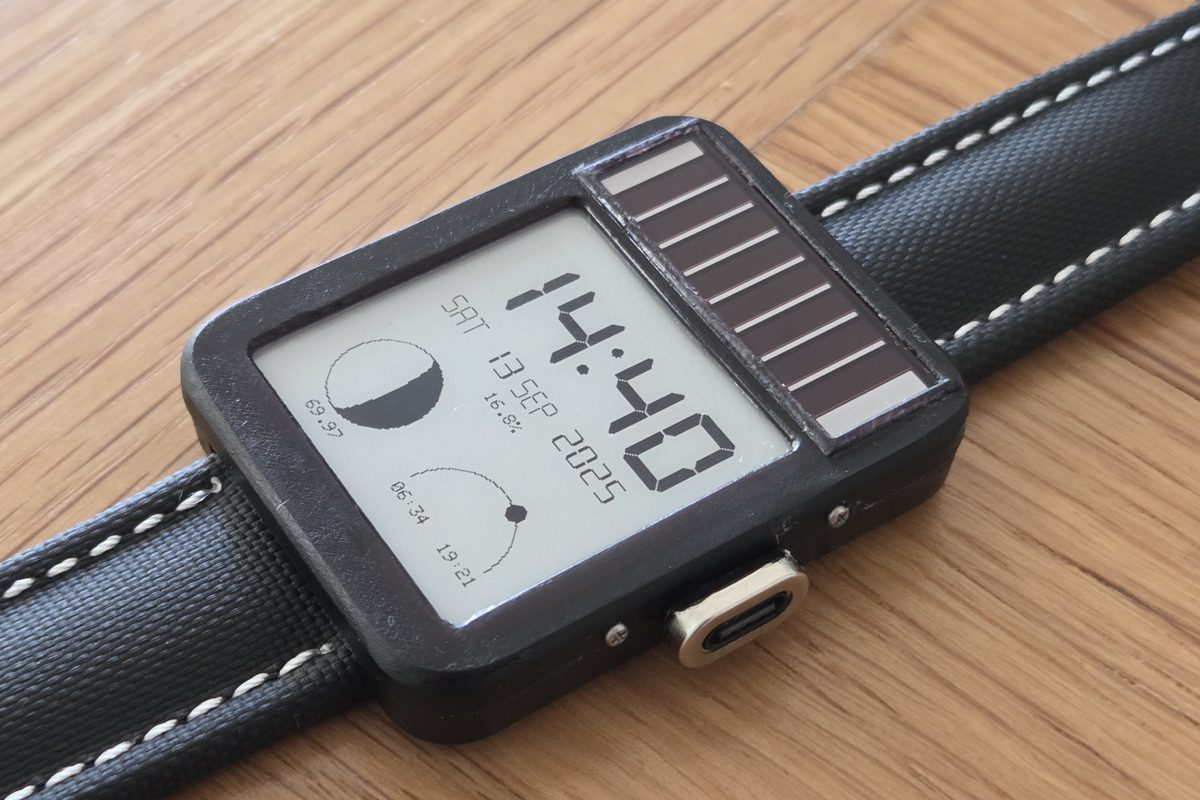
Daniel Ansorregui has developed LightInk, an open-source solar-powered E-ink watch inspired by 90s solar digital watches. It features a 1.54-inch e-paper display and supports Wi-Fi, Bluetooth, LoRa, and GPS, running on a 100mAh battery.
The project integrates a custom low-quiescent-power design using a TPS63900 buck-boost converter, capacitive-touch input, and deep-sleep-driven firmware, along with ultra-fast partial e-ink updates (<1 ms active time) and precise RTC timekeeping with drift calibration. It also supports solar-first operation (no dedicated charging IC) and dynamic power gating of peripherals, enabling around 9–10 months of operation on a small battery supplemented by solar power.

LightInk specifications:
System-in-package – ESP32-PICO-D4 SiP
CPU – Dual-core processor @ 240MHz
Memory – 520KB SRAM
Storage – 4MB flash
Wireless – 2.4 GHz Wi-Fi 4 up to 150 Mbps and Bluetooth 4.2 BR/LE connectivity
Display – 1.54-inch 200×200 B/W e-Paper panel (GDEH0154D67 or compatible)
Audio – 10-15mm piezo electric disc speaker
Connectivity
2.4 GHz 802.11b/g/n Wi-Fi 4 and Bluetooth 4.2 BR/EDR via ESP32 SiP
LoRa via a Wio-SX1262 transceiver
GPS
Misc
Capacitive touch buttons utilizing the ESP32’s internal touch pins
3V 2.0 mm circular mini vibration motor
LED light pins
RTC with manual drift calibration (targeting 1ppm, currently at 10ppm)
Power
TPS63900 buck-boost converter (1.8V to 5.5V, 75-nA IQ) operating dynamically at 2.6V/2.9V
Solar cell input
100mAh battery
Dimensions – TBD
Enclosure – 3D printed

Daniel mentions that the project was started in 2019 using a Heltec Wireless Stick Lite. While platforms like the SQFMI Watchy provided a good starting point, Ansorregui focused on improving power efficiency and adding features like LoRa and solar support without increasing the size.
 Watchy vs LightInk
He goes on to say that the main challenge in building an ultra-low-power ESP32 wearable is the boot process, as an ESP32 typically takes about 28 ms to boot and consumes several milliamps of power before doing any useful work. To reduce this overhead, Daniel uses the ESP32’s wake stub, a function pointer in the RTC memory that allows the core to run code immediately upon waking, in microseconds, bypassing the flash entirely.
By completely reimplementing SPI communication within the wake stub, the device can boot, send data, and update the display controller buffer in less than 1ms. The ESP32 is then immediately put back into deep sleep while it waits for the e-Paper display to refresh. This drastically reduces light-sleep power draw, extending battery life to an estimated 6 to 10 months on just a 100mAh battery.
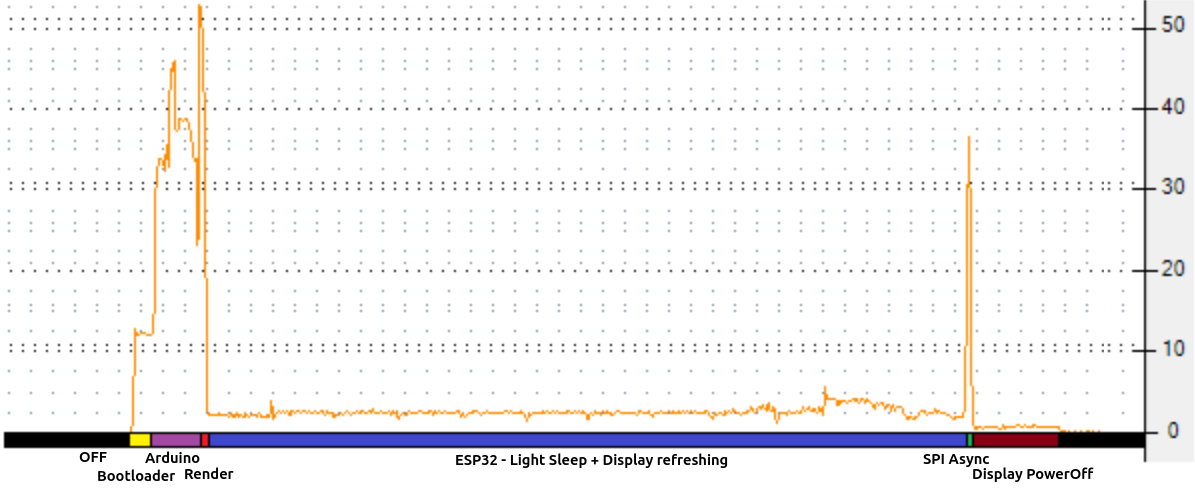 A typical GxEDP2 display update cycle using the standard Arduino core, showing the massive energy overhead required during the initial ESP32 boot sequence
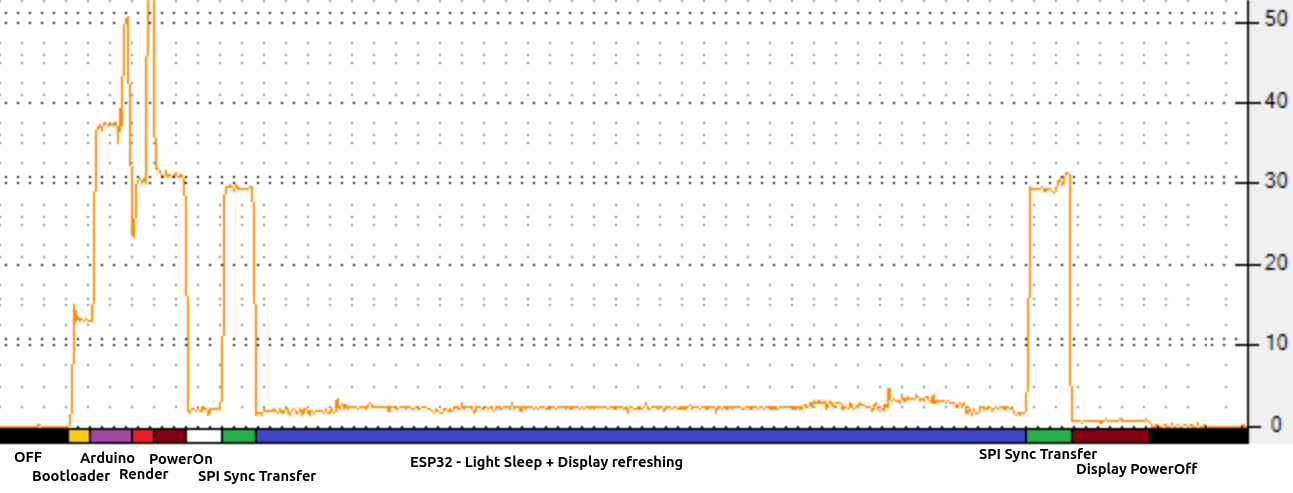 Power consumption before optimization, highlighting the significant energy draw required for the ESP32 to boot from flash memory prior to updating the display
 Power consumption after implementing the RTC wake stub, eliminating the flash boot sequence, so the ESP32 instantly goes to deep sleep while the display refreshes
The hardware uses a single-sided PCB so the e-paper display can sit flat on the back, keeping the design thin and simple. The 3D-printed case has two parts (front and back) and holds all components in a compact layout. Additionally, to save power, the design removes high-power-consumption parts such as accelerometers and battery-charging ICs and relies on a solar cell to supply and maintain power.
The LightInk is an open-source hardware project with the ESP-IDF firmware, EasyEDA hardware design files, and 3D printable case models available on GitHub. Additional build instructions and project logs can be found on Hackaday, where it was recently submitted for the Green Powered Challenge.
Via Hackster.io

Debashis Das is a technical content writer and embedded engineer with over five years of experience in the industry. With expertise in Embedded C, PCB Design, and SEO optimization, he effectively blends difficult technical topics with clear communication
Support CNX Software! Donate via cryptocurrencies, become a Patron on Patreon, or purchase goods on Amazon or Aliexpress. We also use affiliate links in articles to earn commissions if you make a purchase after clicking on those links.