
0-20%: Unlikely – Lacks credible sources
21-40%: Questionable – Some concerns remain
41-60%: Plausible – Reasonable evidence
61-80%: Probable – Strong evidence
81-100%: Highly Likely – Multiple reliable sources
The Android smartphone market is littered with manufacturers to the point where they need to invest millions in discerning features and ‘over the top’ marketing to generate sales. Even after that, the margins often feel like it isn’t worth the effort. To make matters worse, the ongoing DRAM shortage has forced all companies to introduce price hikes, which will consequently make their devices more expensive and lower consumer interest.
Fortunately, a tipster reveals that, after closer inspection, a lot of these companies feel that the demand for high-end camera sensors is declining, and since these parts are more expensive than slightly inferior components, it makes sense to cut production to focus on the less premium hardware, as there’s not a significant difference in image quality. More importantly, these companies are willing to hire engineers to improve algorithms, enabling non-flagship sensors to perform almost on an equal footing with high-end units.
Shifting to less premium camera sensors helps to free up room for company margins, as a major chunk of cost is now attributed to DRAM and storage purchases
The more expensive sensors offer better specifications, such as increased physical and pixel size, allowing for better low-light capture and video recording. Unfortunately, in the middle of the DRAM crisis, which has also made NAND flash thoroughly more expensive, Fixed-focus digital cameras have stated that companies are now moving in a different direction.
While the tipster doesn’t explicitly mention that this transition is the result of the current components shortage, companies are likely initiating this level of brainstorming because a problem exists. For instance, another Weibo tipster, Digital Chat Station, has stated that the pairing of LPDDR6 RAM and UFS 5.0 storage is more expensive than a single Snapdragon 8 Elite Gen 6 Pro unit, and given that Qualcomm’s flagship SoC is expected to cost upwards of $300, sacrificing flagship camera sensors for low-tier ones appears to be the right move.
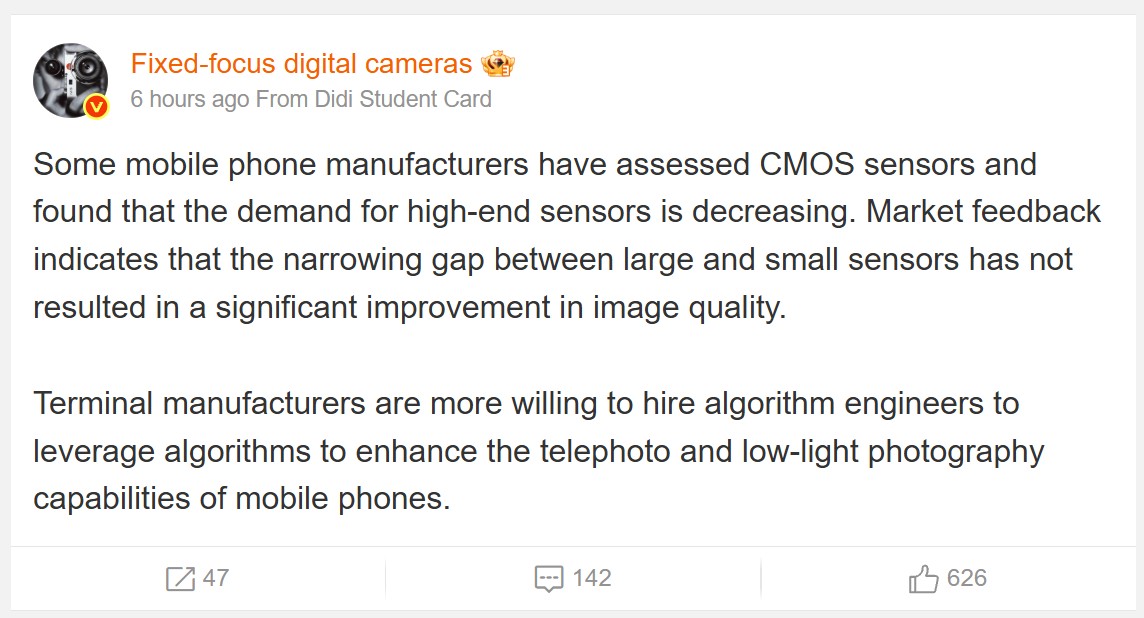
With the hiring of talented engineers, Fixed-focus digital cameras believe that the algorithm improvements to telephoto and low-light photography will greatly enhance the imaging capabilities of smartphones. For the most part, manufacturers like Samsung and Google reuse the same sensors with their flagship releases and focus more on software enhancements to bring all of that magic to the table.
From a business perspective, this is the right move to make, especially since companies have to deal with tackling exorbitant memory and storage costs, and there appears to be no end to this crisis. By tweaking algorithms, the non-flagship sensors can become on par with the top-end ones, improving the smartphone experience while lowering manufacturing costs.
News Source: Fixed-focus digital cameras

About the author: Omar Sohail is a reporter and analyst for Wccftech’s mobile section, specializing in the technology and business of the mobile industry. His expertise lies in the intricate hardware supply chain, covering developments in semiconductor manufacturing, chip lithography, and camera sensor technology.
Follow Wccftech on Google to get more of our news coverage in your feeds.