
The first time I saw a scallop swim, I was 80 feet underwater, descending through the cold green murk toward a sunken freighter called the Diamond Knot. The shipwreck sits at the bottom of the Strait of Juan de Fuca, the stretch of cold Pacific water that separates Washington State from Vancouver Island, and it is, to anyone who dives the Pacific Northwest, a kind of bucket-list dive site. Heart hammering as I dropped, I focused on the bow materializing below me, on controlling my descent rate, on not thinking too hard about the fact that I was hanging in open water with nothing beneath me but 60 more feet of plummeting dark.
Then something jettisoned past at eye level.
It was, unmistakably, a set of false teeth clapping through the water. It chomped in a haphazard but purposeful line away from the wreck before vanishing into the green. I was stunned. I had just seen my first-ever swimming scallop and on my first-ever dive aboard the iconic “Knot.”
An improbable animal
Most people’s relationship with scallops is roughly the same as Dan Speiser’s used to be: They’re a round, white disk of muscle, ideally seared with butter—AKA, a menu item. Speiser, a professor of biology at the University of South Carolina who has spent his career studying marine invertebrates, admits he once thought of them as little more than freezer-section protein.
A scallop, if you’ve never actually examined one, is an improbable animal. “They’re jet-propelled bivalves with dozens of eyes,” says Speiser. “They seem like something so unlikely to exist, but yet they do.”
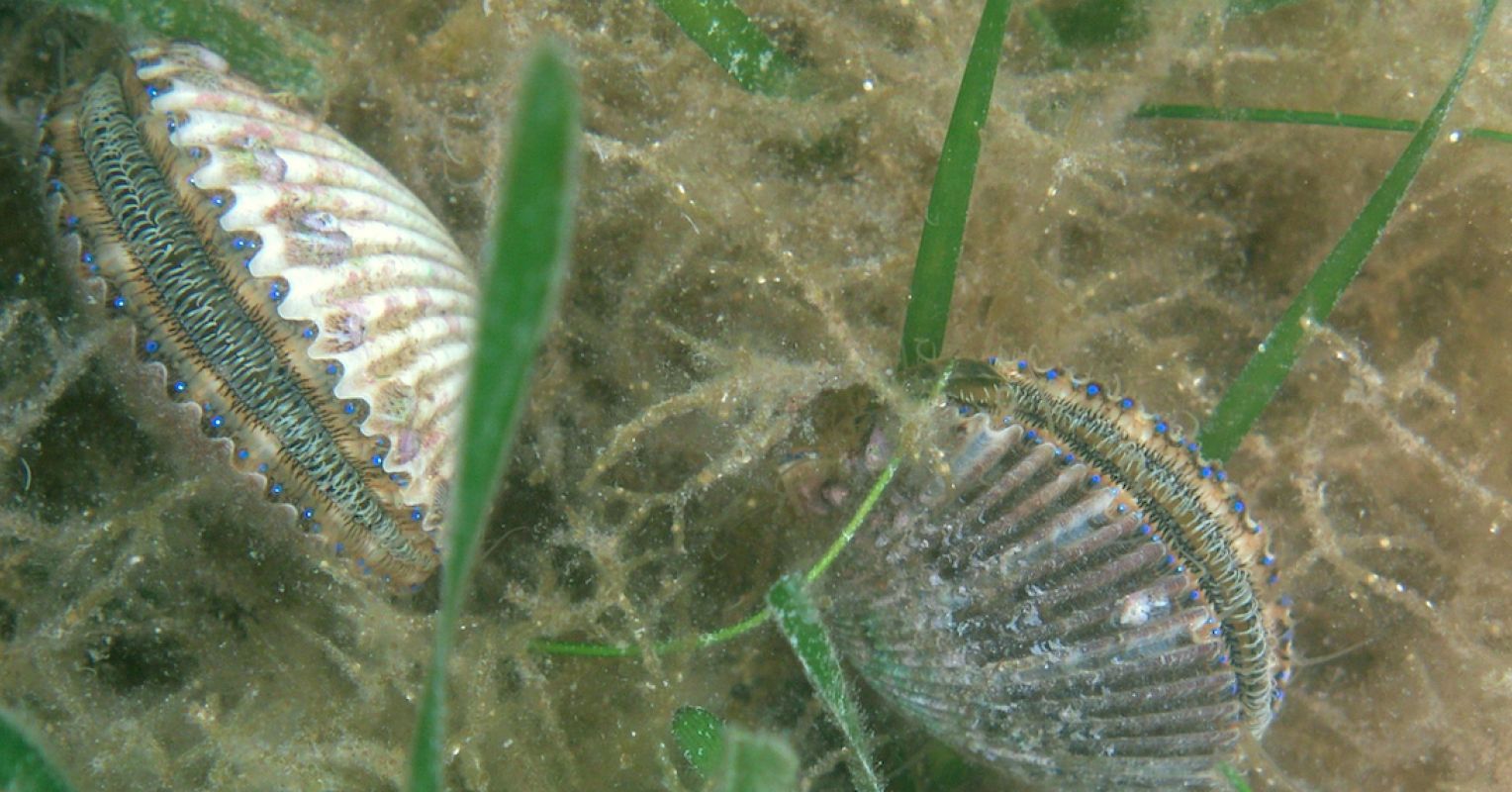
Arrayed around the rim of their shell are as many as 200 small, electric blue eyes that are also utterly alien-looking. And though many might view these blue dots as merely decorative, they’re anything but. They’re functional, image-forming eyes with a mirror-based optical system.
That alone gives many biologists pause, as mirror-based eyes are highly unusual even in nature. Most animal eyes, including ours, use lenses to focus light. Scallop eyes use tiny curved mirrors, bouncing light onto two separate retinas. The optics, Speiser told me in an interview, are “surprisingly sophisticated.”
And yet the scallop has no brain as we understand it. What they have instead are clusters of nerve cells called ganglia, the largest of which—the visceral ganglion—sits directly on the adductor muscle, the meaty part humans eat. This nerve center receives signals from all 200 eyes. What the ganglia do with them has kept Speiser busy for the better part of two decades.
It began with Scallop TV
Early in his career, while completing his Ph.D. at Duke, Speiser built what he cheerfully called Scallop TV. The setup was simple: A small tank with flowing water, a scallop fixed to a little chair cut from white PVC pipe, and a computer screen outside the tank showing the animal footage of food particles drifting past. When the scallop’s eyes registered something edible, they opened their shell to feed.
The experiment worked. Speiser’s thesis adviser later described it as a jaw-dropping moment. It seemed like a clean result: Scallops see, scallops respond, case more or less closed.
Speiser is now embarrassed by what he concluded from it—not because the data was wrong, but because the question was too small. Scallop TV told him the animal could detect visual stimuli and react to them. What it couldn’t tell him—or at least, what he wasn’t yet asking—was whether the scallop was doing anything more than reacting. Whether there was something it might be reasonable to call perception.
The more interesting experiment came later, with doctoral student Dan Chappell. This time, instead of presenting food to a stationary scallop, they created a visual stimulus that rotated slowly around the animal, moving from one side to the other in a continuous arc. What happened next upended Speiser’s earlier conclusion. The scallop’s tentacles and eyes followed the motion in a rippling wave, tracking the stimulus as they moved. The whole animal oriented itself toward the stimulus.
“The experiment told us that instead of having separate visual alarm systems,” Speiser explained, “a scallop integrates information from all of its eyes.” Rather than triggering isolated reflexes in whichever eye happened to be closest, the scallop was doing something more unified. They were constructing a spatial picture of where things were relative to their own body. They knew where the stimulus was. And critically, they knew where it was going.
“Scallops know where you are,” Speiser told me. He meant this literally. The work—part of Chappell’s Ph.D. dissertation—suggests that scallops don’t just detect the presence of objects. They track them. They locate them. They respond not to a stimulus but to a position.
That’s a different category of “thing.” If something can know where it is, if it has a spatial self-awareness, perhaps it could even know what it is.
It’s still in the eyes of the beholder
What scallops see remains genuinely mysterious. Their dozens of eyes have highly overlapping fields of view, which means the animal is, in theory, receiving dozens of near-identical images of the same scene simultaneously. But they don’t behave as if they’re seeing the same thing dozens of times over. Somehow—through the visceral ganglion, through pathways Speiser’s lab is still working to understand—those images are being combined into something coherent. “Something really interesting is happening in that little nerve center,” he told me, “and I hope we can figure out what it is.”
One thing is clear: The deeper one digs, the more questions arise. We’ve been trained to treat the brain (as we understand it) as the seat of intelligence. But something is clearly happening in that visceral ganglion, in an animal that has never had a brain. It’s a notion that raises an uncomfortable possibility: Perhaps intelligence isn’t a thing only brains produce. Perhaps, under the right pressures, life finds a way to do it differently.
Scallops can also use their sensory tentacles (the fringe of delicate filaments interspersed among their eyes) to distinguish between predators and closely related non-predators, using chemical and tactile cues—that is, they discriminate. They make distinctions that matter for survival. Whether they make those distinctions visually, through shape or movement, remains untested. Still, Speiser suspects vision plays a role in it.
I asked him whether intelligence was a fair word. Speiser said he’s comfortable using the word when talking about non-human animals. “If one is willing to say that insects (bees, flies, etc.) demonstrate intelligence (which they do), then I think it may be appropriate to apply this word to scallops. Do scallops learn from experience? Do scallops that live in large groups (like sea scallops) communicate with each other? Do scallops navigate using landmarks? I don’t think we have answers to any of these questions yet, but I don’t think any of them are preposterous to ask.”
We throw the word “intelligence” around freely when it comes to AI, systems built by humans, running on code we wrote. Yet we hesitate to extend it to animals, including ones that have been navigating complex environments, integrating sensory information, and making life-or-death decisions for hundreds of millions of years longer than we’ve existed.
A scallop cannot be coded by humans; it cannot be replicated, except by cloning. We can barely explain what they’re doing. That seems like a strange place to draw the line. Our inability to comprehend a system is not evidence of that system’s deficiency, but may rather be a reflection of our own limitations.
Curiouser and curiouser
I’ve thought about that scallop at the Diamond Knot many times over the years, more so now that I’m familiar with Speiser and Chappell’s research. When I first saw it, my instinct was to set it aside as yet another alien wonder of the depths, worthy of contemplation for only a short amount of time. I know better now.
The scallop wasn’t doing something random when they drifted past me. They were doing something purposeful. The term many use for this is “clap-and-glide.” It’s that motion the scallop produces by rapidly opening and closing its shell to jet water and propel the animal forward and upward, usually away from a threat. Which means the scallop had either registered me, or some other animal, and it meant they should quite literally abandon ship.
In some functional sense, the scallop was paying attention to its world.
“Even animals as seemingly simple as scallops,” Speiser said, when I asked what he most wanted people to understand about them, “are curious about the world around them.”
Curious. It’s not a word we typically extend to animals without backbones, without centralized brains, without any of the equipment we’ve decided—anthropocentrically, one could argue—curiosity requires. But here it is anyway, offered by the researcher who knows these animals best, and I find I’m not inclined to disagree.