
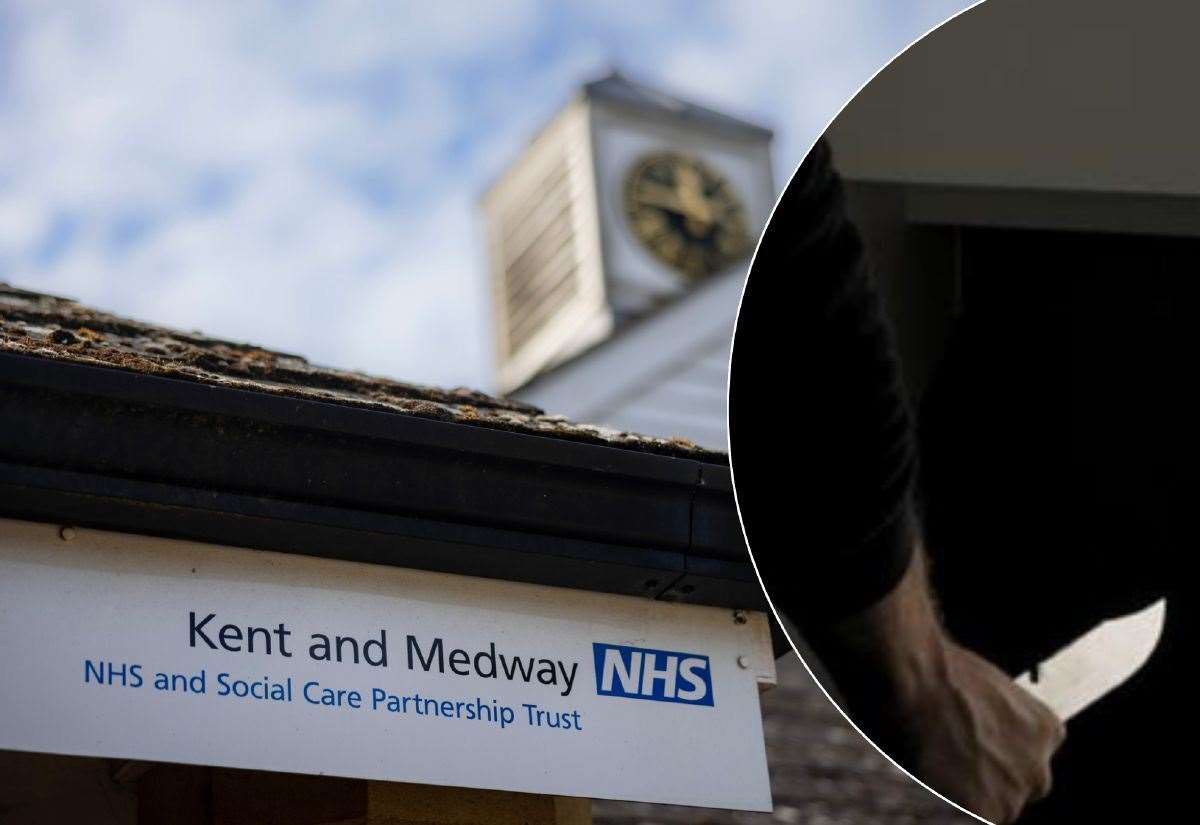
A knife attack which saw an innocent member of the public stabbed might have been prevented if the perpetrator had received better mental health care, an investigation has found.
In November 2020, a 31-year-old randomly assaulted a man in his 30s after being discharged from the care of the Kent and Medway NHS and Social Care Partnership Trust one month earlier.
 The patient was under the care of the former Kent and Medway NHS and Social Care Partnership Trust (KMPT). Picture: Kent and Medway NHS Trust
It happened in Fir Tree Grove, Lordswood, and the man, from Sittingbourne, was arrested on suspicion of attempted murder and later detained under the Mental Health Act before being diagnosed with schizophrenia.
The trust – now known as the Kent and Medway Mental Health Trust – was the subject of an investigation by the Parliamentary and Health Service Ombudsman (PHSO).
It found a series of failings by the trust in the 12 months before the stabbing, as well as a long history of calls from the knifeman’s mother asking for help.
The 57-year-old woman told the PHSO how she was left in fear of her son, who became increasingly paranoid and anxious around 2019, and that she was forced to hide in her car while he stayed in their home.
Poor care planning and discharging the patient without reviewing his risk level were issues the ombudsman outlined in their final report, concluding that these failings might have contributed to the man’s mental health decline.
It said that had he received safe and appropriate care, the stabbing might not have occurred.
“They failed my son, they failed me, and they failed the person he hurt…”
The patient’s mum, who wants to remain anonymous, complained about the care and support the trust provided to her as she tried to get help for her son.
The mother said the experience caused long-term trauma and left her withdrawn for two years.
She said: “I know my son and I was telling the community mental health team for months that he was not well and that it was getting worse. I woke up one day and he was standing in my bedroom staring at me.
“I was too scared to be in my home, so I sat in my car for hours calling staff begging them to help. For months I was telling them he was in psychosis. I was terrified. They offered no real help.
“They failed my son, they failed me, and they failed the person he hurt. Before he committed this crime, he had never been violent. I have no doubt that he hurt someone because of the failings of the community mental health team.
“People with mental health issues are vulnerable and won’t necessarily speak up, so they should have listened to me and took on board what I was saying.
“I know the NHS is under pressure. But when you tell health professionals that your son is going to kill themself or hurt someone, and they question why you are scared if he hasn’t hit you, something has gone badly wrong. That is not pressure, that is reckless behaviour in a broken system.”
Phone records show the man’s mother repeatedly contacted the mental health team in April and May 2020.
She reported that her son had been ripping up blinds and carpets, placing furniture in the garden and blocking her from leaving the house. She told staff she was frightened and, on occasions, was hiding in her car for hours while calling and asking for help.
The PHSO found that the trust knew the man was experiencing a crisis, was in need of a medical review and that the mother was not coping, but failed to develop a care or crisis plan, or support his mother.
An innocent member of the public was stabbed in November 2020. Picture: Stock
Instead, staff repeatedly told her to contact the police, despite knowing this was a mental health matter and the police would be unlikely to intervene unless a crime had been committed.
The Ombudsman found this fell far short of the trust’s own policy and national clinical guidelines.
The man was later arrested for alleged criminal damage and detained in hospital. In June 2020, he was discharged to the community mental health team, which was responsible for assessing his risk and providing his care.
Between June and October 2020, the man received three phone calls but was not seen by the care team in person. The trust did not develop a risk assessment or crisis plan. Not did it review his medication despite clear indicators of non-compliance and relapse.
The ombudsman described this as a failure to undertake an essential and fundamental aspect of care planning and unsafe clinical practice.
Further failings occurred when he was discharged from the trust’s service in October 2020. Staff had not seen him face-to-face since June and did not take appropriate steps to contact him when he did not attend appointments.
He was not informed he had been assigned a new care co-ordinator. The co-ordinator was also unaware he was subject to a care plan or that his mother was his designated carer.
The ombudsman found the failings left the man’s mother in distress for more than a year and caused her to fear for her safety.
PHSO found the trust’s internal investigation was also flawed. The mother was not informed that confidential information would be included in its report and she was not given the opportunity to contribute.
It was recommended that the trust writes to the woman to acknowledge the failings in her son’s care, the lack of support provided to her as his carer, and the serious distress and anxiety this caused.
“This was a deeply serious and complex case, and we recognise the distress experienced by the family…”
The ombudsman also recommended the trust creates an action plan to improve its services.
The trust was also asked to pay the mother £240 for costs to repair property damage when her son was in crisis in May 2020, as well as £3,700 in recognition of the long-term distress and worry caused by its lack of support. The trust agreed to comply.
A Kent and Medway Mental Health NHS Trust spokesperson said: “This was a deeply serious and complex case, and we recognise the distress experienced by the family.
“Concerns raised in 2021 were fully investigated, including through close engagement with the Parliamentary and Health Service Ombudsman, and we have been open and transparent throughout that process.
“We apologise for where care and support did not meet expected standards and have taken action to strengthen community mental health services in line with the National Community Mental Health Framework.”
“Good mental health care must include truly listening to families and using their unique insight to inform care decisions…”
PHSO chief executive Rebecca Hilsenrath added: “This is a sad case involving a vulnerable man who posed a risk not only to himself, but to others. A risk that tragically became reality when he attacked an innocent member of the public.
“It highlights the stark consequences of poor mental health care, not just for patients, but also for their families, carers and even strangers.
“The patient’s mother repeatedly raised concerns about her son’s deteriorating condition and the risks he posed. She was so fearful that she felt forced to hide in her car rather than remain in the home they shared.
“Despite her repeated pleas for help, she was badly let down by the trust and left to cope alone without the support she urgently needed.
Parliamentary and Health Service Ombudsman (PHSO) chief executive Rebecca Hilsenrath. Picture: PHSO
“For over a year, she endured a frightening and distressing situation. During periods when her son was in crisis, her requests for help went largely unanswered, leaving her in fear for her safety.
“Good mental health care must include truly listening to families and using their unique insight to inform care decisions.
“There is still significant work to be done to embed a culture within mental health services that learns from past mistakes.
“While there have been some improvements, including steps towards reform of the Mental Health Act and ongoing Government inquiries, these must lead to real change on the ground – change that improves services and keeps people safe.”