
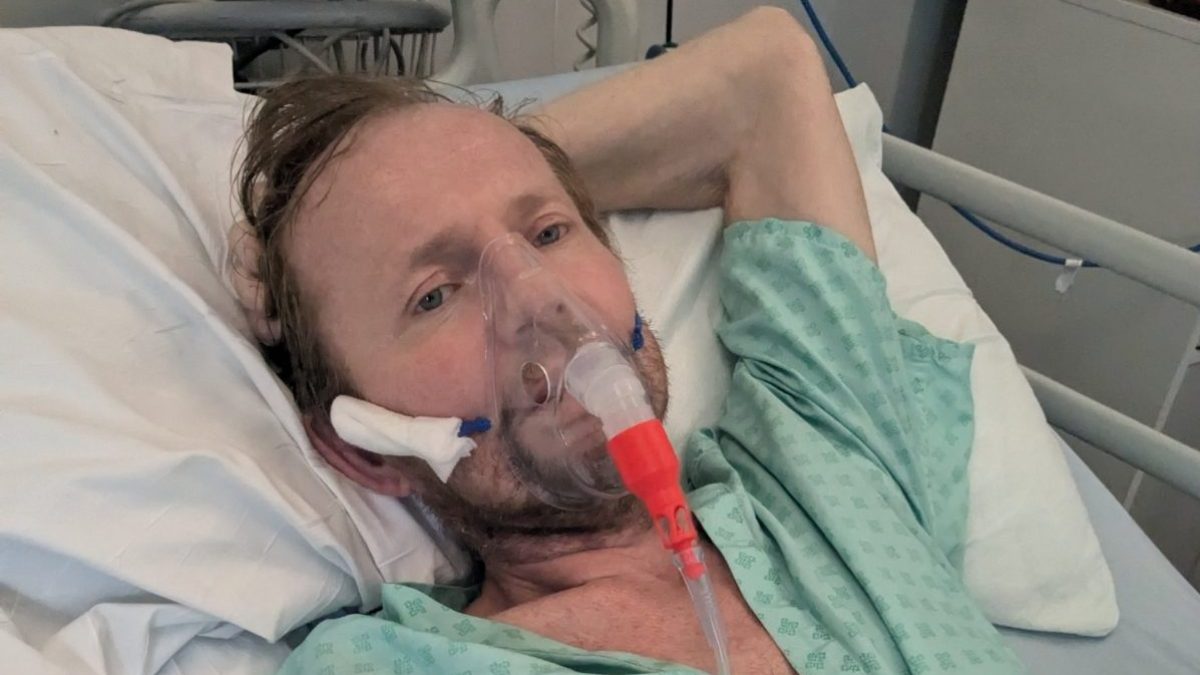
Doctors and experts are warning cases of young kitchen workers becoming seriously ill or losing their lives to a deadly lung disease will continue to rise without a workforce screening programme.
Amid rising cases of silicosis in stonemasons, many in their twenties and thirties, health officials have backed calls for a screening programme to detect cases early, a demand which forms part of The i Paper’s Killer Kitchens campaign.
Doctors warn that early symptoms are often going undetected owing to a lack of awareness, and that even when kitchen workers are examined by doctors, some young stonemasons have been misdiagnosed with sarcoidosis, a rare immune system disorder that frequently begins in the lungs and lymph nodes.
Shorts – Quick stories
Scroll to previous short
Scroll to next short

Fridge or cupboard?
This is your definitive guide on where and how to store your foods at home to maximise the quality and shelf life, from ketchup and butter to nuts and jam.
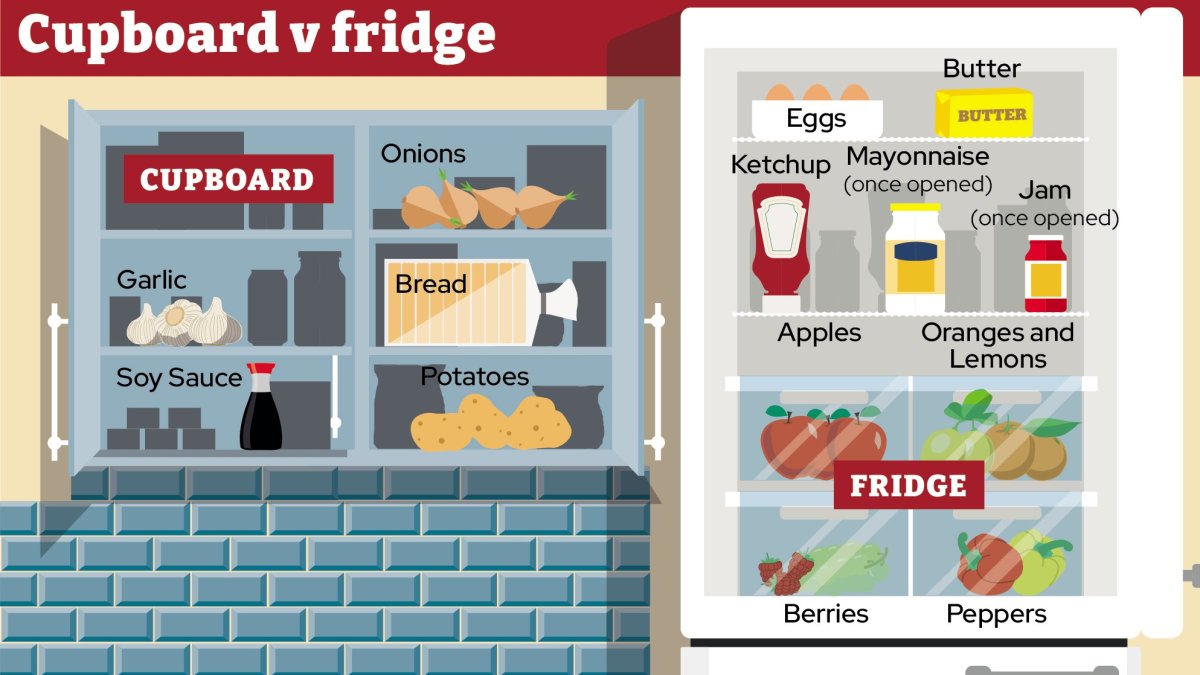
Where to store the basics
Keeping butter in the fridge maximises food safety and freshness.
Ketchup and mayonnaise can be stored in the cupboard but once opened, are best in the fridge.
Bread shouldn’t be refridgerated due to the starch molecules. A bread bin at room temparture, or an airtight container is best.
LIFESTYLE
6 min read
How and where to store food items
There is a fine line between ripe or matured and spoilt.
Jam
Keeping it in the fridge will help it last longer.
Eggs
Storing them at a constant cool temperature, preferably in the fridge, will keep them safe to eat.
Berries
Keeping them in the fridge slows down mould growth and keeps them fresh.

LIFESTYLE
5 min read
Where to store your food
 Caption: Fresh organic tomato closeup .
Photographer: Maria Korneeva
Provider: Getty Images
Source: Moment RF
Tomatoes
Ripe ones should be kept on the counter uncovered if you’re going to enjoy them in the first few days after purchase.
Potatoes
They need to be in a dry, dark place like a cupboard. Exposure to light or moisture can rot the skin.
 When you cook potatoes the right way they go from being a health burden to a health hero (Photo: Getty)
 Caption: A Hand holding a bit brown banana
Photographer: bauwimauwi
Provider: Getty Images
Source: iStockphoto
Bananas
12°C is best, as they will ripen quicker if they are too warm, so a darker space with no direct sunlight is ideal.
Fridge or cupboard?
1Apples are best in cool to cold temperatures so the salad compartment of the fridge is ideal to keep them crunchy.
2At room temperature lemons stay good for a week but in the fridge it stretches to two.
3Ripe avocados should go in the fridge to slow down the ripening process but if they’re firm, a warm sunny spot is best.
4Soy sauce, due to the high levels of salt, is best in the cupboard – even once opened.
Where to store your food
Nuts
Nuts are fine in the cupboard but keeping them in the fridge in an airtight container helps prevent spoilage.
 Caption: Cookie jar, tea, wine, nuts, books, lit candles and Christmas decorations on the table. Cozy Christmas hygge at home. Selective focus.
Photographer: Jelena990
Provider: Getty Images
Source: iStockphoto
 Garlic bulbs (Photo: Emma Dahl/RHS)
Garlic
This suits dry, dark places so a cupboard is ideal.
Onions
Low temperatures can transform the starches of the onion into sugars, making it soft, and potentially mouldy.
 Close up shot of man chopping onions during cooking class – stock photo. (Photo: Getty)
Four key takeaways from Starmer’s antisemitism summit
Iran’s attempts to incite antisemitism in the UK “will not
be tolerated”, Prime Minister Sir Keir Starmer has said.
Here are the main points from
the Downing Street summit.
 Caption: LONDON, ENGLAND – MAY 5: Prime Minister Keir Starmer speaks during a meeting with civic leaders to discuss tackling antisemitism at Downing Street on May 5, 2026 in London, England. (Photo by Hannah McKay – WPA Pool/Getty Images)
Photographer: WPA Pool
Provider: Getty Images
Source: Getty Images Europe
Key takeaways
1Starmer said one of the lines of inquiry is whether a foreign state is behind the attacks.
2He announced £1.5m funding to strengthen community cohesion and protect Jews in at-risk areas.
3Ministers are “fast-tracking legislation” allowing them to ban state threats such as Iran’s Revolutionary Guard Corps.
4Universities must publish the scale of antisemitism on campus and show how they are tackling it.
Go deeper on this topic
The measures to protect the Jewish community come after the stabbing of two Jewish men in Golders Green and a series of attacks at synagogues and other sites in recent months.
Starmer has faced criticism that he has not done enough to keep the community safe, and was heckled during a visit to the north London suburb on Thursday.
 Caption: TOPSHOT – Local residents look on from outside a cordoned off area in the Golders Green neighbourhood of north London on April 29, 2026, following the stabbing to two people nearby. Two people were stabbed on April 29 in north London, Jewish groups said, following a series of arson attacks targeting Jewish sites in the area. A man was arrested after he was seen running with a knife “attempting to stab Jewish members of the public”, the Shomrim Jewish neighbourhood watch said on social media. (Photo by JUSTIN TALLIS / AFP via Getty Images)
Photographer: JUSTIN TALLIS
Provider: AFP via Getty Images
Source: AFP
Copyright: AFP or licensors

NEWS
7 min read
Starmer’s message to Iran
One of the lines of inquiry is whether a foreign state has been behind some of these incidents…Our message to Iran, or to any other country that might seek to foment violence, hatred or division in society, is that it will not be tolerated.
SiR KEIR STARMER, PRIME MINISTER
 Caption: LONDON, ENGLAND – APRIL 30: Prime Minister Keir Starmer (C) and Home Secretary Shabana Mahmood (CR) meet members of Shomrim, the Jewish community security organisation, in Golders Green following yesterday’s attack on April 30, 2026 in Golders Green, England. A 45-year-old British-Somali man was arrested yesterday, after stabbing two Jewish men, Shloime Rand and Moshe Shine, in a terrorist attack in Golders Green. Both victims are in a stable condition, and the suspect was caught by police after being tasered. The government has since pledged ??25 million to improve security for the Jewish community following the incident. (Photo by Leon Neal/Getty Images)
Photographer: Leon Neal
Provider: Getty Images
Source: Getty Images Europe
Copyright: 2026 Getty Images
CELEBRITIES
Dolly Parton cancels previously postponed Las Vegas residency
 Caption: NASHVILLE, TENNESSEE – MARCH 20: Dolly Parton attends Dolly Parton’s Threads: My Songs In Symphony World Premiere at Schermerhorn Symphony Center on March 20, 2025 in Nashville, Tennessee. (Photo by Jason Kempin/Getty Images)
Photographer: Jason Kempin
Provider: Getty Images
Source: Getty Images North America
Copyright: 2025 Getty Images
Country star Dolly Parton has said she is “truly sorry” to those who have tickets to see her in Las Vegas as she announced she is cancelling her previously postponed residency due to ill health.
The 80-year-old told her Instagram followers that “everything I have is treatable” but said it would take a while “before I’m up to stage-performance level”.
What we know
In a video posted to her official Instagram account, she said the medication she is on “make me a lit bit swimmy-headed, as my grandma used to say”. Parton was originally due to perform six shows at The Colosseum at Caesars Palace in December, but was forced to postpone them due to unspecified “health challenges”.
 Caption: GLASTONBURY, ENGLAND – JUNE 29: Dolly Parton performs on the Pyramid Stage on Day 3 of the Glastonbury Festival at Worthy Farm on June 29, 2014 in Glastonbury, England. (Photo by Samir Hussein/Redferns via Getty Images)
Photographer: Samir Hussein
Provider: Redferns via Getty Images
Source: Redferns

LIFESTYLE
4 min read
A closer look at the detail
Her dates were moved to this September, but she announced she was cancelling them on Monday.
 Country music icon Dolly Parton (Photo: Getty/Bravo/NBCU Photo Bank)
 Caption: Dolly Parton in a scene from the film ‘Nine To Five’, 1980. (Photo by 20th Century-Fox/Getty Images)
Photographer: Archive Photos
Provider: Getty Images
Source: Moviepix
“The good news is I’m responding really well to meds and treatments and I’m improving every day,” she said in the Instagram video.
Fans urged not to worry
She also told her fans that her doctors have assured her “that everything I have is treatable, so I’m going with that”. Last year, Parton posted a video to social media joking that she “ain’t dead yet”, following public speculation about her health.

MUSIC
3 min read

CULTURE
3 min read
 Co-op is confident it’s stores will be ‘back to normal’ within days (Photo: Chris J Ratcliffe/Reuters)
NEWS
The supermarket using invisible spray to combat shoplifting
Co-op has been secretly marking frequently shoplifted groceries with a special forensic spray to tackle the resale of stolen goods.
Here’s how the invisible spray works, and how the company hopes it will make shoplifting less profitable.
What’s the story?
Co-op has been marking items with an invisible spray that contains a unique forensic code linked to the shop where it was originally sold, according to Retail Gazette.
 Retail theft on the increase – woman stealing in UK supermarket. (Photo:
Andrey Popov/Getty Images
Copyright: Copyright (C) Andrey Popov
 Caption: A shopper walks along an aisle inside a Tesco supermarket in Manchester, Britain, February 5, 2026 REUTERS/Phil Noble
Photographer: Phil Noble
Provider: REUTERS
Source: REUTERS
Co-op has invested £250m in store security, including body-worn cameras for staff, reinforced kiosks for items such as spirits and tobacco, and shelf fixtures designed to stop thieves sweeping products into bags.
How does the scheme work?
Where?
The scheme has been trialled in Manchester and London and will be rolled out across the UK.
Which items?
High-risk items such as alcohol, laundry detergent and confectionary have been sprayed.
Why?
The aim is to help Co-op and the police identify where stolen products are being resold, making theft less profitable.

NEWS
2 min read
Are you ready for a change?
One career expert shares the surefire signs you’re ready for the next step in your career, and how to turn fear into excitement for new opportunities.

The research
Our research shows almost half of all workers (45 per cent) are ready for a complete career transition, but 49 per cent feel stuck on what to pursue next. The rapid shifts brought about by AI can be intimidating, but it will also create opportunities…
CHARLOTTE DAVIES, LINKEDIN UK CAREER EXPERT
 Young woman at her first job interview with the owner of a coffee shop – stock photo. (Photo: Getty)
Signs you’ve outgrown your role
 (Photo: Getty).
It’s an energy drain
If you’re clocking in and out with zero energy, that could be a sign of burnout by boredom.
You’re not learning
If you can handle all tasks on autopilot, you are not challenging yourself. Instead you’re operating purely on muscle memory.
 Education, laptop and typing with student friends in library of university together for learning or study. Computer, development or growth with serious men and women on college campus for scholarship – stock photo. (Photo: Getty)
 (Photo: DMP/Getty Images).
You don’t feel valued
It can be extremely demotivating, and if it occurs consistently, it’s a strong signal that it might be time to consider moving on.
Your brain has started a side project
 Caption: Side hustles
Photographer: swissmediavision
Provider: Getty Images
Source: E+
When you are seeking out professional development and learning opportunities elsewhere that should be happening at work, it’s a huge signal that you need a job that keeps up with your ambition.

LIFESTYLE
7 min read
You don’t see a path to promotion
 Medium shot of businessman leading meeting in office conference room – stock photo. (Photo: Getty)
If you go into a meeting asking for a growth plan or a promotion roadmap and all you get are vague promises and non-committal language, that’s actually your answer: they aren’t planning for your potential.
A manager who truly values you should be able to list specific training, projects or goals to get you to the next level.
What to do next
You don’t need to make drastic moves.
The very first step is to diagnose the root cause if things feel unsettled, and don’t just assume it’s the job itself.
Find someone trustworthy to talk to. This isn’t a complaint session, it’s about getting perspective.
Refresh your LinkedIn profile and start reviving your in-person network.
Thinking of a new field? Check out a short course or certification to ‘test the waters’ before jumping.
 George Michael in 1985 during the Wham! years (Photo: Michael Putland/Getty)
music
Careless Whisper voted nation’s favourite
George Michael’s beloved 1984 hit has been ranked the number one track for the eighth year running.
His 1986 hit A Different Corner came in at number two.
I’m never gonna dance again
Careless Whisper came top of Smooth Radio’s All Time Top 500 list.
Michael’s first breakaway single from Wham!, he penned the lyrics when he was just 17-years-old.
Smooth Radio presenter Kate Garraway said: “It’s a fitting tribute to one of the greatest artists of all time.”
 George Michael: Outed wil be broadcast on Channel 4 (Photo: Jim Steinfeldt/Michael Ochs Archives/Getty)

MUSIC
7 min read
Top of the pops
1Careless Whisper – George Michael
2A Different Corner – George Michael
3Bohemian Rhapsody – Queen
4Man In The Mirror – Michael Jackson
5Bridge Over Troubled Water – Simon and Garfunkel
ROYAL FAMILY
Princess Eugenie pregnant with third child
 Princess Eugenie and Jack Brooksbank have moved into Frogmore Cottage, the Grade II listed home of Meghan and Harry. It is understood the Sussexes will retain the residence near Windsor Castle but Eugenie and Mr Brooksbank, who married in 2018, will share the property. (Photo: David Mirzoeff/PA Wire)
Princess Eugenie and her husband Jack Brooksbank are “very pleased” to be expecting their third child to be born this summer, Buckingham Palace said.
The King is “delighted” with the news, while the couple’s sons August, five, and Ernest, two, are “very excited” to welcome a younger sister or brother to the family.
What you need to know
In a photograph shared by Eugenie, 36, Ernest and August can be seen holding a picture of a baby scan. In a statement, Buckingham Palace said: “Her Royal Highness Princess Eugenie and Mr Jack Brooksbank are very pleased to announce that they are expecting their third child together, due this summer.”

Analysis
3 min read

OPINION
3 min read
Could the new baby be king or queen?
 Caption: Sarah, Duchess of York with her daughters Princess Beatrice and Princess Eugenie during a visit to the Teenage Cancer Trust unit at University College Hospital, London. Picture date: Wednesday April 23, 2025. PA Photo. See PA story ROYAL Sarah. Photo credit should read: Aaron Chown/PA Wire
Photographer: Aaron Chown
Provider: Aaron Chown/PA Wire
Source: PA
Copyright: PA
The baby, who will not be an HRH, will be born 15th in line to the throne, with the Duke of Edinburgh moving down to 16th place.

NEWS
4 min read
Fifth grandchild for Andrew
The new arrival will be the fifth grandchild of Andrew Mountbatten-Windsor, following the birth of Princess Beatrice’s daughter Athena Mapelli Mozzi in January last year.
 Caption: (L-R) Britain’s Princess Eugenie of York, Britain’s Princess Beatrice of York and Britain’s Prince Andrew, Duke of York leave Buckingham Palace to meet guests at the Patron’s Lunch, a special street party outside Buckingham Palace in London on June 12, 2016, as part of the three day celebrations for Queen Elizabeth II’s official 90th birthday. Up to 10,000 people are expected to attend the Patron’s Lunch along with the monarch, her husband Prince Philip, Prince William and Prince Harry. (Photo by JUSTIN TALLIS / AFP) (Photo by JUSTIN TALLIS/AFP via Getty Images)
Photographer: JUSTIN TALLIS
Provider: AFP via Getty Images
Source: AFP
Copyright: AFP
 Andrew Mountbatten-Windsor has been mostly laying low since his move to Marsh Farm (Photo: Kirsty Wigglesworth/AP)
 Caption: An archive image of the cruise ship Hondius, in Vlissingen, Netherlands May 17, 2025. IMAGE OBTAINED BY REUTERS/Handout via REUTERS THIS IMAGE HAS BEEN SUPPLIED BY A THIRD PARTY NO RESALES. NO ARCHIVES VERIFICATION: – Reuters confirmed the location from the shipyard, signage and fuel depot which matched file and satellite images. – Coordinates of the shipyard: 51.461283930722175, 3.6998162498897433. – The date when the pictures were taken was verified by original file metadata.
Photographer: IMAGE OBTAINED BY REUTERS
Provider: via REUTERS
Source: Handout
health
What caused the fatal cruise ship outbreak?
A rare outbreak of hantavirus, transmitted by rodents, has killed three on a cruise ship in the Atlantic Ocean, leaving one Briton in intensive care.
What’s the situation?
A suspected hantavirus outbreak has left three people dead and one in intensive care.
It occurred on the MV Hondius cruise liner, which was travelling from Argentina to Cape Verde.
The ship is now grounded in South Africa, and five more suspected cases are under investigation.
One British national is reportedly in intensive care and tested positive for the virus.

NEWS
3 min read
What is hantavirus?
Hantavirus cases are usually linked to environmental exposure, such as contact with waste from infected rodents.
In rare cases they can spread between people, resulting in severe respiratory illness.
It can cause two diseases, one that primarily affects the lungs and the other that attacks the kidneys.
Hantavirus pulmonary syndrome, the respiratory illness, is most commonly found in the Americas.
What are the symptoms?
 Photographer: ljubaphoto
Provider: Getty Images
So it begins
At the outset, it has flu-like symptoms, such as fatigue and fever, one to eight weeks after exposure.
Respiratory effects
Four to ten days later, coughing, shortness of breath and fluid in the lungs appear.
 Caption: Adult man wearing a yellow hoodie in a living room, coughing or sneezing into elbow.
Photographer: ti-ja
Provider: Getty Images
Source: E+
 Young women patient’s hand receiving IV drip medicine after surgery – stock photo. (Photo: Getty)
No known treatment
There is no specific therapy, so treatment includes rest and fluids. Some may be put on a ventilator.
A similar screening programme in Australia, – where around 1,000 stonemasons have been diagnosed with silicosis since 2015 – uncovered the scale of the epidemic there, and led to the country becoming the first in the world to ban quartz, also known as engineered stone, which is used to make kitchen worktops.
Dr Jo Feary – a consultant at London’s Royal Brompton Hospital, where most of the UK’s more than 50 quartz silicosis patients are being treated – said she was seeing new patients every month and expects more cases.
At least four of the men have died since the first cases emerged in mid-2023.
“You have people who are diagnosed with sarcoidosis by respiratory clinicians who we need to try and increase awareness about how similar sarcoidosis and silicosis are,” she told The i Paper.
Cases missed through lack of screening
In a recent paper on 32 UK patients with quartz-induced silicosis, Feary and other respiratory doctors described how cases were going unrecognised due to asymptomatic early disease, inadequate screening, a lack of awareness among medics, and the disease being mistaken for sarcoidosis.
Of the 19 referred from respiratory specialists, seven had been treated for sarcoidosis for between six months and five years prior to referral to the Brompton’s occupational lung disease clinic.
Early diagnosis is important to help prevent progressive disease, the paper said, with 15 of the cases showing signs of acute and accelerated silicosis, indicating very high exposure to silica dust.
Last year, The i Paper spoke to Ryan Fenton, whose diagnosis at the age of 47 came out of the blue and was only detected after he suffered a mini-stroke in December 2022. Doctors scanned him and told him initially that he had sarcoidosis, but a biopsy was sent to the Royal Brompton, which told Mr Fenton he had silicosis.
“Anything that would help detect early disease, I would welcome and that would include a screening programme,” said Feary. “I think it would need to be carefully designed so it wouldn’t necessarily be what they did in Australia, and I don’t know what it would look like, but I feel that something like a screening programme could be really useful.”
In Australia, as part of programmes funded by regional governments, silica field teams went on the road to identify smaller workplaces and track down tradespeople at risk of exposure to silica dust.
Officials would leaf through old Yellow Pages, scour the internet and knock on doors in an “enforcement blitz”, said Dr Ryan Hoy, whose research team at Melbourne’s Monash University helped develop Victoria’s state screening programme.
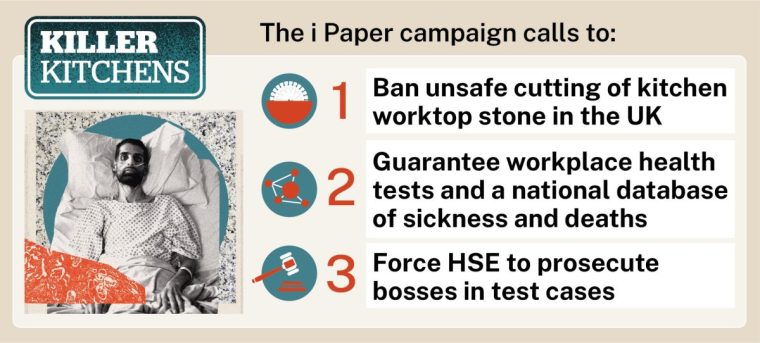 Amid rising cases of silicosis in stonemasons health officials have backed calls for a screening programme to detect cases early
Of the more than 50 UK cases of engineered stone-induced silicosis that Feary has been treating at the Brompton only two patients had access to occupational health.
There was, therefore, a need to help stonemasons who did not have access to workplace health checks. Many of the men who were diagnosed described working for companies that flouted safety measures. “So if we want to detect early disease, then we need to think about a way to do that that doesn’t just involve occupational health screening or occupational health surveillance,” Feary said.
“From a pragmatic point of view, a screening programme would be the way to detect those patients.”
Professor Neil Greenberg, president of the Society of Occupational Medicine, also backed a screening programme and called for mandatory occupational health provision for all workers in the industry.
He said: “If you’re working in an industry that uses asbestos, you have to have occupational health professionals advise you and do the surveillance. And so we would say, because the kitchen countertop industry is one which exposes people to the risk of a serious illness – silicosis, it’s like asbestos – there should be similar mandates that they must have access to occupational health.”
He called for an education campaign aimed at GPs to ensure a patient who goes to their doctor with possible early of silicosis is assessed properly. “Most GPs don’t think about silicosis as being something that affects young men and young people,” he said
“If someone comes in and they’re talking about asthma symptoms or smoking-related symptoms, the GP might just write it off as that when actually, underneath it all, it is because they’ve been working with these kitchen tops.”
Professor Victoria Tzortziou Brown, president of the Royal College of GPs, said the GP curriculum stressed the importance of history-taking in relation to occupation, alongside smoking and other “red-flag symptoms”.
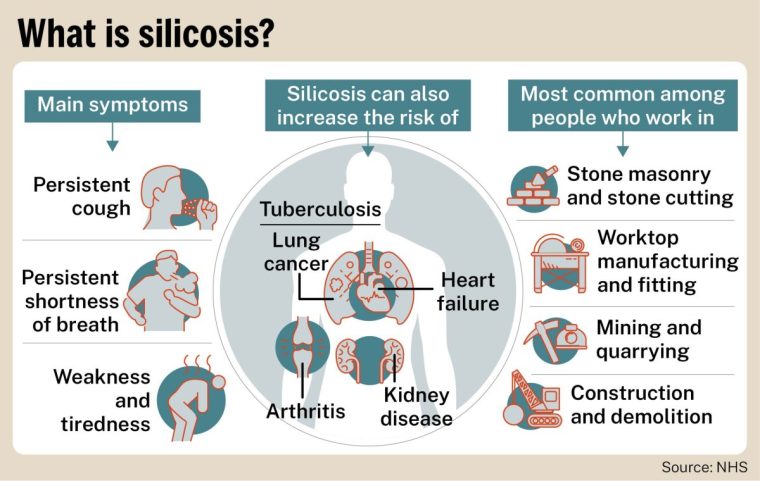 Cases of silicosis have continued to increase among engineered stone workers
However, diagnosing less common respiratory conditions in general practice can be challenging, she added, as early symptoms can overlap with more common conditions such as asthma, infections or smoking-related illness.
Feary said while increased awareness of occupational medicine and lung disease generally was to be welcomed, there was no criticism of GPs. “I’ve got no evidence to say that GPs are missing things,” she emphasised.
A spokesperson for the Department of Work and Pensions said silicosis “remains a ministerial priority”, but that said there were strong laws to protect workers from hazardous substances such as artificial stone. “We support the Health and Safety Executive to ensure silicosis remains a priority in their regulatory work,” the spokesperson added.