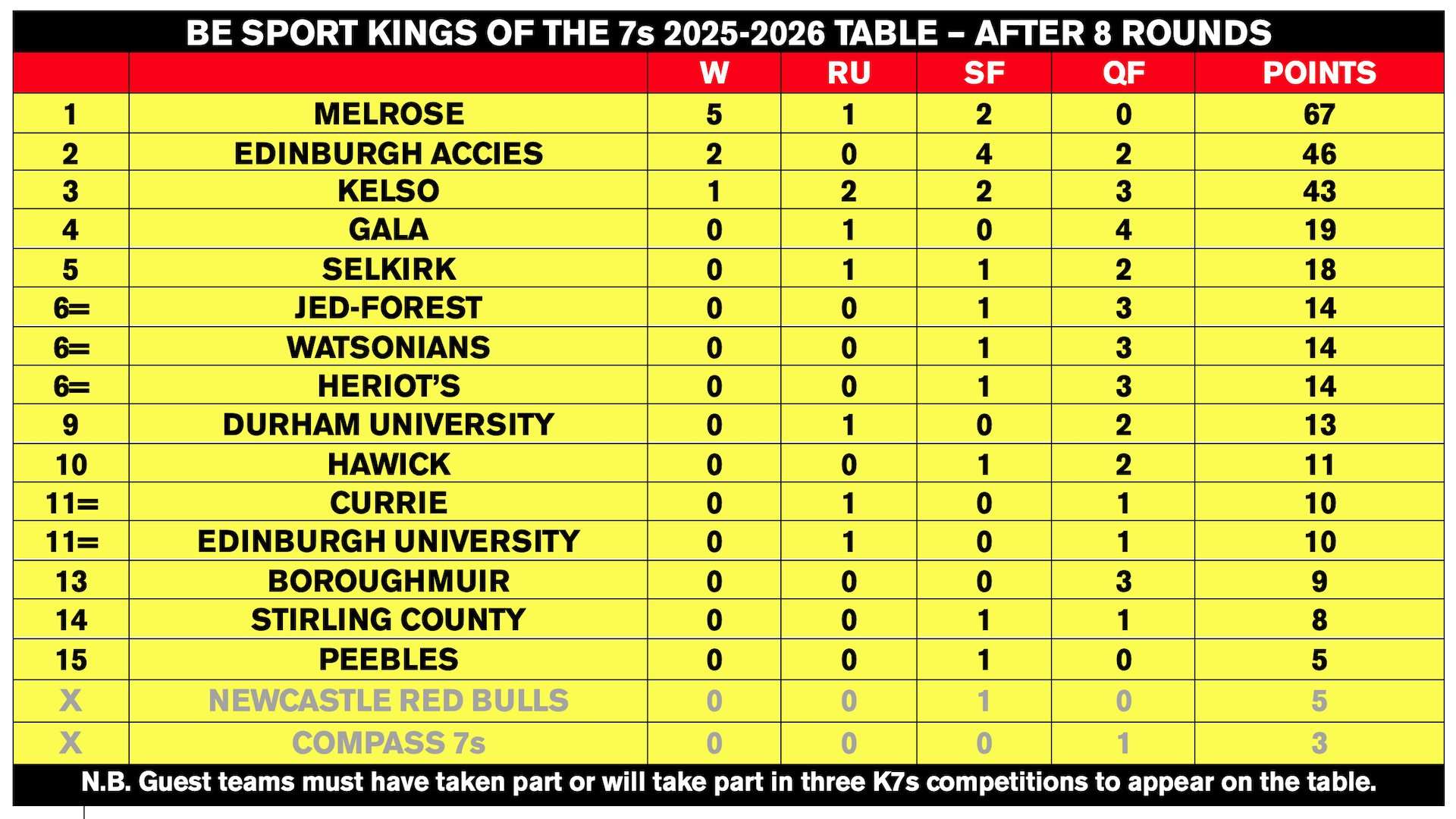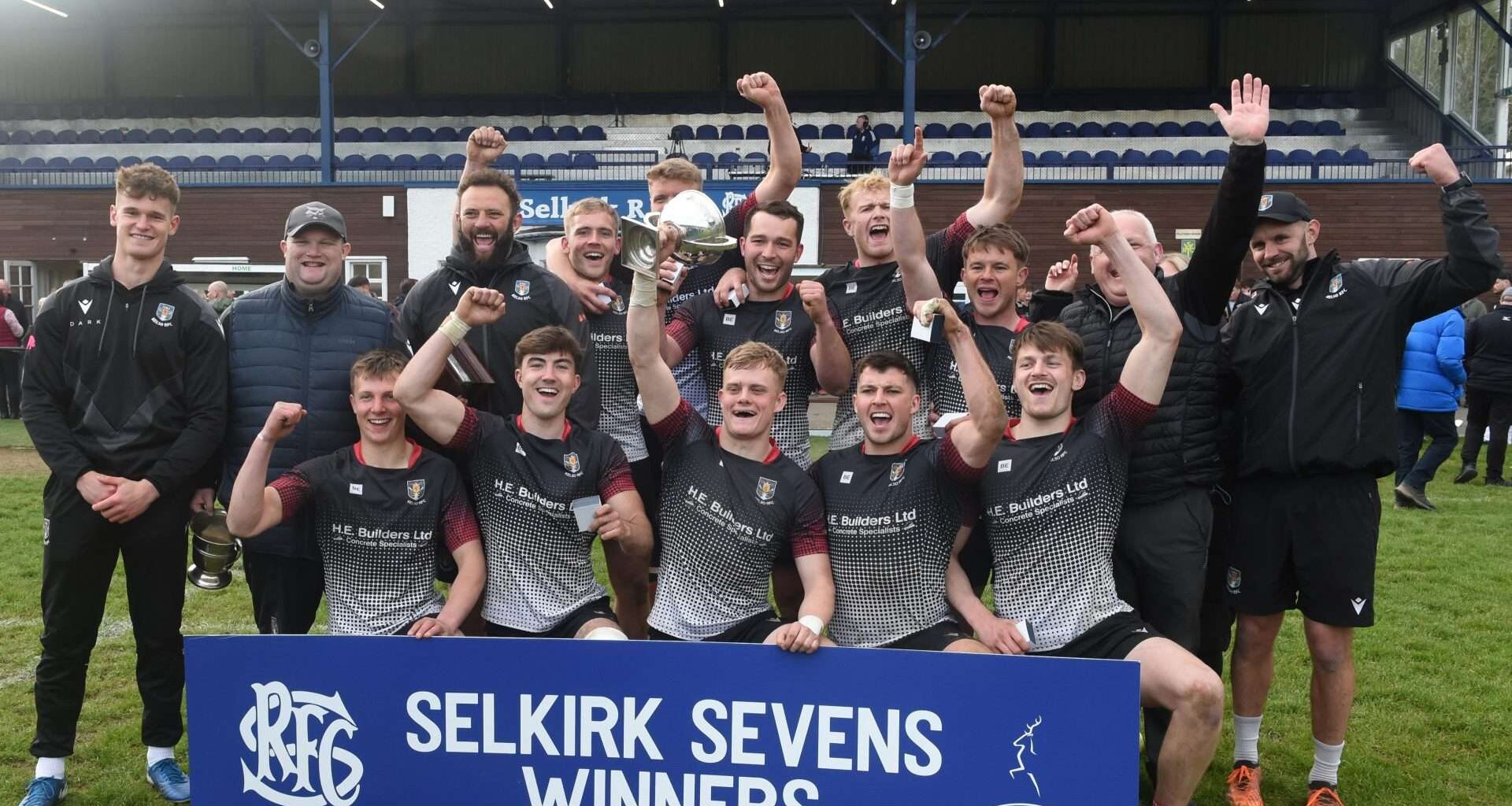
He added: “I just really want to praise their attitude in training, their resilience, and the hunger for wanting to get to the final, and then the hunger for winning the final against a really stacked Currie team.
“I think we varied again quite well. We kicked when we were in control of kicking. We focussed really hard on the contact area and a lot of things we’ve done in training – set-piece, kick offs, etcetera, we’ve got better. Credit to the players just for being resilient and understanding that, what we do in the training field, has to apply in the game”.
Central to Kelso’s success was skipper Dwain Patterson, who looked back to his elegant best, showing his full repertoire of skills from pacy running, strong defence, goal kicking and creative play for which Patterson justifiably earned the player of the tournament award.
In truth, it was the backline combination of Patterson, Liam Herdman and Archie Barbour that proved so affective behind a strong forward effort in which Hamish Tweedie played a key role.
Kelso’s progress through the rounds was a smooth and straight route, a win over Boroughmuir in the first round before success against a strong Edinburgh University side in the quarter-finals. n the semi-finals, Kelso came up against a Melrose seven weakened by a string of injuries last weekend but still able to compete strongly when it mattered.
In the event, tries for Kelso by Murray Woodcock (2) and Patterson were sufficient to see the Poynder Park men through to the final with a 19-7 win, the Melrose try coming from Harry Makowski.
Of the four semi-finalists, it was Currie Chieftains who were being spoken of likely tournament winners after defeating Edinburgh Accies, 38-7 in the first of the penultimate first round ties from a hat-trick of tries by Alex Harley and one apiece from Fraser Sayers, player coach James McCaig and Lachlan Ferguson, the Selkirk player drafted to cover for an injury to Currie’s Euan Crombie.
For Accies, whose only try came from Finlay McNeil, this was a below par performance from the Raeburn Place men, who, this season, have set high standards in the Kings of the Sevens. They could not contain the pace of the likes of Ryan Daly and Sayers, nor the skill of Harley, nor the power up front of Ed Hasdell, whose sheer size and turn of speed earned the Malleny Park back-row a collection of tries in the first two rounds.
Currie’s player coach McCaig, who has been instrumental at Malleny Park in advocating participation in top sevens competition, acknowledged that in the final his side came up against a quality team.
He said: “They’re just that next level for us. If we got a bit of a line break, there wasn’t really anyone chasing hard after the break. When we made breaks in the final there, you had two or three Kelso boys working real hard defensively. They were really good at the breakdown and then once they got that momentum shift, they were just outstanding at their kick-offs”.
Currie will not be at the Jed-Forest Sevens next weekend but will be back in the Borders a fortnight hence for the prestigious Melrose tournament. McCaig, having learned so much from playing against Kelso, now knows what his side has to achieve before entering the Greenyards arena on 23rd May
“We’ll be working hard on certain aspects of the game. Selkirk has given us the opportunity to see what we can do and see areas where we need to get better,” asserted McCaig, who appreciates that Currie’s participation in the Kings competition has had to be restricted because of the club’s involvement in the both the Cup and Premiership play-offs.
In the final at Selkirk, Kelso quickly went into a 14-0 lead with tries from Tweedie and Herdman, before Sayers clawed back some ground for Currie with a try. But, before the break, Kelso engineered another scoring move that gave Tweedie his second touchdown and a 21-5 interval lead.
Then in the second half, Kelso dominated possession to score tries by Herdman and a brace from Patterson, the second of these from a driven line-out. Five out of the six Kelso tries were converted by Patterson.
If well beaten, Currie still had the final say in points scoring with a second try for Sayers but for the aspiring Malleny Park club the final was lesson in how to play sevens rugby by a Kelso side on top of its game.
Selkirk Sevens results –
Round 1: Edinburgh Accies 21 Jed-Forest 12; Stirling County 22 Hawick 10; Selkirk 26 Gala 0; Currie 24 Peebles 17; Kelso 31 Boroughmuir 14; Edinburgh University 24 Heriot’s 19; Melrose 28 Watsonians 5; Durham University 31 President’s VII 12.
Quarter-finals: Edinburgh Accies 21 Stirling County19; Selkirk 17 Currie 36; Kelso 26 Edinburgh University 0; Melrose 17 Durham University12.
Semi-finals: Edinburgh Accies 7 Currie 38; Kelso 19 Melrose 7.
Final: Currie 10 Kelso 40.
Selkirk 7s Final teams –
Currie Chieftains: E Hasdell, J McClay, S Robeson, G Christie, A Harley, R Daly, F Sayers, L Fiddes, J McCaig, L Ferguson.
Kelso: H Tweedie, A Hall,M Cranston, W Tweedie, D Patterson, A Barbour, L Herdman, N Stingl, C Thompson, M Woodcock.
Referee: Steven Turnbull