
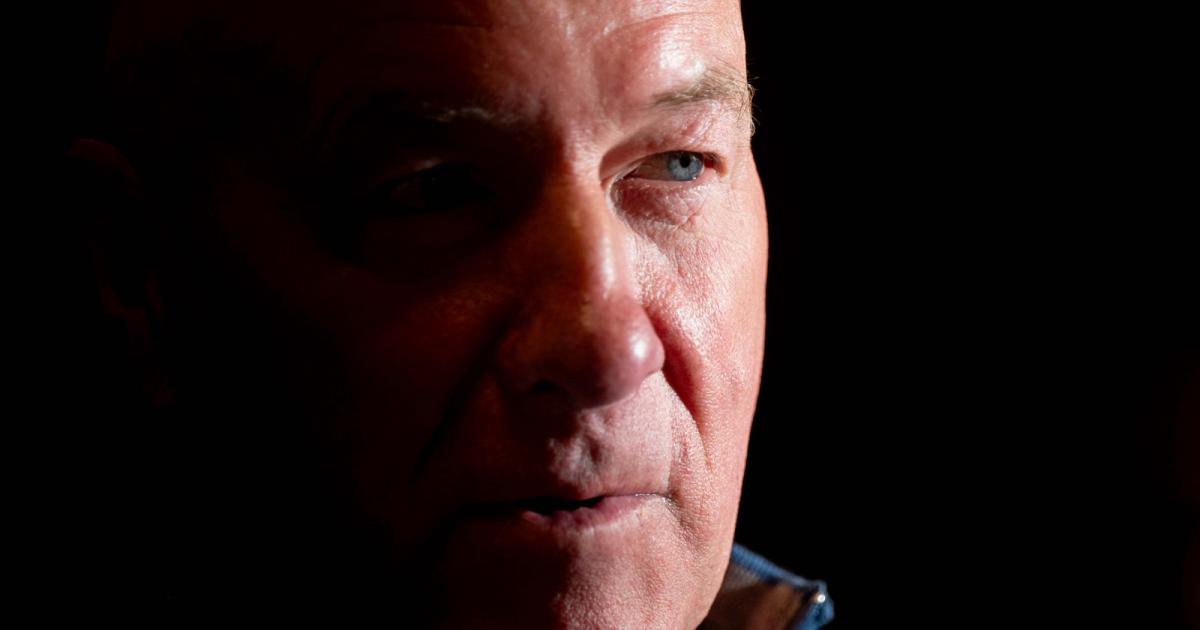
Neil Simpson was looking forward to the second leg of the Champions League semi-final between Bayern and Paris Saint-Germain at the Allianz Arena when he sat down for a cup of tea and a blether in the Legends Lounge at Pittodrie on Wednesday afternoon at the launch of his new autobiography, Simmy.
The first encounter the previous week had brought memories of the glorious evening when Sir Alex Ferguson’s redoubtable side came from behind twice to knock Pal Csernai’s celebrated team, Klaus Augenthaler Paul Breitner, Dieter Hoeness, Karl-Heinz Rummenigge et al, out of the competition flooding back to him.
Read more:
“I scored that night,” he said with a grin. “It does make you think about what we did when you watch these games on television now.
“But at that time Aberdeen were the best team in Europe. It is difficult for some people to comprehend just how good we were now. We were better than Barcelona, Bayern Munich, Inter Milan, Paris Saint-Germain, Real Madrid, better than all of them.
“After we beat Hamburg in the Super Cup final (a double header against the European Cup winners which the midfielder also netted in) we were rated the best team in Europe by France Football and Adidas. It is incredible when you think about it.”
The Bayern win is just one of many epic matches which he recounts on in the pages of Simmy. The reader finishes the enjoyable memoir wondering why it has taken so long for the author, who turned 64 back in November, to put pen to paper. Very few players from this country have scaled such heights.
He came from humble beginnings in rural Aberdeenshire, showed early potential as a footballer and signed for the club he supported. He flourished under Ferguson and his assistant Archie Knox, lifted every major honour in the domestic game, conquered the continent not once but twice and represented Scotland with pride.
Aberdeen great Neil Simpson has released his autobiography, Simmy (Image: Promotional)
He has a fascinating personal tale to tell too. He tracked down his biological father using DNA ancestry websites after his mother, who had brought him up with the help of his grandparents until she married his stepfather, passed away during the Covid pandemic and met him for the first time in 2021. So why wait until now?
“I was asked a number of times over the years, but I was never interested,” he said. “I didn’t feel I had the profile to be honest. Guys like Jim Leighton, Willie Miller, Alex McLeish and Gordon Strachan were the stars in the team that I played in, not me.
“Don’t get me wrong, we all had a part to play. I would like to think I did my bit. I was good at winning the ball, I could run all day, I could defend, I could attack. I had my attributes and I was certainly determined. But I was never at the higher end, was never close to Jim or Willie or Alex or Gordon. They were just quality.
“I suppose the inspiration came from John McMaster and Dougie Bell doing books. By that time, I had managed to find my father too. I thought, ‘I’ve got quite a story now’. That was when I decided to do it.”
Could a reluctance to revisit what was a dark period in his life, to reopen old festering wounds, have been a contributory factor as well?
Read more:
Simpson is remembered as much for his foul on Ian Durrant in a match against Rangers at Pittodrie in 1988 as he is for his many accomplishments with Aberdeen in certain quarters in Scottish football.
Durrant suffered cruciate ligament damage and spent nearly three years out of the game afterwards. However, there were grave ramifications for the man who caused his serious injury as well. He has never spoken publicly about that sorry episode in any detail until now. It is not difficult to understand why when he finally does so.
But more about that later. It would be wrong, as many of those who view the world through light-blue tinted spectacles continue to do, to focus solely on that unfortunate affair and overlook his myriad successes with club and country.
Simpson was one of a number of gifted young players who Ferguson, with no little assistance from Knox, developed during his tenure at Aberdeen. He is indebted to the greatest manager Scottish football has ever produced and his deputy for the grounding he received in the game. Still, he needed to develop a thick skin to make his breakthrough.
Former Aberdeen FC player and Gothenburg Great Neil Simpson, right, speaks to Matthew Lindsay of The Herald this week (Image: Michael Traill)
He recalls in Simmy how he and his young contemporaries were ordered to stay away from the first team squad by their livid gaffer after losing a reserve cup tie 5-0 to Celtic in case they “contaminated” them. But he knows the tough apprenticeship which he and others served was priceless.
“Fergie really promoted youth,” he said. “It gave the side an enthusiasm. He moulded us in to the players we became. We were just him on the pitch really. He dictated how you acted on the park and how you appeared and behaved off it as well.
“If you didn’t follow that path, you were surplus to requirements. I think I was 22 or 23 before I felt comfortable having a drink in my hand. I was always looking over my shoulder. But I had no fear when I played a game, no matter who I was playing against.
“Archie was the best coach I ever worked under. He was so good, I absolutely loved him. But he was every bit as formidable as Fergie. It was bad cop and super bad cop. I asked Archie once if they would get away with what they did back then today and he said, ‘We would get the jail now!’
“But Fergie’s management was something else. He had this incredible drive to be successful. But he knew the game as well. He could see things which were happening and change matches with substitutions.
“That game against Bayern was the perfect example of that. He replaced Stuart Kennedy with John McMaster and me with John Hewitt. There weren’t any defensive midfielders on the park. We scored twice and got the victory. John grabbed the winner.”
Read more:
Hewitt also came off the bench to clinch the European Cup Winners’ Cup with an extra-time goal, a sublime diving header after a perfectly-weighted cross from Mark McGhee, against Real Madrid in the Nya Ullevi in Gothenburg a couple of months later.
Yet, for the young man who partnered Strachan in central midfield that evening, a local loon who hailed from the tiny hamlet of Cluny and was the tender age of 21, it was just another game.
“That was the way it was,” he said. “You prepared as normal. The routine was the same. You trained, you got ready, you got your team talk and you played. Yes, some games, like that one, had a higher profile than others. But Fergie wanted us to treat every match the same.
“The ambition that Fergie had was integral to that. He was driven to win matches, he just wanted to beat everybody. Guys like Stuart Kennedy, Willie Miller and Alex McLeish had exactly the same attitude and mentality.”
They will forever be known as the Gothenburg Greats. But for many followers of Rangers, those who have never forgiven him for the Durrant injury, there is nothing especially great about Simpson. Nearly 38 years have passed since the brief flashpoint in a typically full-blooded meeting between the bitter Scottish rivals, but he remains a hate figure for some.
Neil Simpson, right, in action for Aberdeen in the European Cup Winners’ Cup final in 1983 (Image: Colorsport / Shutterstock)
He declined to discuss the actual foul, which he was only booked by referee Louis Thow for, when we spoke and stressed that he had already covered it in his book.
“Grisly tackles were flying in during the first few minutes,” he writes. “This was seriously combative. Nothing was being held back. Then, as I strove to get the ball, I stood on the knee of Ian Durrant, who was coming from the other direction. It was a bad incident.”
But he had no qualms about expressing his deep regret. “If I could turn the clock back I would,” he said. “I definitely wish that it had never happened. I am sorry for the outcome.
“I was known at that time as a hard but fair player. I was never sent off in my whole career. That tells you something about the kind of player I was and person I am. In football, these things happen. Unfortunately, I was involved in that incident.”
Durrant would play on at a high level with Rangers, Kilmarnock and Scotland for many more years after recovering. He never, though, became the world-class player he promised to be when he emerged at Ibrox as a teenager. But Simpson endured a tough time himself for different reasons.
A Rangers fanzine drew up a “hit list” – STV commentator and newspaper columnist Gerry McNee, Roman Catholic cardinal Thomas Winning and Aberdeen footballer Neil Simpson – and published the home addresses of the three people on it.
Read more:
The staff at his local grocery store near his home in Newmachar reported that several people had been in the shop asking where he lived and police offered to instal security cameras at his home.
Durrant then sued him for £2m in 1990. The matter was settled out of court for a six figure sum years later when he was playing for Motherwell. But the protracted case took a heavy psychological toll on him and ultimately led to him leaving Aberdeen at the age of just 28.
“It was a stressful period,” he said. “I almost became resilient to the pressure of it. There were so many things that happened. Did I fear for my personal safety at any stage? It was in the back of my mind, especially after my address got published.
“There was actually a Neil Simpson Voodoo doll in the fanzine after that as well. You could buy it and stick pins in it. Make him really hurt! So there was a lot for me to contend with.
“I am not scared to say that there were members of the media who had an allegiance to Rangers who felt it was an opportunity to undermine Aberdeen, and obviously myself because I was in the middle of it, at that time. I would get a solicitor’s letter regarding what was happening next and within two days it was in the tabloids.
“But I have been in Glasgow so many times over the years and there has never been any bother. When I was at Motherwell I used to go in to Glasgow all the time to go shopping. I don’t remember any occasion when I thought, ‘Ooft! This could be a dodgy situation here’. On the whole, I have never felt physically threatened.”
Former Aberdeen player Neil Simpson (Image: Michael Traill)
Simpson continued, “I’ve never met Ian or spoken with him about it since. We had a nod at an Aberdeen v Rangers game a Pittodrie once when he was in the tunnel. But that is it.
“I used to do events with Davie Cooper, fan Q&As and what have you, up here. He broached the subject with me once. He said, ‘If having a quiet meeting with Ian was something you were interested in I could ask him’. But Davie tragically passed away and nothing happened. Time moves on. I have got my life, Ian has got his life.”
The resentment at Rangers lingers. Simpson got a job as an SFA community development officer after retiring from playing and found himself at Auchenhowie one day in the early 2000s, a time when his close friend McLeish was manager. John Greig spotted him and asked, “Who the f*** let him in the building?”
“It is just the way it is,” he said. “It is part of my history I suppose. I’ve never spoken about it before and I’ve been asked numerous times. But I felt my book was an opportunity to show what it was like from my perspective, through my eyes, during that whole period. As I say, I definitely wish it hadn’t happened.”
Read more:
Simmy, which contains a glowing foreword from Sir Alex Ferguson, underlines that Neil Simpson, who won two Scottish titles and two European trophies, deserves to be remembered for far more.
“I would hope that people, and I think the Aberdeen fans do, see me as a player who contributed to 310 games and scored some important goals,” he said.
“I am one of the only Scottish players to score in the quarter-final, semi-final and final of a European competition. I won eight winners’ medals and played for my country. I served my club, and the community, for 35 years. I was involved in the grassroots game as well as at elite level. I think I gave a lot back.
“I am proud to have been part of that great Aberdeen team. It was an amazing experience. I was just born at the right time, was lucky to be part of that period and to serve under the greatest manager there has ever been. He is still the boss to me. I’m sure he’ll be raging that I’ve called him Fergie in the book!”
Simmy: Tackling life with Aberdeen and Fergie by Neil Simpson with Neil Drysdale is published by Pitch Publishing and is available to buy now. Signed copies can be purchased at neilsimpson8.com