
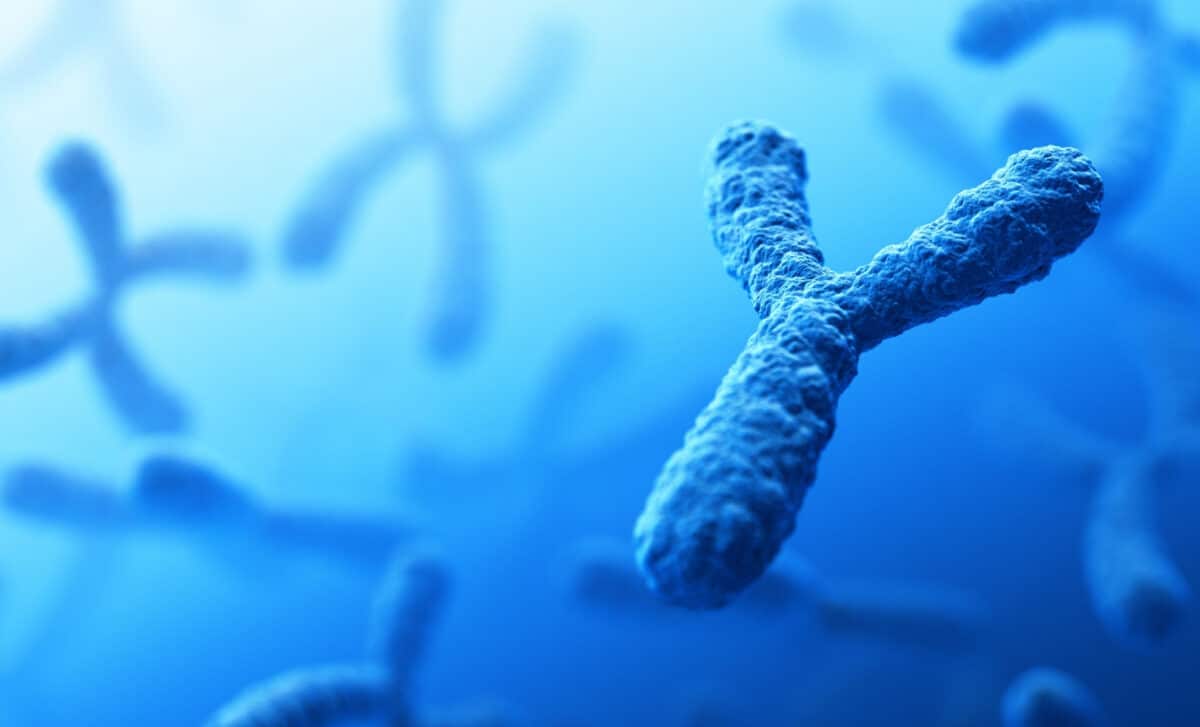
For years, the fate of the human Y chromosome has made for irresistible headlines, extinction of males, end of mankind, that sort of thing. The reality, as is almost always the case, is considerably more complicated. Behind the sensationalism lies a genuine, unresolved scientific debate between two researchers who have studied the same evidence for decades and arrived at fundamentally opposite conclusions.
What makes this dispute unusual is not its intensity but its civility. Evolutionary biologist Jenny Graves and her MIT counterpart Jenn Hughes have disagreed openly, publicly, and respectfully for over a decade. In 2011, they debated the question in front of an audience at the 18th International Chromosome Conference. The crowd voted. The result was a perfect 50/50 split, and as of 2025, no tiebreaker has emerged.
A Chromosome in Freefall, or One That Found Its Floor?
The starting point for both scientists is the same. According to Hughes, in the ancestor of placental mammals the X and Y chromosomes were identical, each carrying around 800 genes. Roughly 200 million years ago, once the Y became specialized for male sex determination, it stopped recombining with the X in males and began losing genes at pace. The X, continuing to recombine in females, stayed largely unchanged. Today, the human Y carries only 3 percent of the genes it once shared with the X.
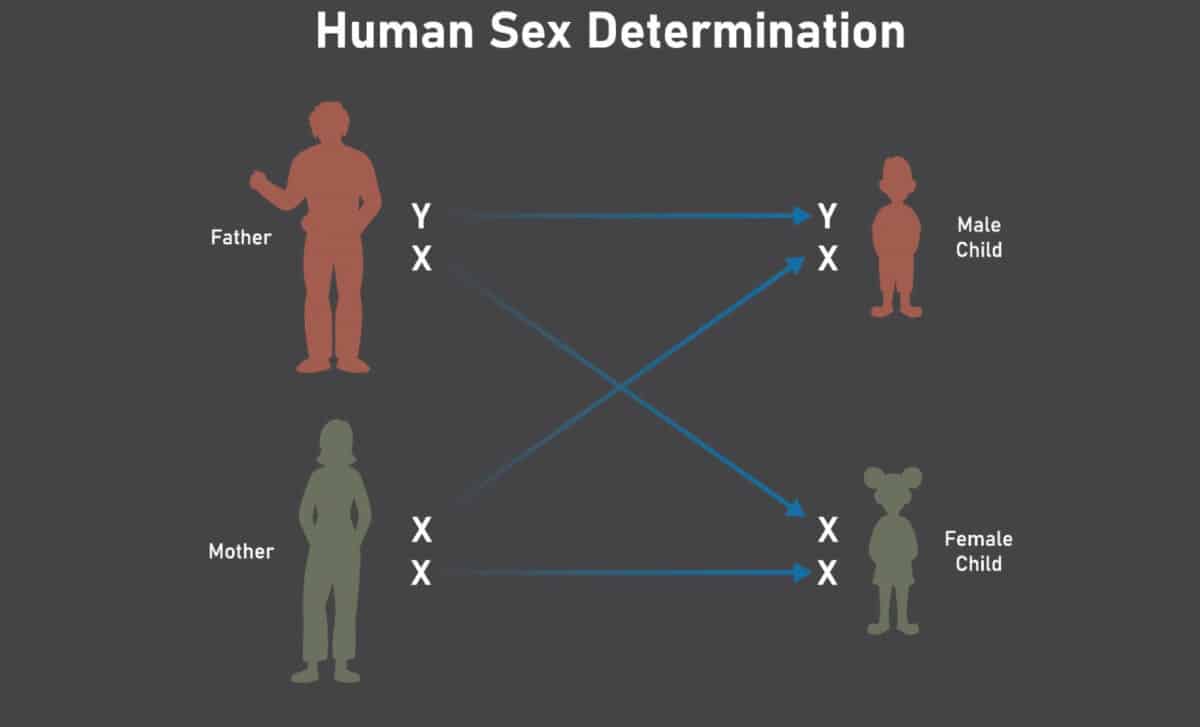 Scientific approach to human sex determination – © Shutterstock
Where the two scientists part ways is over what happened next. Hughes and her colleagues published findings in 2012 showing that very few core Y genes have been lost in the human lineage over the past roughly 25 million years. More recent comparisons of Y gene content across many mammals, she said in 2025, showed that “the gene loss was rapid at first, but quickly leveled off, and gene loss has essentially stopped.” In her view, the genes that survived did so because they serve crucial functions across the whole body, the selective pressure to maintain them is simply too strong.
Graves does not accept this reading. She acknowledges the apparent slowdown but argues that conservation is not the same as permanence. The extra genes identified in recent Y chromosome sequencing, she contends, are largely repeat copies, some of which may be inactive. Gene duplication can improve the odds of survival, she explains, the more copies of a message you send, the more likely one gets through, but it also increases the chances of distortion along the way. She has previously referred to the Y as a “DNA junkyard.” That characterization still stands, in her view.
The Number That Launched a Thousand Headlines
The figure most people remember, and most often misread, is Graves’ projection that the Y chromosome could disappear entirely within several million years. That calculation, published in a 2004 commentary, was based on a straight-line rate of deterioration. Graves herself has since clarified, at length, that she considers such a constant rate highly unlikely. The real estimate, she told ScienceAlert, carries an enormous margin of error: “anything from now to never.“
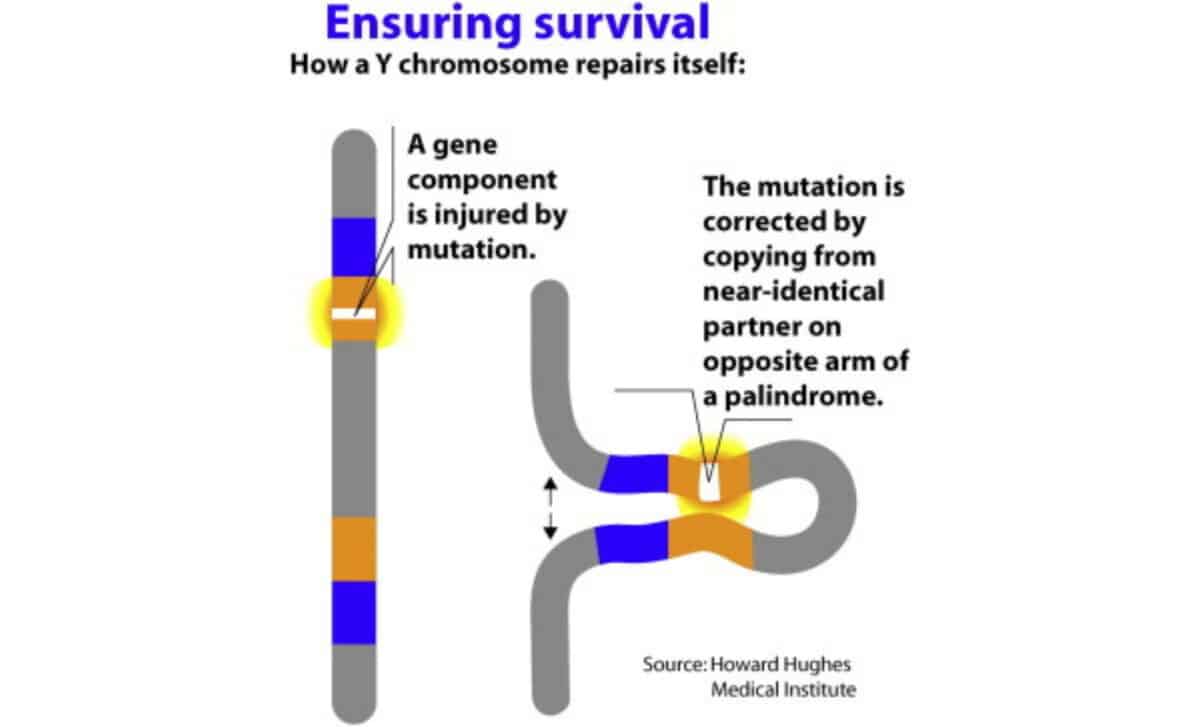 The Y chromosome cannot repair itself by ordinary meiosis with its homologous mate, and therefore, has to try to recombine with itself (gene conversion) – © Middle East Fertility Society Journal
None of that nuance made it into most of the coverage at the time. According to ScienceAlert, Graves described the public reaction as “hysterical” and said she was “surprised it was taken so seriously.” What she had intended as a rough back-of-the-envelope academic exercise became, in many outlets, a prediction of male extinction. “It really amazes me that anyone is concerned that men will become extinct in 5 or 6 million years,” she said. “After all, we have only been human for 0.1 million years. I think we’ll be lucky to make it through the next century.”
For her part, Graves has never backed away from the underlying argument, only from the straight-line math used to dramatize it. She maintains that Y chromosome degradation is real, ongoing, and proceeding “in fits and starts, for reasons we well understand.” She simply does not believe that a 25-million-year snapshot of apparent stability is enough to declare the process finished.
When the Y Disappears, Males Don’t Have To
Perhaps the most underreported element of this entire debate is what the animal kingdom already suggests about life without a Y chromosome. Three species of mole vole, Ellobius talpinus, Ellobius tancrei, and Ellobius alaicus, now carry only X chromosomes. Their sex-determining genes did not vanish; they relocated. The spiny rat Tokudaia osimensis followed a different path, losing its original Y chromosome while a new chromosome took over its function.
These examples point to a possibility that rarely features in the headlines: the Y chromosome’s role could be transferred, quietly, to another chromosome in a human population, and no one might notice. Sex-determining variants are not routinely screened for in genome studies. There would still be males; they would still reproduce. As Graves put it, “If a new variant should arise that works better than our poor old Y, it could take over very rapidly. Maybe it already has in some human population somewhere — how would we know?“
That open question, genuinely unanswered, may be the most honest summary of where the science stands. Two plausible interpretations of the same data, a tie vote from the scientific community, and a chromosome that has been declared both doomed and indestructible. Whatever its fate turns out to be, it almost certainly will not be resolved on a timescale that warrants much anxiety.