

If you’ve ever dreamed of seeing a total solar eclipse, the next few years present a rare opportunity. Between 2026 and 2028, Earth will experience three total solar eclipses in two years, but it’s the first two that are sparking debate among wannabe eclipse chasers.
On Aug. 12, 2026, and Aug. 2, 2027, the moon’s shadow will sweep across some of the most accessible and visually striking regions on Earth. Both events promise unforgettable views of the sun’s corona, plunging daytime into an eerie twilight. Yet they offer very different experiences.
You may like
2026 total solar eclipse: pros and cons
Do you really want to miss the next eclipse? By the time Aug. 12, 2026, comes along, it will have been almost two-and-a-half years since the last one in North America. This time, the path of totality begins in Siberia, crosses eastern Greenland and western Iceland, then arcs across northern Spain, before ending in the Mediterranean.
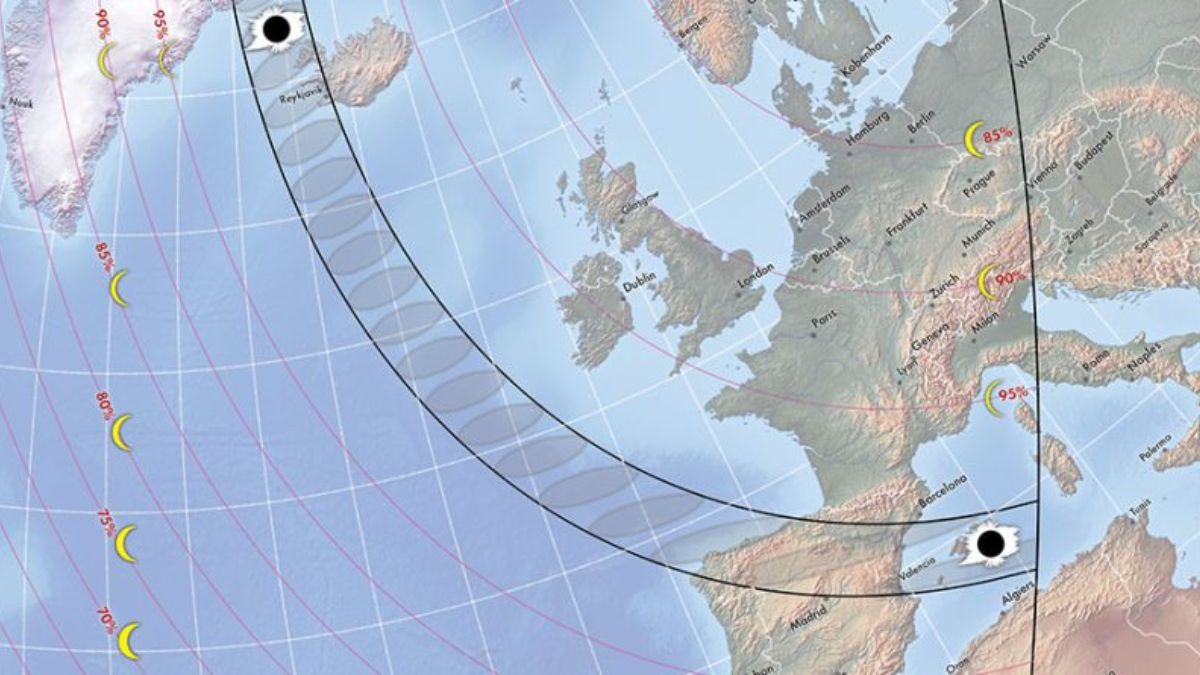
A map of the 2026 total solar eclipse. (Image credit: Michael Zeiler/EclipseAtlas.com)
For Europeans, this is a no-brainer. The first total solar eclipse over mainland Europe since 1999, the path of totality includes Reykjavik, Iceland and Spanish cities such as Bilbao, Zaragoza, León, Burgos and Valladolid. The path of totality is only a few hours’ drive from Toulouse, Bordeaux, Montpellier, Marseille and Lyon in France and only a day’s drive from Paris, Geneva in Switzerland and Turin in Italy. Besides, Spain receives about 11 million visitors each August; many Europeans will already be in Spain.
While in Iceland, there are dramatic landscapes — volcanic terrain, glaciers and rugged coastlines — in Spain, the sun will be relatively low in the sky, creating the relatively rare spectacle of a totally eclipsed sun on land just before sunset (that effect will reach its nadir in the Balearic Islands).
However, there are trade-offs. Congestion is expected in Iceland and Spain, maximum totality will last just over two minutes — a shorter time than is possible — and clear skies are not guaranteed. In Spain, wildfires could create a smoky atmosphere, reducing clarity (as happened in summer 2025).

2027 total solar eclipse: pros and cons
On Aug. 2, 2027, the “eclipse of the century” will take place, its nickname derived from its exceptionally long duration of totality. In Luxor, Egypt, the moon will completely cover the sun for 6 minutes and 22 seconds — more than three times longer than in 2026. In fact, it will be the longest inland totality since July 11, 1991, and the longest until Aug. 3, 2114.
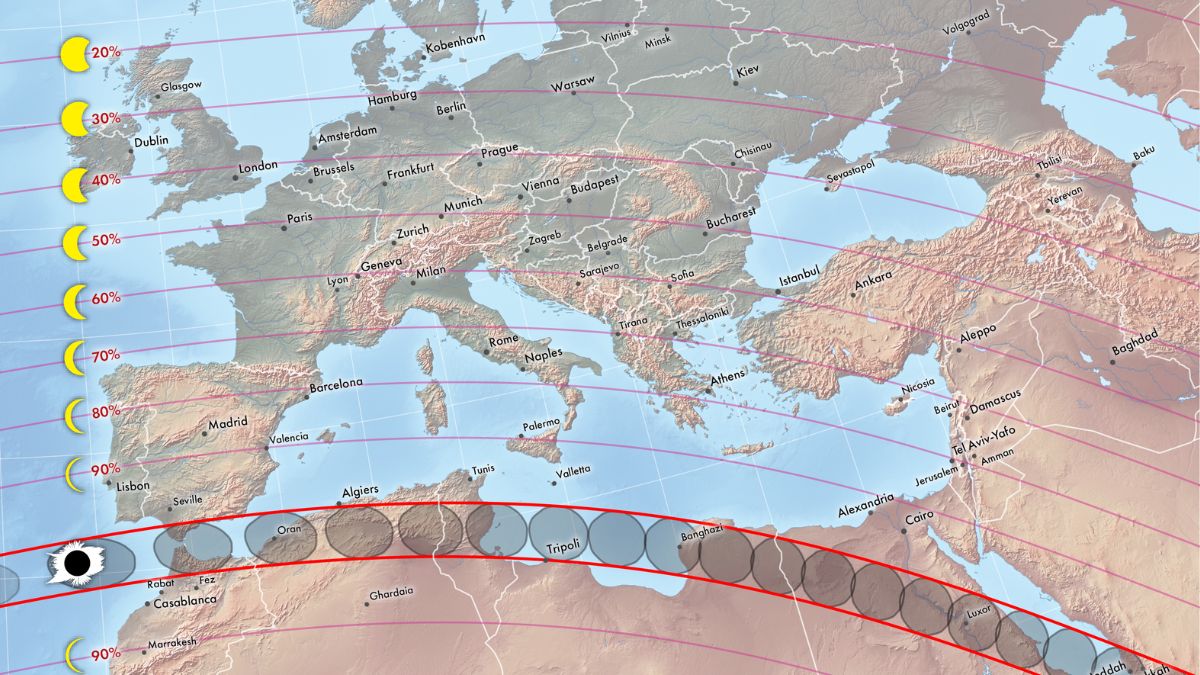
A map of the 2027 total solar eclipse. (Image credit: Michael Zeiler/EclipseAtlas.com)
The path of totality will stretch from Spain — this time, the south of the country — through North Africa and into the Middle East. While Spain offers a European setting, many eclipse chasers are eyeing destinations like Tunisia and Egypt for their very long totalities and very high chances of clear skies. Luxor, in particular, has become a focal point. With its ancient sites such as Karnak Temple and the Valley of the Kings nearby, it offers a striking backdrop. The risk of clouds is lower than that of a dust storm.
Again, there are trade-offs. Travel to North Africa or the Middle East may require more planning, higher costs and longer journeys. The scramble to get on organized tours to Luxor makes it prohibitively expensive, and by now, near-impossible. There’s also intense summer heat to worry about (an average daytime high of 105°F/41°C in Luxor), adding another layer of preparation.
What to read next
Key factors to consider
When choosing between the 2026 and 2027 eclipses, a few core differences stand out that may help eclipse chasers decide:
Duration: The 2027 eclipse is significantly longer, offering an immersive experience. The 2026 event is shorter and arguably more dramatic. However, this only applies if you are close to the centerline of the path of totality.Weather: Northern Spain and Iceland in 2026 carry moderate cloud risk, while southern Spain and North Africa in 2027 generally offer more reliable sunshine, though coastal cloud can still be an issue. Don’t conflate climate — the science of averages — with weather forecasts three days before the eclipse. The latter is all that matters.Accessibility: The 2026 eclipse is easier for European travelers, with straightforward transport and familiar infrastructure. The 2027 eclipse may involve more complex planning, especially outside Spain.Viewing conditions: A low sun in 2026 creates dramatic visuals, but requires a clear horizon. The higher sun in 2027 simplifies viewing, but takes place in mostly much hotter conditions.Crowds and logistics: Both events will be busy, but 2027 — especially in southern Spain — may see more concentrated crowds, particularly if the 2026 eclipse acts as a global advertisement for 2027’s “eclipse of the century.”Why prioritizing by duration is a mistake
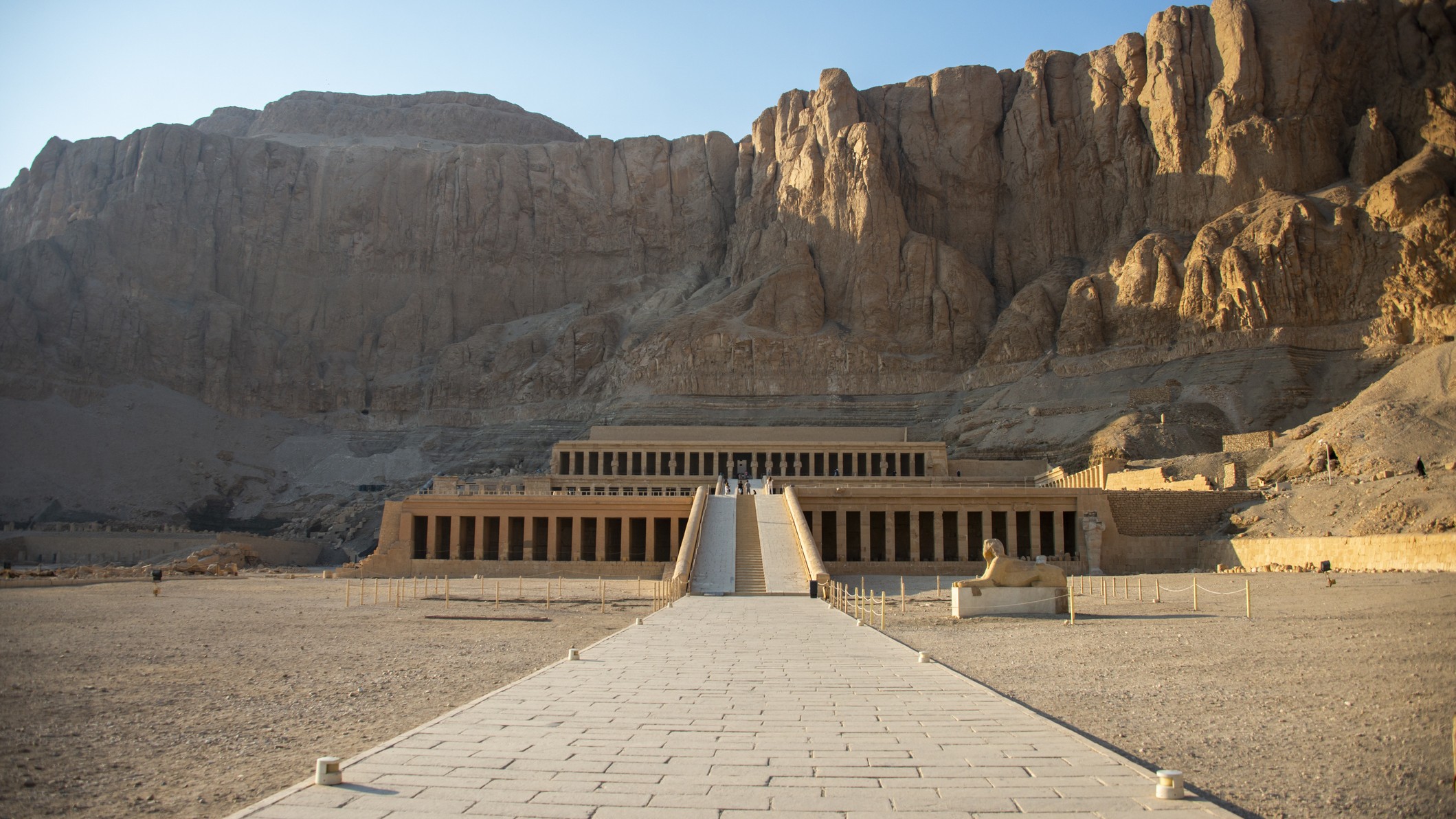
Totality will last 6 minutes 20 seconds at the Mortuary Temple of Hatshepsut, Luxor, Egypt. (Image credit: Paul Biris via Getty Images)
There’s a number that dominates almost every conversation among inexperienced eclipse chasers about a total solar eclipse: duration. Two minutes, four minutes, six minutes. It’s treated like a score — as if longer automatically means better. It doesn’t. The miracle isn’t how long totality lasts — it’s that it happens at all. The sun and moon appear almost the same size in our sky by pure coincidence. When they align perfectly, day turns briefly into night. Given how short all total solar eclipses are, being at all concerned about how many seconds totality lasts is actually ridiculous.
In fact, shorter eclipses are very often more dramatic — more sudden, more intense, more unforgettable. If you’re after drama, a total solar eclipse will deliver — and I guarantee you will never remember exactly how many seconds it lasted. There’s a reason why some experienced eclipse chasers head to the edge of the path of totality to glimpse a 1-second totality.
Sure, there’s a good case to be made that the 2027 total solar eclipse is the exception to this rule purely because of the extreme length of totality. After all, the longest until 2114 is really hard not to get excited about. Yes, there will be more time to absorb the changing light, the drop in temperature, and to take in the solar corona in detail. If you’re heading to Luxor in 2027, great decision — you’ll not regret it. However, anyone watching an eclipsed sun on the cusp of setting while on a beach in the Balearic Islands in 2026 will have just as much drama — if not more.
There’s a cautionary tale from recent history. Many eclipse chasers ignored South America’s total solar eclipse in 2019, which was short and predicted by some to be cloudy, for a slightly longer, supposedly clearer one in 2020 in almost the same place. Both COVID-19 and intense rainstorms kiboshed those plans.
The conclusion, of course, is simple: if you can afford it, always go to the next total solar eclipse, no matter the duration, no matter the climatic predictions.
Spain’s double totality
One of the most fascinating aspects of this eclipse cycle is Spain’s unique position. It sits in the path of totality for both 2026 and 2027 — offering two entirely different eclipse experiences just a year apart.
In 2026, Spain delivers a low, sunset eclipse across its northern and central regions. Open landscapes in Castilla y León — around León, Burgos and Palencia — are expected to be popular for their clearer western horizons and slightly higher sun. Coastal and eastern areas offer more dramatic settings, but come with greater risk from haze and obstruction.
In 2027, the focus shifts south to Andalucía. Here, the eclipse occurs high in the sky, with durations exceeding 4 minutes near the Strait of Gibraltar. Locations like Tarifa, Cádiz and inland hill towns offer expansive views and long totality, though with the likelihood of heavy crowds.
The contrast is striking. One year offers a fleeting, cinematic eclipse around sunset; the next delivers a long, high-altitude spectacle. Anyone heading to Spain twice in succession will have a case study in how different eclipses can feel.
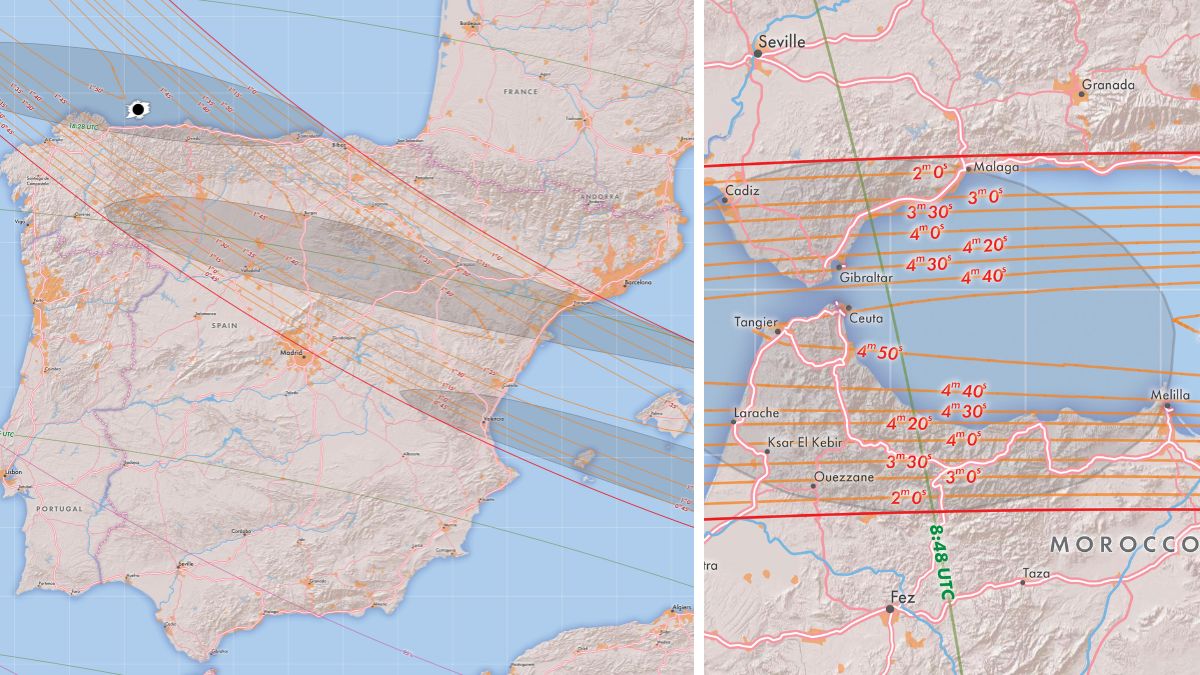
Maps of the 2026 and 2027 total solar eclipses in Spain. (Image credit: Michael Zeiler/EclipseAtlas.com)What kind of eclipse experience do you want?
Eclipse chasing is about choosing the experience you want, so if you’re deciding between the 2026 and 2027 total solar eclipses, think about where you want to travel. “I always highly recommend picking someplace in the path of totality you’d like to go to, regardless of whether or not the total eclipse would be happening,” Tyler Nordgren, an Ithaca, New York-based astronomer and eclipse artist at Space Art Travel Bureau, told Space.com.
Iceland in August — with an almost midnight sun — is a bucket-list experience in itself. So is touring the castles of Spain, or seeing the Arctic fjords in Greenland.
Wherever you plan to go, bear in mind the practical reality on the day. You may plan to be on the centerline for a super-long totality, but if there are clouds, you may find yourself driving to the edge of the path, where totality lasts only a few seconds, but in a clear sky. Be inside the moon’s umbral shadow, and be forever grateful, for being able to witness nature’s most perfect moment is the real prize.