
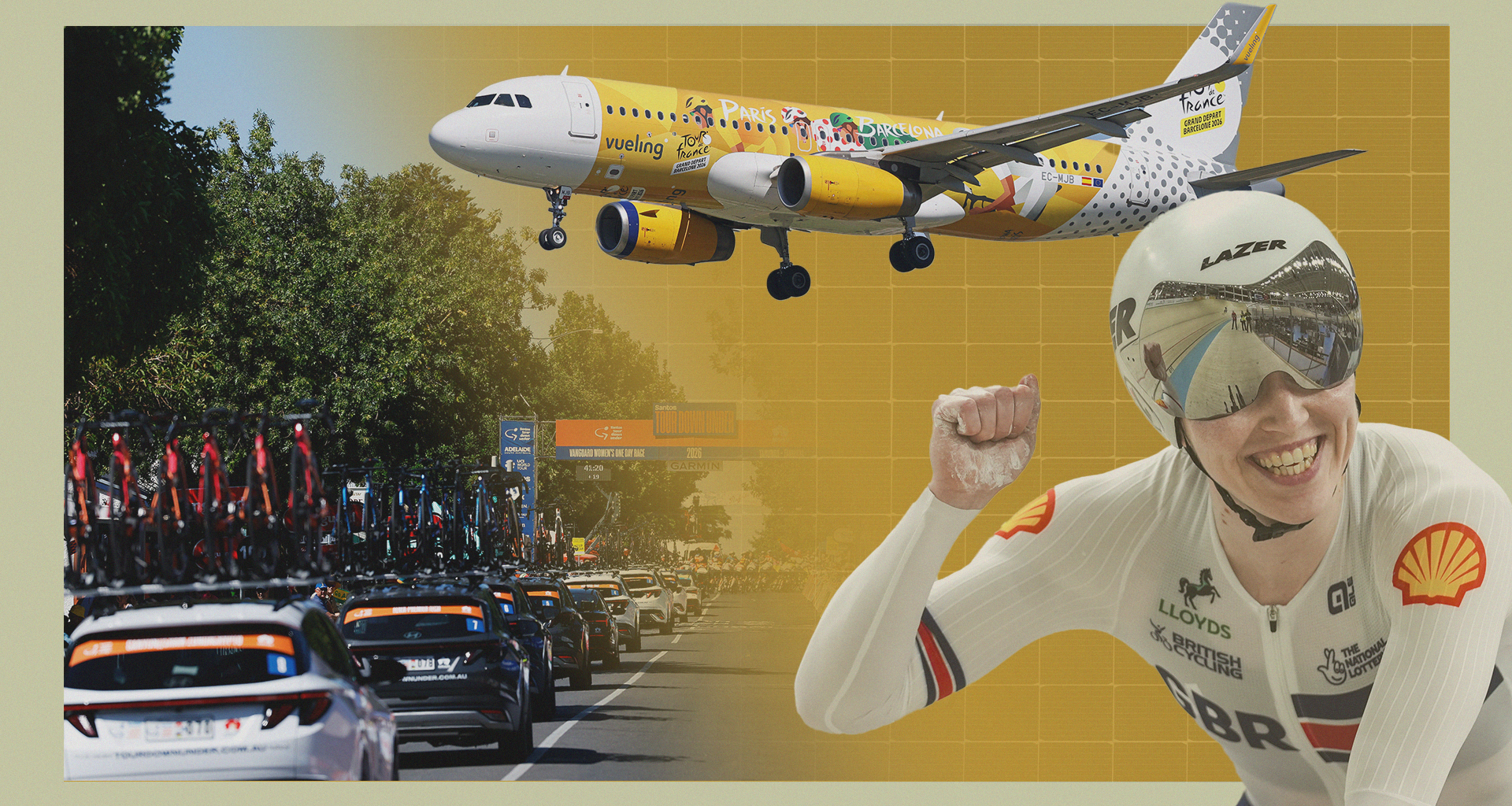
Professional cycling finds itself in a fairly unique situation when it comes to environmental sustainability. There are no stadiums to power, no pitches to maintain and the bicycle itself is increasingly promoted as a method of low-carbon mobility. Yet the reality of the modern WorldTour, with its sprawling logistics, global calendar and a continued reliance on sponsorship linked to fossil fuels, tells a more complicated story.
Race organisers are facing growing scrutiny. Pressure is coming from multiple directions: governing bodies’ targets, teams working towards net-zero commitments, and a fanbase that is increasingly aware of their sport’s environmental impact. For much of its recent history, the professional side of cycling has leaned on its obvious connection to cycling as a low-carbon activity. That position is becoming harder to defend.
What is being done already?
One of the most visible and measurable shifts across professional cycling has come through the electrification of the race convoy. The sheer number of vehicles following a WorldTour race has long been one of its defining images and increasingly, one of its most scrutinised.
The clearest benchmark is the Arctic Race of Norway, which has emerged as a testbed for what electrified race logistics might look like. Since 2023, the race has operated with a fully electric fleet of support vehicles, covering everything from team cars to race officials. Around 120 to 130 electric vehicles are deployed, supported by temporary charging infrastructure that travels with the event.
Crucially, the organiser provides teams with these vehicles. That not only ensures consistency across the fleet but also removes the need to transport team cars into what is, geographically, one of the more remote races on the calendar. It is a small but significant intervention that highlights the influence organisers can exert when they control the logistics.

The peloton and a fully electric convoy weave through the Norwegian landscape during the 2023 Arctic Race of Norway (Image credit: Luc Claessen/Getty Images)
There are caveats. The model relies on sufficient charging infrastructure and on ensuring that electricity supply does not simply shift emissions elsewhere through diesel-powered generators. According to a recent report, 95.9% of all new Norwegian passenger cars bought in 2025 were electric and therefore, Norway’s position as a global leader in electric vehicle adoption gives the race a natural advantage. However, expanding charging networks across Europe suggests this model may become easier to replicate in the coming years.
Elsewhere, progress has been more incremental. Many of the sport’s biggest races, including all three Grand Tours, have introduced a mix of electric and hybrid vehicles through manufacturer partnerships. But details remain vague, making it difficult to assess how far the transition has really gone.
For now, hybridisation appears to be a stepping stone rather than an end point. As fully electric vehicles become more viable across longer distances, the expectation is that combustion engines will gradually be phased out. The pace of that transition, however, remains uncertain.
Another element that organisers have within their control is the distance race routes cover and the length of transfers during stage races. The Tour de Suisse is one of the more progressive events in this area. Organisers have explored shorter stages and a more compact format, alongside plans to align men’s and women’s events. The logic is straightforward with fewer transfers, shared infrastructure and less duplication. It is a relatively simple adjustment and not environmentally motivated per se, but one that points towards a more efficient model.
Read more member-exclusive features like this
(Image credit: Getty Images/Illustration by Michael Rawley)
Elsewhere, similar efficiencies already exist. Many of the sport’s biggest one-day races, from Paris–Roubaix to Strade Bianche, effectively share infrastructure across men’s and women’s events. Whether driven by logistics, cost or broadcast considerations, the environmental benefits are a by-product rather than the primary aim.
At the other end of the spectrum sit the Grand Tours. Their global reach, from foreign Grand Départs – highlighted in the last week by the Giro d’Italia’s Bulgarian start – to increasingly extreme stage locations, remains central to their appeal, but also raises questions. Long transfers are a routine part of modern stage racing, and while teams are restricted in how they move between stages, it is not uncommon for support staff, equipment and race infrastructure to rely on air travel.
There is also a growing conversation around where races take place. Mountain stages often produce many of a stage race’s defining images, but they can take place in environmentally sensitive regions. Research into the impact of large-scale sporting events in alpine areas has highlighted pressures on fragile ecosystems, particularly when large numbers of spectators travel to remote locations. Race organisers have made efforts to mitigate this by creating green zones for riders, deploying clean-up crews once the race has passed, and imposing restrictions on vehicle access, but the tension remains.
A middle ground may be possible in most situations. Few would push for the removal of iconic summit finishes, but there is scope to rethink how spectators access them. Transport hubs in nearby towns or cities could act as gateways, with public transport provision helping limit the number of vehicles on sensitive climbs. Other sports have experimented with offering free public transport to ticket holders, such as both of the most recent men’s and women’s UEFA Euro 2024 & 2025 tournaments; although road cycling’s free-to-attend roadside model makes this more challenging. Without ticketing, any incentive scheme would need to be free to all on the day.
Beyond individual races, the structure of the calendar itself comes into focus. On paper, cycling already follows a loose geographic flow: early-season racing in Australia and the Middle East, a European core through spring and summer, before a shift towards North America and Asia later in the year. In practice, however, teams often criss-cross continents in search of ranking points, especially those sitting below WorldTour level. This is less an issue for individual organisers than for the sport’s governing structure. A more coordinated calendar could reduce travel demands significantly. Other sports have begun to move in this direction. In motorsport, recent calendar reforms in Formula One have grouped races into regional blocks; while Extreme E has gone as far as using its own dedicated ship, the St. Helena, to transport the cars, equipment and series infrastructure by sea from round to round.
Cycling’s greatest power (and responsibility?)
Whilst race organisers can influence how events are run, their greatest impact may lie elsewhere, in how they influence people to travel in their everyday lives.
Few sports are as closely tied to a real-world solution as cycling. The same machine used in competition is also one of the most accessible forms of low-carbon transport. The opportunity, then, is obvious. To use the platform of professional racing to shift everyday behaviour.
The 2023 UCI Cycling World Championships offered a glimpse of what that might look like in practice. In the build-up, organisers developed a ‘Power of the Bike’ strategy that positioned the event as more than elite sport, with a clear focus on participation and everyday cycling. The results were notable. Post-event data suggested that 82 per cent of visitors travelled via active modes, while 79 per cent of surveyed Scottish residents said they intended to cycle more.

Scottish minister for Public Health, Women’s Health and Sport, Maree Todd, MSP alongside Trudy Lindblade, CEO of 2023 UCI Cycling World Championships raising awareness for the event’s ‘Power of the Bike’ campaign (Image credit: UCI)
It is a rare example of a cycling event measuring its influence beyond the race itself. Without clear targets or data, it becomes difficult to separate genuine impact from well-intentioned messaging. Glasgow 2023 demonstrated a more deliberate approach, one that could be replicated elsewhere and embedded into event strategies, key performance indicators and even sponsor agreements.
For a sport built around the bicycle, the potential reach is enormous. The question is whether organisers are prepared to treat behavioural change not as a by-product of racing, but as a central objective.
Turning fans into participants
Other sports have begun to move beyond simply reducing their own footprint and are instead focusing on influencing their audiences’ behaviour. Football has started to treat fans not just as spectators, but as participants in climate action.
Initiatives such as Green Football Weekend are built around that idea. Supporters are encouraged to make practical changes, from how they travel to what they eat, with their actions tracked and converted into measurable impact. Fans effectively compete on behalf of their clubs, earning points and climbing league tables, often with incentives such as match tickets, a signed shirt or other prizes.
The model taps into both competition and collective identity. It has also attracted coverage and attention from TNT and Sky Sports, albeit not without criticism. Questions around greenwashing persist, and the long-term impact of such campaigns is difficult to quantify. Even so, the shift in approach is commendable.
Cycling, arguably, is better placed than most to adopt a similar model. Spectators are already embedded within the landscape of the race, often arriving on foot or by bike. Yet there is little in the way of coordinated, large-scale activation. The opportunity is there, but largely untapped.
Making sustainability part of the competition
Sailing offers a different, but equally pioneering, example. SailGP has introduced an ‘Impact League’ that runs alongside its racing series, embedding sustainability directly into the competitive structure.
Teams are awarded points based on a range of criteria, including emissions reduction, waste management and community engagement. Performances are independently assessed and publicly ranked, with prize money and prestige up for grabs. While separate from the racing standings, the system creates a clear incentive for teams to consider environmental sustainability seriously.
The principle is transferable. A framework that rewards measurable environmental progress, whether through UCI points, prize money or rankings, would mark a significant shift from the current approach largely reliant upon morality.
Professional cycling continues to rely heavily on partners with links to fossil fuels. Seven teams in the 2025 Tour de France were sponsored by companies or nation-states tied to fossil fuel production. The race’s organisers, ASO, entered a partnership with TotalEnergies for the 2026 edition, a company whose annual carbon emissions are roughly equivalent to those of the entire United Kingdom. The contradiction is difficult to ignore. A sport centred on the bicycle, often framed as a solution to low-carbon transport, remains financially tied to some of the world’s worst polluters.
Cycling, like many other sports, finds itself in a tricky situation. Accept the fossil fuel sponsorship money and continue the status quo, or pass it up and risk not being able to find another willing sponsor. Australian gas giant Santos has seen its title sponsorship of the Tour Down Under come under fire in recent months, but this criticism appears to have been brushed aside. In contrast, Tennis Australia ended its sponsorship agreement with the fossil fuel company in 2022 after just one year as a result of a targeted anti-sportswashing campaign on social media. Likewise, in a similar vein, ExxonMobil were reportedly turned down by the English Rugby Union to the tune of £2.5m. Some may read this and wonder why British Cycling didn’t do the same when it came to entering a long-term partnership with Shell in 2023. These decisions remain the exception rather than the rule, but they point to a shifting landscape.
The bike is a clear climate solution, but the authenticity of this message quickly collapses if the sponsors and their values contradict this. It is difficult to promote cycling as sustainable mobility when sponsorship values appear to pull in the opposite direction.
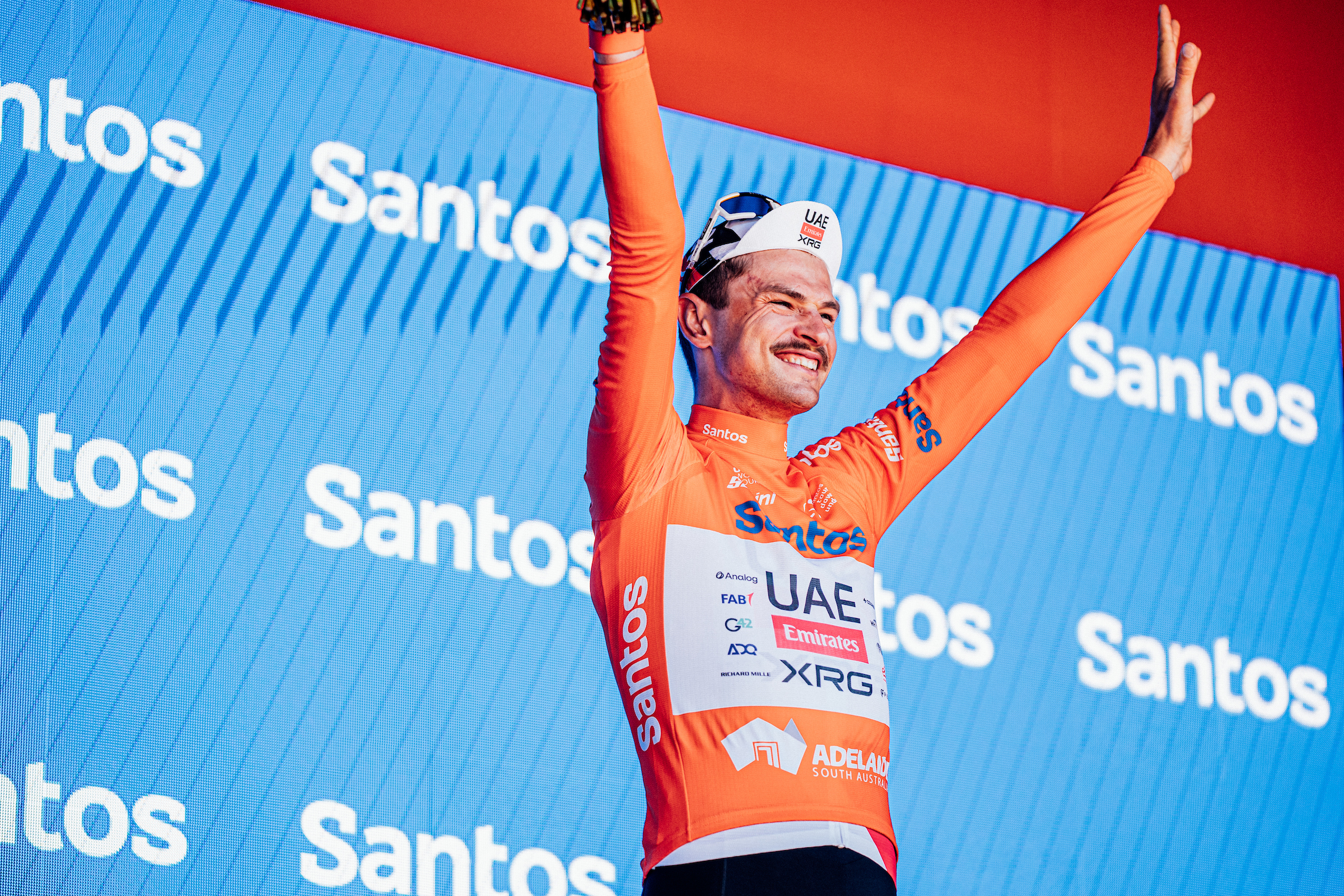
Santos has been the Tour Down Under’s title sponsor since 2010 (Image credit: Zac Williams/SWpix)
Where does all this leave us?
It is fair to question whether it is the responsibility of race organisers to drive this change in the first place. The UCI has set emissions reduction targets for both itself and WorldTour teams, but events have avoided the same level of scrutiny. The largest organisers, like ASO, will soon be, or are already, required to measure and disclose their emissions by European legislation, albeit yet to be required by law to reduce emissions.
However, events are already being affected by the climate crisis. The Santos Tour Down Under is very much the proverbial canary in the cage, with extreme heat and wildfire risk regularly shaping the race and forcing stage modifications, as it did this year with the removal of Willunga Hill on Stage 4. Similarly, an academic study published earlier this year concluded that dangerous heat for the Tour de France is only a matter of time, as summers in Europe grow hotter. It’s not just the heat that races will need to worry about, either. More extreme and unpredictable wind, rain and snowfall can jeopardise the safe passage of races at worst and, at best, make it a miserable day out for spectators and riders alike.
In that context, the role of organisers becomes harder to ignore. Events sit at the centre of the sport. They are its most visible expression and, in many cases, the point at which its environmental impact is most concentrated. While teams, governing bodies and sponsors all have a role to play, organisers retain significant control over logistics, route design and delivery.
There is also an opportunity. Few sports are as closely linked to a well-known climate solution as cycling. That gives its events a chance not only to reduce their own impact, but to influence behaviour more widely. Whether they choose to take this opportunity may help define the sport’s trajectory in the years ahead.