
The Prime Minister called me tonight to extend his congratulations on @theSNP election victory. We discussed the cost of living issues faced by the public and the election of the largest number of MSPs committed to Scottish Independence. We agreed to meet next month for talks.
— John Swinney (@JohnSwinney) May 12, 2026
However, No 10 has disputed the SNP‘s interpretation of the conversation, saying its opposition to another independence vote remains “unchanged”.
The two men spoke for the first time since last week’s election, which saw the SNP returned as the largest party, and Labour come joint second with Reform.
In a statement released after the call, a spokesperson for Mr Swinney said: “The First Minister is pleased that the Prime Minister reached out to congratulate him on his emphatic election win and that the Prime Minister stressed his willingness to work in collaboration with the Scottish Government where possible.
“It is particularly welcome that the Prime Minister agreed to meet next month to discuss a referendum on independence.
“Given the SNP’s landslide victory and the fact that the people of Scotland have elected more pro-independence MSPs than at any point in the Parliament’s history, the previous refusal of the UK Government to consider Scotland’s right to decide its own future was clearly unsustainable.
“A way forward must be found and so these discussions are welcome.”
READ MORE:
John Swinney speaks exclusively to The Herald in his first post-election interview
John Swinney: Why I have little empathy for Sir Keir Starmer
The massive independence challenge facing John Swinney after SNP fail to win majority
The First Minister’s spokesperson also referenced recent comments by Labour MSP Paul Sweeney, who has backed calls for a cross-party convention that could agree a trigger point for a second referendum to “settle” the debate.
“Coming alongside Labour MSPs making clear that there must be a way for this question to be resolved, it is now very clear that the momentum is building behind Scotland’s right to decide,” the spokesperson said.
“The First Minister looks forward to the talks with the UK Government, and is confident that the people of Scotland will choose the fresh start of independence.”
A Downing Street spokesperson said: “The PM committed to meeting to discuss shared issues including the cost of living.
“As the PM told the First Minister, the manifesto this government was elected on was unambiguous that Labour does not support independence or another referendum.
“Our position remains unchanged.”
Under a strategy agreed by party members last year, had the SNP won more than 65 seats at the election this would have been taken by the Scottish Government as a mandate to start negotiations for a second vote on independence.
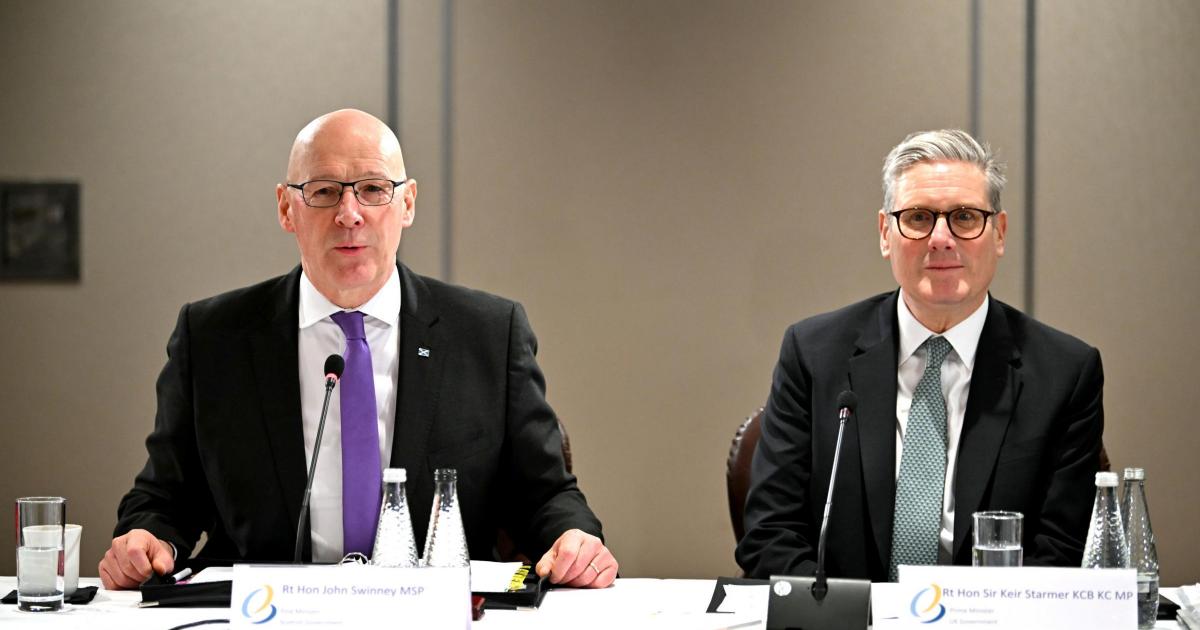
Sir Keir Starmer and John Swinney spoke this afternoon for the first time since last week’s election (Image: Andy Buchanan/PA)
However, while they were returned to Holyrood as the largest party last week, they were seven seats short of the threshold.
But on Saturday, Mr Swinney insisted his party still has a mandate for a second independence referendum.
He argued that the record 15 Scottish Green MSPs elected meant there were “more pro-independence politicians in Holyrood than at any point in the history of the Scottish Parliament.”
There has been consistent opposition to re-opening the constitutional question from Downing Street.
Last year, Chancellor Rachel Reeves said there would “not be another referendum,” regardless of the result of the election.
She told Radio Scotland Breakfast: “When there was a referendum just a few years ago, they said this was a once-in-a-generation referendum. People gave their verdict then; we do not need another one.”
Asked how long she believed a generation was, Ms Reeves said it was “certainly not 12 years”.
READ MORE:
Starmer vows to fight on as Labour MPs urge him to set a timetable for exit
Inside the turmoil in Scottish Labour as anger over Keir Starmer deepens
‘Secure the culture brief’: John Swinney faces arts industry demand over cabinet seat
Any independence referendum needs to have the agreement of Westminster.
The Supreme Court made that unambiguously clear in 2022 when Nicola Sturgeon asked the justices to rule on whether the Scottish Parliament could legislate for a consultative referendum without Westminster’s permission.
The court unanimously concluded that it could not, because the Union is a reserved matter.
Scottish Conservative leader Russell Findlay said he was stunned by the Prime Minister’s willingness to discuss independence.
“Even by Sir Keir Starmer’s dismal standards this is an extraordinary capitulation to John Swinney,” he said.
“We warned during the election campaign that if Swinney achieved his self-imposed ‘mandate’ of an SNP majority, Starmer would be likely to surrender to his referendum demands.
“But for Starmer to entertain talks on the subject when the Nationalists haven’t even met their own target is downright foolish and reckless.
“If he wasn’t so weak, Starmer would have sent Swinney packing and told him to get on with the day job.”
In 2014, Scots voted no to independence by 55.3% to 44.7%. There was an exceptionally high turnout across the country, with 84.6% of eligible voters taking part.