
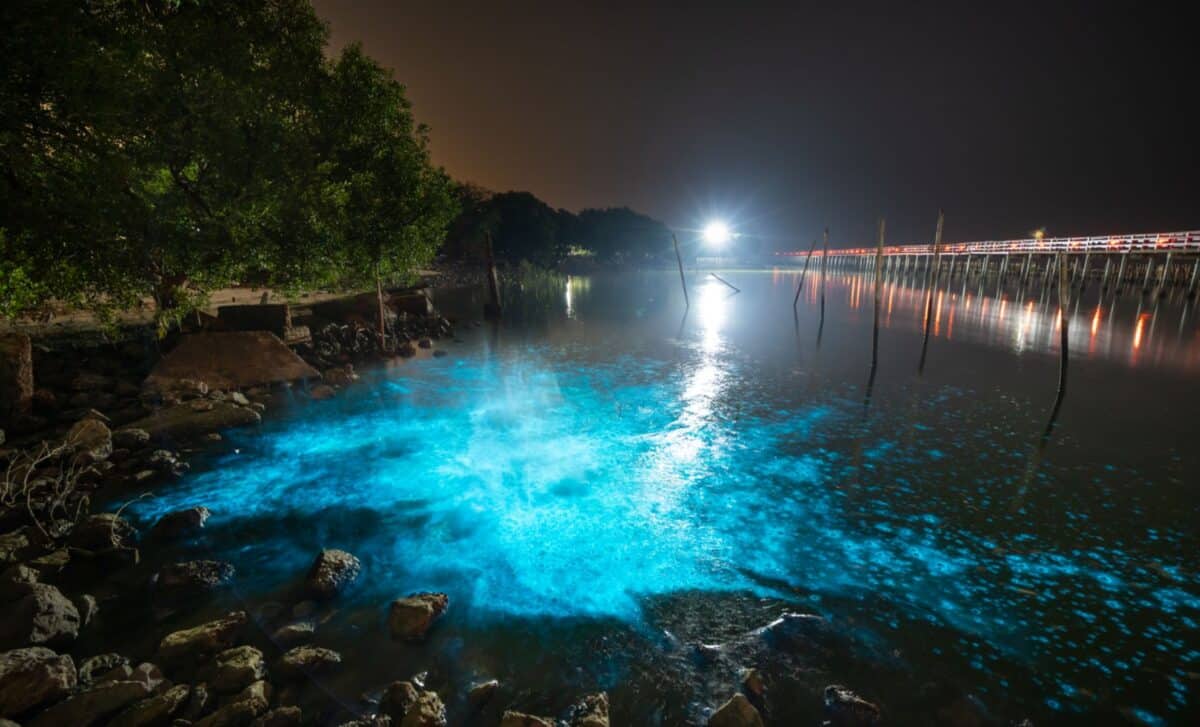
Researchers at the University of Colorado Boulder have developed a method to chemically trigger sustained bioluminescence in a marine algae species, keeping it illuminated for up to 25 minutes without electricity. The cells were then embedded in 3D-printed structures that remained viable and light-emitting for four weeks.
Bioluminescence (the production of light through biological chemical reactions) is widespread in nature, from fireflies to deep-sea organisms. In marine environments, the dinoflagellate Pyrocystis lunula naturally emits a brief blue flash when physically disturbed, a defense mechanism against predators. Until now, sustaining that response in a controlled, repeatable way had proved difficult.
Chemical Triggers Replace Physical Agitation
The central challenge the UC Boulder team addressed was converting a transient, mechanically triggered response into something durable and controllable. According to the study, published May 6 in Science Advances, researchers exposed P. lunula to two chemically defined environments, an acidic solution at pH 4, roughly equivalent to tomato juice, and a basic solution at pH 10, comparable to mild soap.
Both triggered bioluminescence, but with markedly different results. Acid stimulation produced intense, localized light emission concentrated in intracellular compartments called scintillons, persisting for up to 25 minutes with a peak photon flux of approximately 112,000 photon counts. Base stimulation generated a more diffuse, shorter-lived response, initially localized but quickly spreading across the entire cell as alkaline stress degraded cellular structures, reaching a peak of around 43,000 photon counts.
“It was a very exciting moment when we found the right chemical stimulant that allowed the light to stay on for a long time,” said Giulia Brachi, research associate at UC Boulder and the study’s first author. “This is the first time we have figured out how to sustain luminescence.”
The researchers also found that combining chemical preconditioning with mechanical compression produced a synergistic effect. According to the study, acid-primed constructs subjected to compressive loading achieved total luminescent output of 661.3 arbitrary units, compared to 304.6 in mechanically stimulated controls, more than double the light emission, without compromising the cells’ native mechanoresponsiveness.
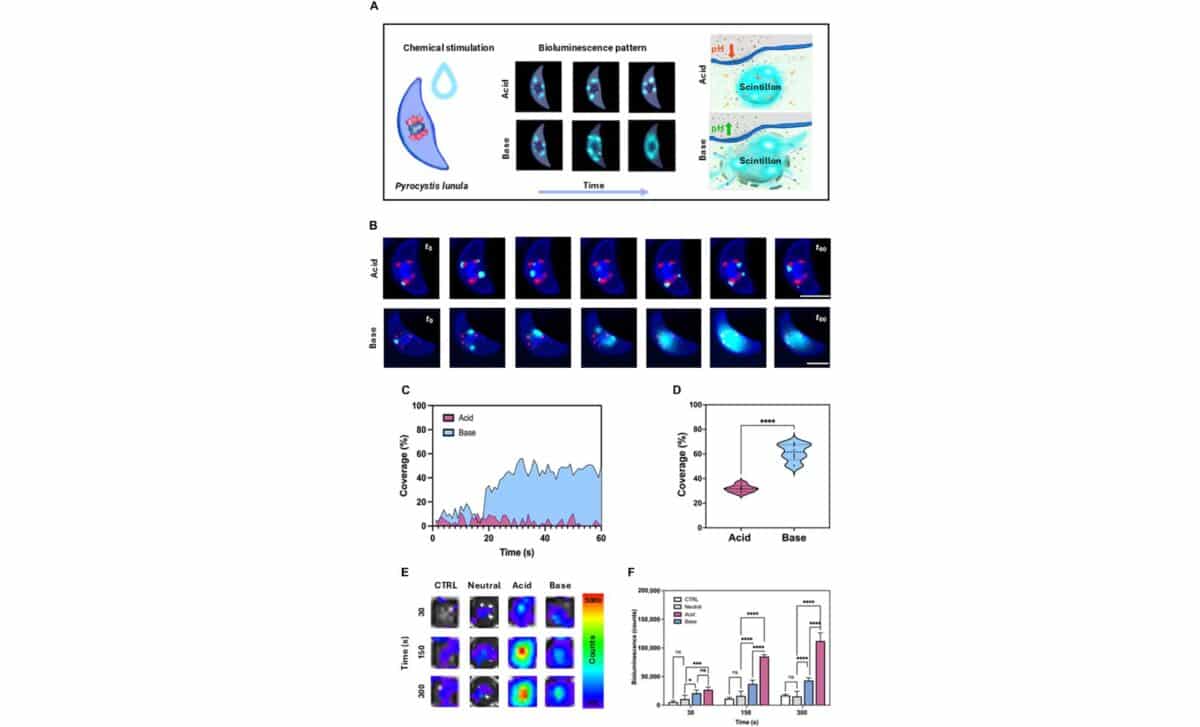 Ph-Dependent Bioluminescence in P. Lunula: Acid Triggers Localized Scintillon Emission; Base Induces Diffuse, Cell-Wide Response ©Science Advances
Living Structures That Persist Over Weeks
Beyond triggering the light, the team needed a way to integrate the algae into a usable format. P. lunula cells were suspended in sodium alginate (a water-based, naturally derived gel) and extruded through a 3D bioprinter into defined shapes, including a crescent and a university logo. The resulting constructs were ionically crosslinked to maintain structural stability.
Imaging confirmed that the printing process preserved cellular viability and produced uniform cell distribution throughout the hydrogel matrix. When exposed to the acidic solution, the embedded algae illuminated the full geometry of each printed form in blue light.
Critically, the cells did not exhaust after a single activation. In longitudinal testing over four weeks, acid-conditioned constructs were stimulated weekly and monitored for bioluminescent output. According to the study, acid-treated structures retained 75 percent of luminescent activity through week four, with peak photon flux remaining above 200,000 arbitrary units in cycles three and four. Base-treated constructs, by contrast, lost nearly all function by week three, a 97 percent overall reduction attributed to alkaline-induced membrane degradation and cell death.
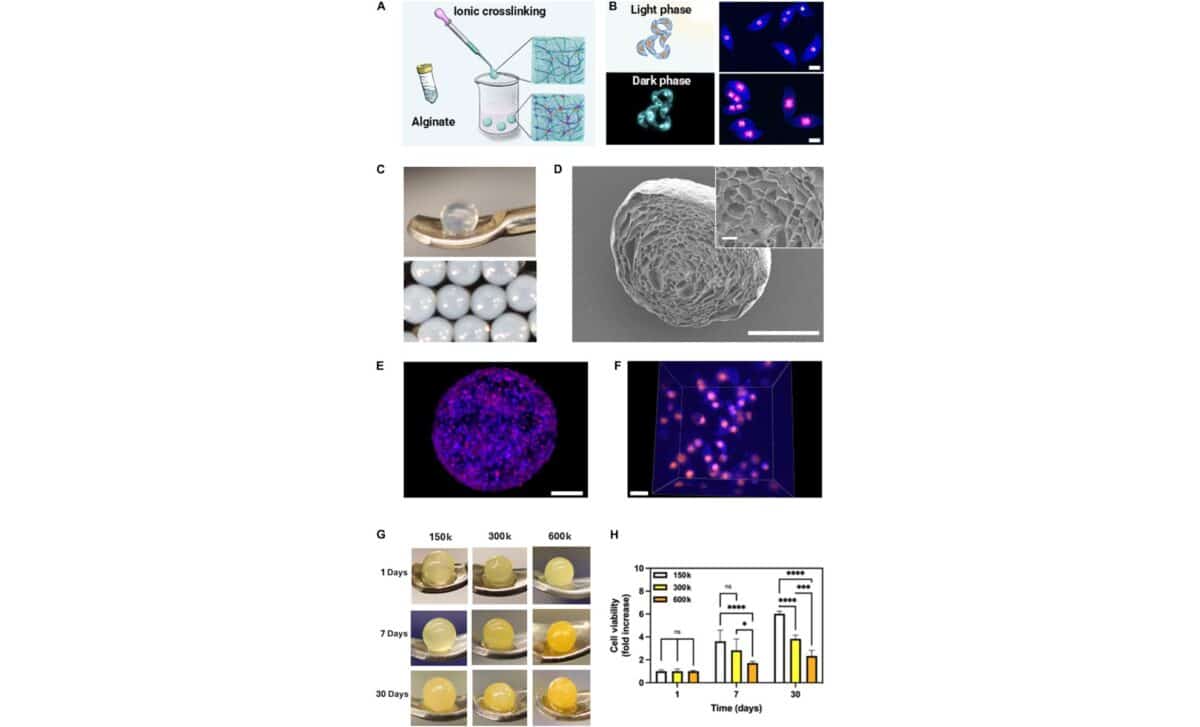 P. lunula encapsulated in alginate hydrogel beads: uniform cell distribution and sustained viability confirmed over 30 days across seeding densities ©Science Advances
Fluorescence imaging corroborated these findings: acid-treated and control scaffolds maintained dense, viable algal populations with intact hydrogel architecture, while prolonged base exposure resulted in extensive structural collapse.
Professor Wil Srubar, the study’s senior author and a civil and environmental engineering professor at CU Boulder, described the ambition behind the project plainly: “I was curious if we could create a world in which we don’t use electricity but rather use biology to produce light. This discovery really paves the way for engineering other living light materials and devices.“
There is also an environmental dimension to P. lunula that sets it apart from conventional light sources. Because the organism is photosynthetic, it absorbs carbon dioxide as it grows, meaning that, unlike electric lighting, it consumes rather than produces carbon during operation.
Potential applications outlined by the researchers include biosensing platforms capable of detecting water-borne toxins through changes in luminescent response, as well as autonomous lighting for soft robotics operating in environments (deep-sea or space) where battery power is impractical. The team indicated that future work will focus on expanding the range of chemical stimuli the system can respond to and integrating multiple inputs for greater functional control.