
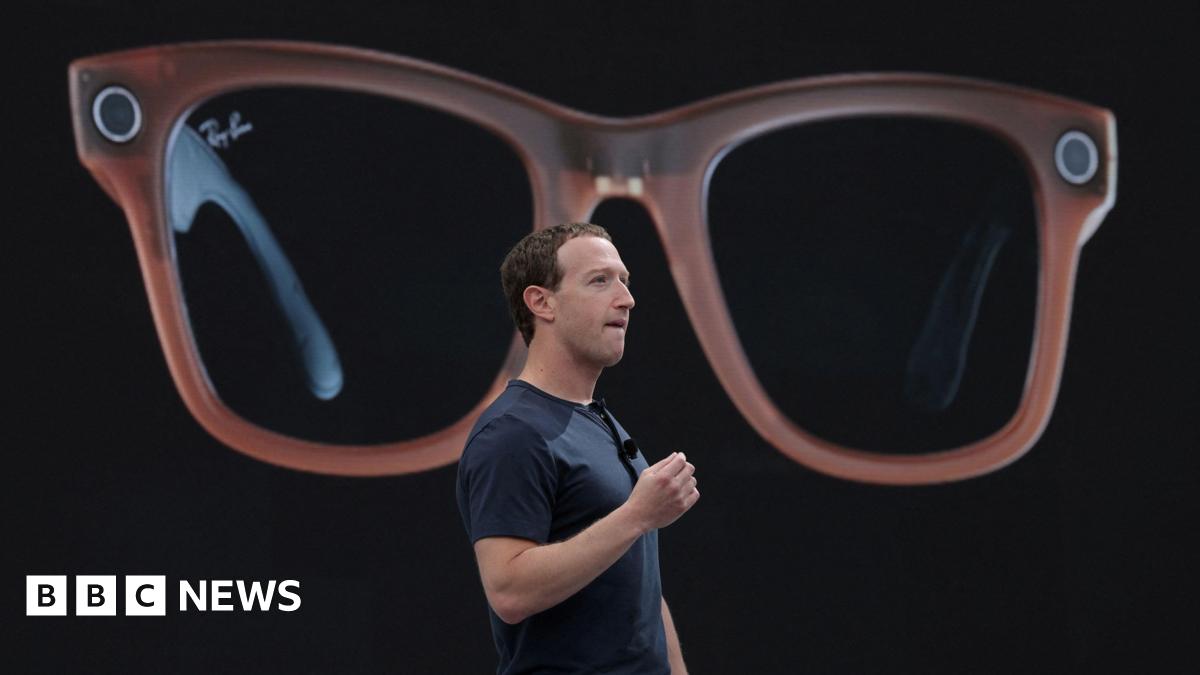
Issues with a new wave of “smart glasses” seem to be piling up.
Yet some of the biggest technology companies in the world are poised to sell many millions of pairs in the coming years.
Women leaving the beach, going into a shop, or simply standing outside are now being approached by men usually wearing Meta’s Ray-Bans, the company’s “smart” or “AI” glasses, often in order to film the women’s responses to casual questions or pick-up lines without their knowledge or consent.
The women only find out about the videos of them after they gain traction, and often abuse, online. They have little legal recourse as photography in public is broadly considered legal. One woman told the BBC that when she asked the person who posted a secret recording of her to remove it, she was told that doing so was “a paid service”.
Meta’s glasses are currently the most popular on the market, estimated, external to make up more than 80% of all AI or smart glasses sales, as the company was the first major tech player to launch such a product in recent years.
Made in partnership with EssilorLuxottica and offering the classic look of Ray-Bans, the glasses feature an almost invisible camera in the frames, small speakers in the arms, and lenses that can show a wearer some information. People can start recording video or take a photo with a casual touch of the frames.
The nature of the camera in Meta’s glasses can be so unobtrusive that even their wearers have been caught off guard by what and when they’re recording, and where those recordings are going.
After workers in Kenya, tasked with watching videos made through Meta’s glasses to create AI training data for the company, said they were being required to watch graphic content like sex and bathroom usage, people who own the glasses filed two lawsuits. In one, people said they had no idea such videos had been made. In the other, they said they did not know their videos were being shared by the company for review.
Meta has previously said that users were made aware of the possibility of human review in some circumstances in its terms of service.
Nevertheless, sales continue to rise. Today, seven million pairs and counting have been sold, according to the company.
“They’re some of the fastest-growing consumer electronics in history,” Mark Zuckerberg, Meta’s chief executive, boasted earlier this year.
Tracy Clayton, a Meta spokesman, told the BBC that people should behave responsibly with any technology.
“We have teams dedicated to limiting and combating misuse, but as with any technology, the onus is ultimately on individual people to not actively exploit it.”
Now, other major tech companies are planning to get in on what may have the potential to be the tech industry’s long-awaited new product category.
Apple is reportedly developing, external its own version of smart glasses, possibly to be released next year. Snap has said it will release a new version, external of its smart glasses, called Specs, this year.
Google, too, is set to try again, external with smart glasses, more than a decade after its notorious Google Glass flop, which the company pulled from the public within two years of launch as the pricey gadget came under fire over privacy concerns.
All are expected to offer some combination of artificial intelligence (AI) and augmented reality (AR) technology, as Meta’s glasses do, which typically requires a camera.