
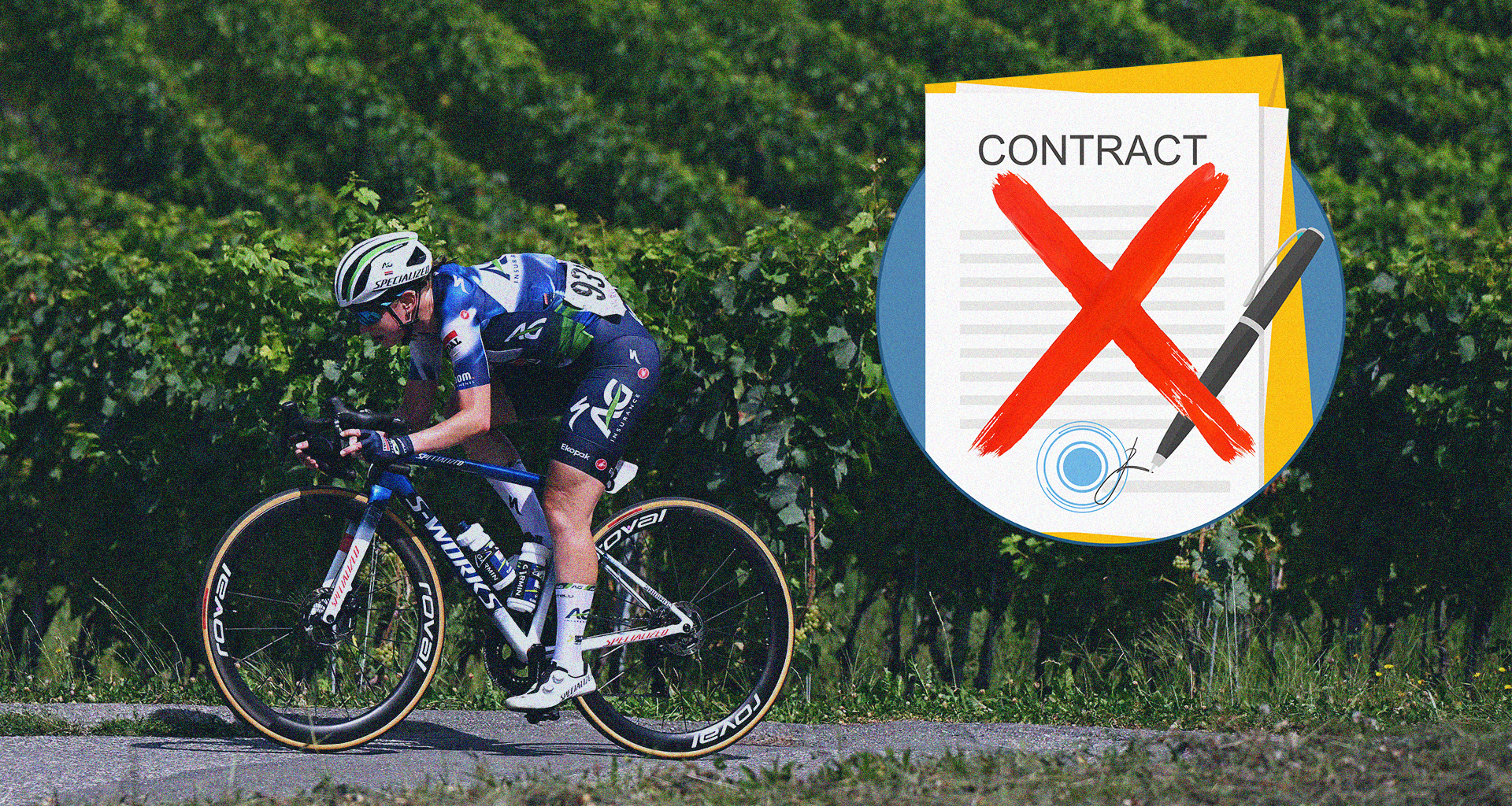
Being a professional cyclist at the highest level and racing some of the biggest races in the world is a dream for many. For the lucky few who ride for WorldTour squads that we get to enjoy watching every year, this dream is a reality.
Riders race their bikes, deliver results or work hard for their teammates, get noticed by teams, and sign on the dotted line to ply their trade in any given squad for a few years. But what happens when that contract reaches its end and you haven’t been re-signed? What’s it like to be a pro cyclist without a contract? What happens to your bike and equipment? How do you earn money? Do you stop racing altogether or fight to keep the dream alive?
You may like
In search of uncovering the reality for riders who are left without a team, I spoke to Sweden’s Julia Borgström, who rode professionally for AG Insurance-Soudal from 2020 to 2025 – joining straight out of the junior ranks and staying there until she was 24. She competed at races like Paris-Roubaix, the World Championships, and the Tour de France Femmes, where she was a contender for the white jersey in 2022, and her career looked promising.
But in the spring of 2025, she learned through her agent that her contract wouldn’t be renewed and she didn’t have a place on the team in 2026.
Read more member-exclusives like this
I asked Borgström if they gave her a reason for not offering a new contract. Her response was very pragmatic: “No. I don’t blame them for it because I also understand that it’s a business and they don’t owe me an explanation. However, that doesn’t take away that it’s really, really hard. You put so much passion into developing something, and – even though they don’t owe me anything – it’s really hard because you just want to know what to do better.”
At this point in her season, Borgström and her agent had already started speaking to other teams in search of another contract.
What to read next
“I actually thought I had a good chance of moving elsewhere. But then I realised it was clear people wanted numbers. I could see my training was going well, but I hadn’t done proper testing because I was busy trying to race. We started doing some tests again and could see that my numbers are getting there; they’re not great, but they’re still not bad.”

(Image credit: Getty Images)
Throughout 2023 and 2024, Borgström experienced RED-S (Relative Energy Deficiency in Sport), a condition caused by low energy availability, where athletes don’t consume sufficient calories to support their training, causing issues like reduced bone density, hormonal imbalances and fatigue. After a long and arduous period of treatment, recovery, and a return to normal training, she was able to continue racing. However, her results and training data didn’t accurately reflect her full potential as an athlete, which, in a competitive market, is a massive hurdle to overcome.
I asked her why she thought Pro-level or Continental teams didn’t offer her a ride, which is often the landing spot for riders who drop out of the WorldTour, but it isn’t always as straightforward as it seems.
“I think people assume that you are a very demanding rider as a WorldTour rider coming down to a Conti team, but I was desperate to just keep on racing, so I think I would be the least demanding rider. Some people would have assumed that I had a conflict with AG, which I definitely didn’t have.”
The practicalities
One of the most coveted parts of being a pro cyclist is the equipment. Multiple bikes and all the equipment you could ask for is the dream for any bike rider. But when a contract reaches its end, what happens to it all?
Borgström continued to be employed by AG Insurance-Soudal until December 31, 2025, two and a half months after her final race with the team. Pro riders typically don’t travel to races with bikes, as these are moved around by the team, and keep a training bike at home. But even though contracts last until the end of December, teams often try to recall equipment earlier than that.
“This team asked for all bikes and even some helmets and wheels to be returned. I pushed to be allowed to keep my training bike until the end of the year, and they agreed on me sending it back by mail. It turns out it’s really hard from Sweden to Belgium, so it got bounced back a couple of times, but now it is with the team,” Borgström explained.

(Image credit: Getty Images)
With her AG Insurance-Soudal spec bikes returned to the team’s service course, she had to bite the bullet and invest in her own race machine to continue riding. “I got really, really good help from a bike shop and a few people I know. I got the best price you absolutely can get, but I have paid for the bike.”
It’s not uncommon for riders to sell or donate their clothing and spare equipment from previous seasons to clear out space for new kit, and I wondered if Borgström had used this to generate some income.
“According to my contract, they can ask for everything back. Usually they don’t want old clothes and stuff like that back, but they could ask in theory. I tried to donate as much as possible to people that need it,” she said.
What to do next
Despite no longer having a pro contract at only 24, Borgström clearly still had a real passion for racing her bike. Towards the end of 2025, she was offered a ride on a club-level team in Belgium, Kassein Feits Huis. Belgian law stipulates that club-level teams cannot pay their riders, so she was racing without a salary.
“My savings account is taking a big hit,” she said. “I was preparing myself to close the chapter of racing. I got over the shame, and then I realised that the only thing that’s left is just being sad because I wasn’t allowed to race my bike anymore. That was where Jess and Jake called [owners/managers of Kassein Feits Huis].”
From the outside, the step down from the WorldTour to a club-level team appears severe, but Borgström was humble and honest in her outlook.
“At first I thought, ‘No, I can’t, I can’t do that. I cannot go to a team house anymore. That chapter is done.’ And then every time I spoke to them, I just had this really, really good feeling in my gut. It was the first time I’d spoken to someone in so long and felt like I really wanted to race for them.”
Although she wouldn’t be receiving payment, she was presented with an opportunity to keep racing.
“I had a chat with my partner, and I looked at how long I can survive out of my savings. How much could we actually do? We realised that I can get one season out of my savings. We decided that we will give it one more year and see what happens.”
She spent the start of 2026 splitting her time between Meulebeke in Belgium, where the team is based, and her home in Sweden, paying for all her own flights and travel and coming across for a month or so at a time to compete in kermesse races, and the occasional UCI race against her former colleagues.
Borgström was still represented by The Team, formerly Wasserman – the same agency that manages the likes of Julian Alaphilippe, Lotte Kopecky, and dozens more top-level riders – in the hope that, through consistent racing on the Belgian circuit, she could find a space on a UCI team once more – a hope that’s backed by her contract at Kassein. “As long as it’s a move to a team at a level higher than this, I can break my contract if I’m offered one elsewhere.”
As it turned out, that chance came along soon after our conversation. Borgström was offered a contract with Norwegian high-level Continental outfit Hitec Products-Fluid Control, based in her native Scandinavia, and she officially joined their ranks on Tuesday. It’s not quite a return to the WorldTour, but it will give her opportunities to race higher-level races and access to equipment and resources that she doesn’t have to pay for herself.
Despite this chance, and a contract for the rest of 2026, when we spoke, Borgström was still thinking ahead to the future and the possibility of a life without bike racing, having come face to face with the precarity of this sport once already.
“I am studying a little bit to get my grades up to apply for university. It’s not taking away any time from my cycling, so the training I do is actually the same as I would have done if I was still a WorldTour pro,” she explained.
“In Sweden, you get paid to study, or you can take a loan, so studying means a really, really small income, which is also why I’m hoping to get into a university at the end of the season, because that will also mean that I have a small salary. I’m really trying to get some money in as well, but getting prize money is proving to be a bit harder than I thought.”
The difference mindset makes
Borgström’s passion for racing remains, and it’s clear that – despite the financial challenges – her heart is set on the road, whilst some other athletes are turning to gravel racing and the privateer lifestyle.
“I was a bit naive in searching for sponsors because I was really hoping to get on a Conti team or something right up until the last minute at the end of 2025, and I didn’t want to bring on a sponsor and then have to cancel it later if it conflicted with a potential team sponsor,” she explained.
“I’ve done one gravel race, and I really loved that. But comparing how much I love road racing to how fun it is racing the gravel, I really want to race road. For me, the cool thing about cycling is the tactics and understanding the game, and positioning in the bunch is one of my traits that I actually am quite proud of. Road is where my big passion in cycling lies.”

(Image credit: Getty Images)
However, in a bittersweet twist of fate, the acceleration in growth of women’s cycling could be more of a hindrance than a help for riders who find themselves in Borgström’s situation.
“I think women’s cycling is growing so fast that if you struggle with your health or if you have a problem, no one can wait for you,” she said.
Two things really struck me throughout my conversation with Borgström. Firstly, her incredibly calm, pragmatic demeanour about the realities of being left without a job and the struggle of trying to forge a career in bike racing with the odds stacked against her. She was incredibly professional with how she approached the situation, which is a testament to her quality as a pro rider.
Secondly, her obvious passion for racing and ability to still find joy in the sport that would have left others jaded and maybe even bitter were they in her shoes. It’s probably down to this outlook and determination that she was able to do what all free agents are trying to do: find a new team, no matter how late in the season.
“It’s really cool to be in races having no clue what I’m doing anymore and trying to figure that out together with my teammates. It’s also really scary because I know how to race a WorldTour or a UCI race, but I have no idea how to race an interclub or a kermesse,” she said.
“It’s quite inspiring to be reminded of the early days of elite racing where you didn’t know how to race, and you learned. I think mentally for me it’s been really important to focus on where I am at the moment and trying to see it as I’m here for this one year. If something else happens, we will take it when that comes – but that’s not a problem for now.”